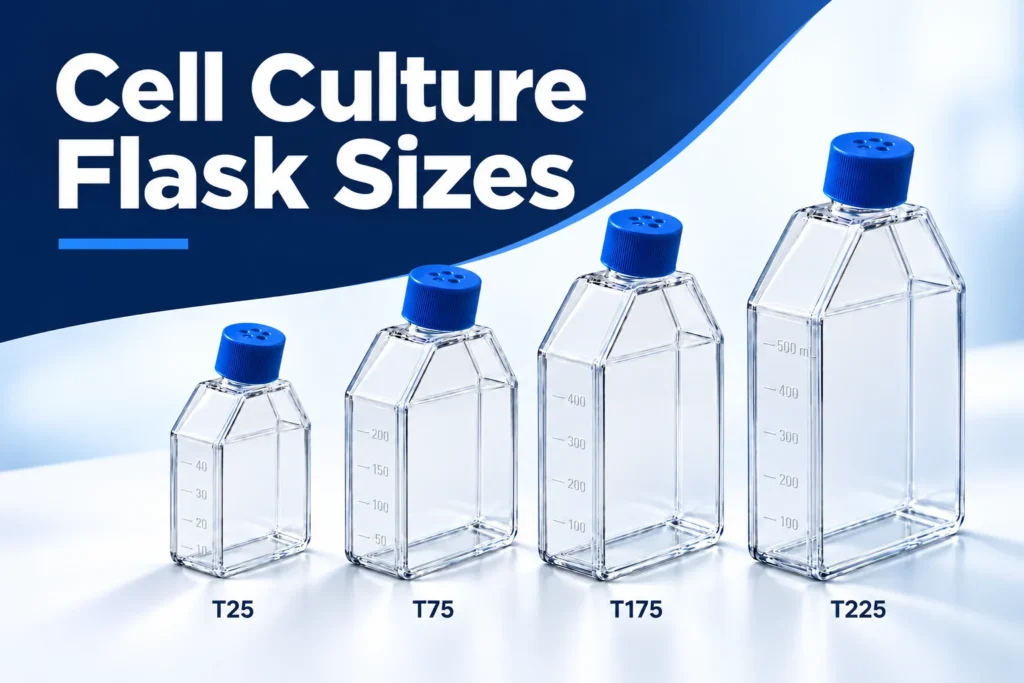
Cell culture flask sizes such as T25, T75, T175 and T225 refer to nominal growth area, expressed in square centimeters (cm²). Choosing the right format means matching that area to the viable cells available for seeding, the cells required for the next experiment and the time available for culture.
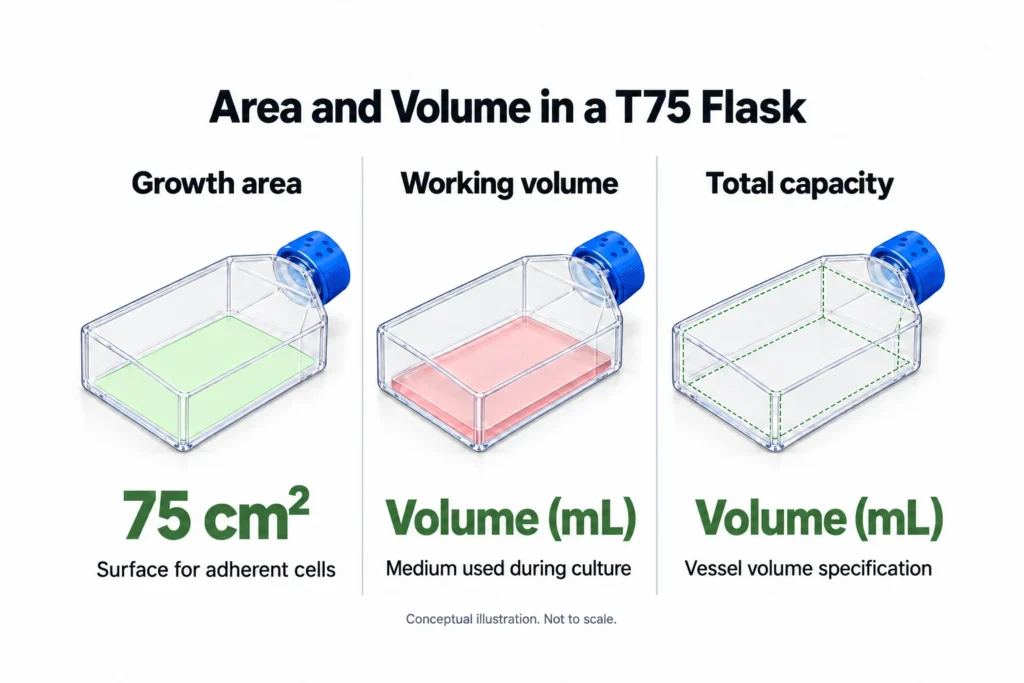
We recommend checking growth area, working medium volume and total flask capacity separately when comparing flasks. This guide focuses on conventional single-layer T-flasks for adherent culture, explaining how to interpret size specifications, estimate cell numbers and plan a move from T75 to T175.
What Do T25, T75, T175 and T225 Mean?
A T75 flask provides a nominal growth area of 75 cm². The number describes the culture surface; it does not mean that 75 mL of medium should be used. The same naming convention applies to T25, T175 and T225.
| Flask Format | Nominal Growth Area | Growth Area Relative to T25 |
|---|---|---|
| T25 | 25 cm² | 1× |
| T75 | 75 cm² | 3× |
| T175 | 175 cm² | 7× |
| T225 | 225 cm² | 9× |
Kelabscience supplies these four formats in its cell culture flask range. Surface treatment and cap type are separate configuration choices, so specify them alongside the flask size when selecting a product.
Flasks with the same nominal growth area can differ in external dimensions, body shape, neck geometry and total capacity. Where incubator clearance or access with a pipette or cell scraper matters, compare the selected models’ dimensions and neck designs rather than relying on the T-number alone.
How Much Medium Does Each Flask Size Need?
The working volume is the final volume of culture medium in the flask, including the medium introduced with the cell suspension at seeding. The flask’s total capacity is a separate vessel specification and does not determine how much medium a culture requires.
The ATCC Animal Cell Culture Guide lists the following reference working volumes for common T-flask formats.
| Flask Format | Nominal Growth Area | Reference Working Volume |
|---|---|---|
| T25 | 25 cm² | 5–10 mL |
| T75 | 75 cm² | 15–25 mL |
| T175 | 175 cm² | 35–60 mL |
| T225 | 225 cm² | 45–75 mL |
Source: ATCC Animal Cell Culture Guide. These are general reference ranges; recommended volumes can differ by flask design and culture protocol.
Medium volume affects both the amount of medium available per cell and the depth of liquid above the growth surface. In stationary cultures, a deeper medium layer increases the distance oxygen must diffuse from the gas–liquid interface to the cells. Oxygen availability also depends on cell density and cellular oxygen consumption, as discussed by Al-Ani et al. (2018). Increasing the fill volume therefore does not necessarily improve growth.
Use the selected flask’s instructions together with the cell-line protocol to choose a working volume, taking account of medium formulation, cell density and feeding interval. Where published ranges differ, compare their vessel designs and culture conditions instead of combining the lowest and highest values into a new operating range.
How Many Cells Can You Grow in Each Flask Size?
Cell numbers in a T-flask depend on cell density as well as growth area. For adherent cultures, distinguish the viable cells seeded, the population present before harvest and the viable cells ultimately recovered.
Seeding Cell Number vs. Harvest Yield
Seeding cell number is the viable cell count introduced at the start of culture. Harvest yield describes the cells recovered at the chosen endpoint; for applications requiring live cells, plan around the recovered viable count. A reference yield for an established culture should not be treated as a recommended seeding count.
Estimating Cell Numbers from Growth Area
Calculate the inoculum using a viable seeding density appropriate to the cell line and culture protocol:
Viable cells to seed = growth area (cm²) × viable seeding density (cells/cm²)
A separate calculation estimates the population on the growth surface at a later stage:
Estimated cell population = growth area (cm²) × cell density at that stage (cells/cm²)
Using an illustrative density of 100,000 cells/cm² gives the following estimates:
| Flask Format | Nominal Growth Area | Estimated Cells at 100,000 Cells/cm² |
|---|---|---|
| T25 | 25 cm² | 2.5 million |
| T75 | 75 cm² | 7.5 million |
| T175 | 175 cm² | 17.5 million |
| T225 | 225 cm² | 22.5 million |
Reference basis: ATCC Animal Cell Culture Guide, which uses 100,000 cells/cm² for its flask-yield estimates. These figures are not recommended seeding counts or guaranteed harvest yields.
These area-based estimates do not account separately for detachment, collection or viability losses. The number of viable cells recovered can therefore be lower than the population present on the growth surface before harvest.
Why Cell Yield Varies Between Cultures
Confluence describes surface coverage rather than a direct cell count. Differences in cell size and growth pattern mean that two cell lines at the same confluence can contain different numbers of cells per cm². The appropriate passage or harvest stage also depends on the cell line; full confluence is not a universal target.
For practical planning, we recommend using recovered viable cells per cm² measured in comparable cultures of the same cell line, with the same surface treatment, harvest stage and collection method. A yield measured this way already reflects recovery and viability under those conditions, so the same losses should not be deducted again.
How to Choose Between Cell Culture Flask Sizes
Start with the viable cells needed for the next experiment, the cells available for seeding and the time available for culture. Together, these determine whether to use a smaller flask, move to a larger format or distribute the culture across several vessels.
Match Flask Size to Your Culture Goal
Routine maintenance and preparation for a large harvest can require different amounts of growth area. Use recovery data from comparable cultures to estimate the area needed, then consider whether samples or treatments must remain separate.
Estimated total growth area needed (cm²) = required viable cells ÷ recovered viable cells per cm² from comparable cultures
| Culture Requirement | Key Question | Practical Approach |
|---|---|---|
| Limited viable cells for seeding | Can the available cells seed the planned area at an appropriate density? | Use a smaller area or allow time for an intermediate expansion step. |
| More cells needed for a pooled harvest | How much area is needed based on previous viable recovery? | Compare a larger flask with multiple smaller flasks. |
| Separate samples or treatments | Which cultures need independent handling or collection? | Allocate flasks by sample and condition before choosing their size. |
| Limited incubator space | Which arrangement fits while allowing routine access? | Compare actual flask dimensions and the total number of vessels. |
A T225 provides 50 cm² more growth area than a T175, an increase of approximately 28.6%. If you assume the same recovered viable yield per cm², the estimated total yield also increases by 28.6%. Use this as a planning estimate and check it against actual recovery from the T225.
Check Whether You Have Enough Cells to Seed It
Before moving to a larger format, count the viable cells available and check the resulting seeding density. Distributing the same inoculum over more area lowers the initial density and may change growth and the time needed to reach the intended harvest stage.
If the planned area would put the culture below its established seeding range, choose a smaller flask or schedule another expansion step. This is particularly relevant when the experiment has a fixed deadline: additional surface area alone does not ensure that enough cells will be ready on time.
Consider Incubator Space and Routine Handling
Check the selected model’s dimensions against incubator shelf clearance, microscope access and the space needed to handle the flask comfortably. Include feeding and harvesting workload in the comparison, especially when several cultures must be processed within a limited period.
One larger flask reduces the number of vessels to label, open and handle. Several smaller flasks allow separate observation, feeding and collection, which may be more useful when cultures have different treatment schedules or harvest times.
Moving from T75 to T175: What Should Change?
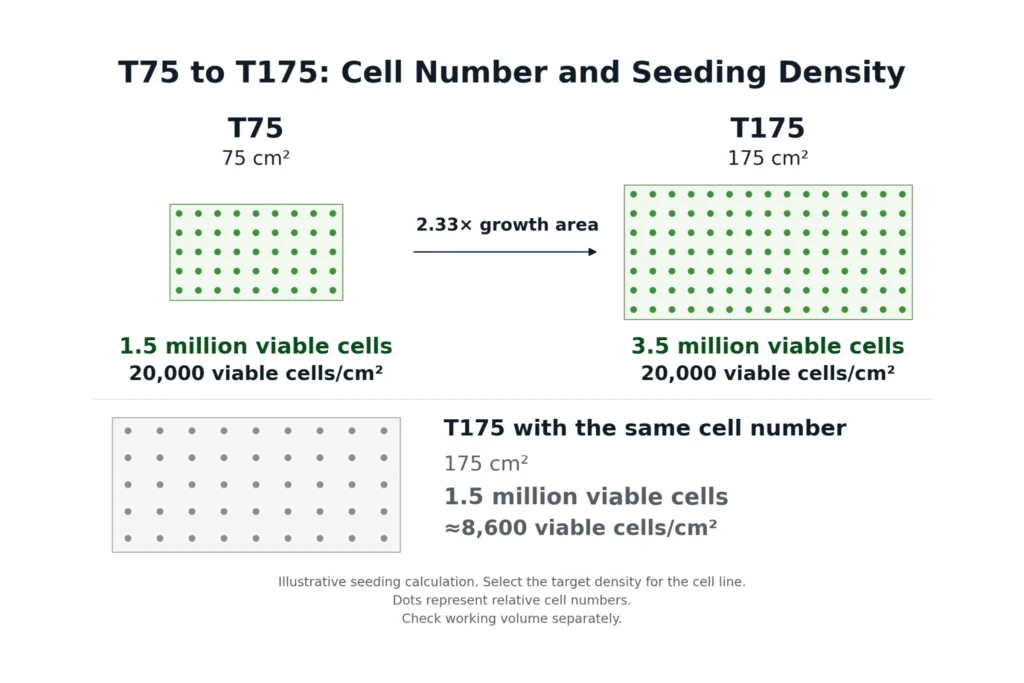
A T175 provides approximately 2.33 times the growth area of a T75: 175 ÷ 75 ≈ 2.33. To maintain the same viable seeding density, the viable inoculum needs to increase in proportion to that area.
Consider a calculation using an illustrative seeding density of 20,000 viable cells/cm²:
| Parameter | T75 | T175 |
|---|---|---|
| Nominal growth area | 75 cm² | 175 cm² |
| Example viable seeding density | 20,000 cells/cm² | 20,000 cells/cm² |
| Viable cells required for seeding | 1.5 million | 3.5 million |
The density of 20,000 viable cells/cm² is a calculation example. Choose the appropriate seeding density from the cell-line protocol or an established culture procedure.
If the same 1.5 million viable cells are seeded into the T175, the seeding density falls to approximately 8,600 viable cells/cm². This changes the starting conditions and may affect growth and the time needed to reach the intended harvest stage.
Review the working medium volume separately, using the selected T175 flask’s guidance and the cell-culture protocol. Scaling the T75 volume in proportion to area can provide an initial estimate, but check the resulting volume against the recommended range and feeding schedule for the intended culture.
For the first comparison, keep the cell line, surface treatment, medium formulation and cap configuration consistent. We recommend checking attachment, cell distribution and morphology after seeding, then recording the time to harvest and the recovered viable cell count. Compare these results with the T75 cultures to assess whether the larger format meets the required cell number within the planned culture period.
Check the Flask Configuration Before Ordering
Before ordering, list the required flask size, surface treatment, cap type and quantity. Check the following details against the culture protocol and purchasing requirements:
- Surface treatment: Tissue culture (TC) treatment modifies the surface to improve wettability and support the attachment of many adherent cell types. Non-treated flasks lack this attachment-promoting treatment and may be used for some suspension cultures where specified by the protocol. If a coating is required, check both the specified base surface and coating instructions; standard TC treatment does not replace that coating.
- Cap type: Specify vented or sealed caps to match the culture’s gas-exchange requirements. Follow the closure instructions for the selected flask model.
- Sterility and packaging: Check the stated sterility status and number of flasks per bag when calculating the order quantity. Pack size also matters when planning how frequently bags will be opened during routine work.
- Dimensions and access: Check external dimensions where incubator clearance is limited, and confirm that the neck allows access with the pipettes or cell scrapers used in the procedure.
Our cell culture flask range includes sterile polystyrene T25, T75, T175 and T225 flasks, with TC-treated and non-treated surface options and vented or sealed caps. The listed pack sizes are 10 flasks per bag for T25 and 5 flasks per bag for T75, T175 and T225.
For a quotation, send us your flask requirements, including flask size, surface treatment, cap type, total quantity and delivery destination. We can then check the requested configuration and confirm the applicable packing details before quoting.
Frequently Asked Questions
Do T75 Flasks from Different Suppliers Have the Same Dimensions?
Not necessarily. T75 identifies a nominal growth area of 75 cm², while body shape, height, neck geometry and overall capacity can vary between models. Compare the selected products’ dimensions when checking incubator clearance, microscope access or compatibility with existing handling equipment.
Can One T75 Flask Replace Three T25 Flasks?
One T75 and three T25 flasks provide the same total nominal growth area of 75 cm². If all three flasks grow the same cells under the same conditions for a combined harvest, a T75 may be a practical alternative, with an appropriate seeding density and medium volume.
Retain separate vessels when the T25 flasks hold different samples or treatments, or serve as experimental units that must remain independent. Equal total area does not preserve the ability to observe, treat and harvest those cultures separately.
Does This Size Guide Apply to Suspension Cell Cultures?
The T-number still describes growth area, but the area-based cell estimates in this guide are intended for adherent cultures. For suspension cultures, estimate cell numbers from working volume and cell concentration (cells/mL), using viable counts when planning live-cell requirements.
Some suspension cultures can be maintained in stationary T-flasks, while others use cell culture shake flasks or other agitated systems. Choose the vessel and operating conditions according to the cell-line protocol, including its mixing and gas-exchange requirements. A non-treated surface alone does not make a flask suitable for every suspension culture.