How to Choose Plastic Reagent Bottles for Buffer, Solution, and Routine Chemical Storage

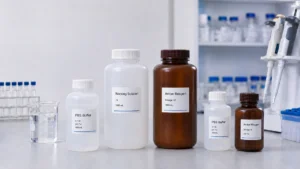
A plastic reagent bottle often looks like a simple storage container until it starts affecting daily laboratory work. A buffer bottle that is too large may be opened repeatedly by several users. A cap that does not close smoothly may become unreliable after weeks of routine handling. A clear bottle may be convenient for checking […]
Reagent Bottle Storage Problems and How to Prevent Them in Laboratory Work

Introduction In laboratory workflows, reagent bottles are often treated as basic infrastructure—simple containers used to store chemicals and solutions. Most attention is typically given to the reagents themselves, while the role of the bottle is rarely examined during routine operations. In practice, however, many small inconsistencies in laboratory work can be traced back to how […]
How to Choose Laboratory Reagent Bottles: Materials, Types, and Selection Guide

Introduction In most laboratories, shelves of chemical reagents are part of the everyday working environment. Behind this seemingly routine storage system, reagent bottles play a critical role in maintaining chemical stability, safe handling, and workflow efficiency. As one of the most widely used and standardized solutions for storing liquid chemicals and prepared solutions, laboratory reagent […]
Condensation in Petri Dishes: Causes, Risks, and Practical Solutions

Introduction Condensation is one of the clearest examples of how cultureware interacts with everyday workflow. It depends not only on incubator settings, but also on how plates are handled, stacked, opened, and sealed. Once you understand why moisture forms—and how laboratories typically deal with it—it becomes much easier to treat condensation as a manageable variable […]
How to Choose the Right Petri Dish for Routine Laboratory Work

Introduction In many laboratory protocols, Petri dishes are treated as neutral consumables. As long as the correct medium, incubation conditions, and experimental steps are specified, the dish itself is often assumed to perform consistently. Under this assumption, Petri dish selection rarely receives explicit attention during method design. However, once experiments move into routine laboratory work, […]
Common Petri Dish Problems in Routine Laboratory Use

Introduction Laboratory protocols are designed to describe experimental conditions with clarity and reproducibility in mind. They focus on variables that directly influence biological outcomes—such as media composition, incubation parameters, and timing—while assuming that routine consumables like Petri dishes perform consistently under standard use. As a result, the role of the dish itself is rarely examined […]
Why Petri Dish Problems Rarely Appear in Protocols — but Emerge in Daily Laboratory Work

Introduction Laboratory protocols are designed to describe experimental conditions with clarity and reproducibility in mind. They focus on variables that directly influence biological outcomes—such as media composition, incubation parameters, and timing—while assuming that routine consumables perform as expected. Under these idealized conditions, many aspects of daily laboratory work are intentionally simplified. In practice, however, experiments […]
Petri Dish Types and Materials Explained: Glass vs Plastic for Laboratory Use

Introduction In practice, choosing a Petri dish is rarely a neutral decision. Glass and plastic dishes may look interchangeable on the bench, but they behave differently once they are integrated into real laboratory workflows. As experiments move from occasional use to routine practice, the effects of material choice become harder to ignore in everyday work. […]
What Is a Reagent Bottle? Types, Uses, and Laboratory Applications

In laboratory settings, reagent bottles are often treated as basic infrastructure—containers that are simply there to hold chemicals. Most attention is paid to the reagents themselves, while the bottle is rarely questioned. In practice, however, an unsuitable bottle can quietly introduce risk into everyday work. A poorly sealed cap may lead to gradual solvent evaporation, […]