Centrifuge Tube RCF Rating Explained: Why Maximum Speed Is Not the Only Selection Factor

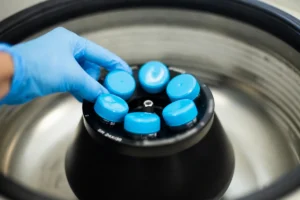
Centrifuge tubes seated in a rotor for RCF rating and workflow compatibility evaluation

A centrifuge tube can remain below its stated RCF rating and still become unreliable. The problem is not always the force number itself, but the workflow conditions behind that number. When laboratories choose centrifuge tubes, maximum RCF is often one of the first specifications they check. This is understandable. If a tube cannot tolerate the […]

Why Do Centrifuge Tubes Leak? Common Causes and Prevention Tips

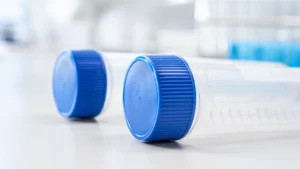
Clear centrifuge tubes with blue screw caps in a lab rack, showing subtle leakage risk around the cap area

Why Do Centrifuge Tubes Leak? Common Causes and Prevention Tips Centrifuge tube leakage is often noticed only after it begins to affect the workflow. A small trace of liquid may appear around the cap after centrifugation, recovery volumes may vary between tubes, or residue may be found in a rotor position after a run. The […]

Common Centrifuge Tube Problems in Routine Laboratory Use

Closed centrifuge tubes with blue screw caps showing subtle cap integrity inspection in routine laboratory use

Introduction In many laboratories, centrifuge tubes are treated as routine consumables that only attract attention when something visibly goes wrong. If a tube does not crack during centrifugation, leak after a spin, or show obvious deformation, it is usually assumed to be performing normally. In practice, however, many centrifuge tube problems begin long before a […]

PCR Plate Compatibility: Why Instrument Fit Matters More Than Specifications

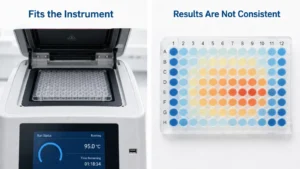
PCR plate fits a thermal cycler but shows inconsistent qPCR results with uneven signal distribution across wells

Introduction In many laboratories, PCR plates are treated as standardized consumables. As long as the format matches the instrument—96-well, 384-well, standard footprint—they are usually assumed to be interchangeable without much further evaluation. In practice, that assumption is not always reliable. A plate can fit into the thermal cycler, allow the lid to close normally, and […]

Why Your PCR Results Vary: The Overlooked Impact of PCR Plate Design

PCR plate heatmap showing structured variability with edge effects across wells

Introduction In many PCR and qPCR workflows, inconsistent results are often traced back to familiar explanations—reagent quality, pipetting variation, or thermal cycler performance—the usual suspects in almost every troubleshooting discussion. These factors are undoubtedly important, but in practice, many laboratories find that even after optimizing them, variability can still persist without a clear explanation, appearing […]

How Plate Sealing Affects PCR and qPCR Reliability

PCR plate showing variability across wells during laboratory observation

Plate sealing is often treated as a simple closing step in PCR workflows, mainly intended to prevent evaporation during thermal cycling. In practice, however, the quality and consistency of sealing can directly influence how stable and reproducible PCR and qPCR results are, especially when working with multi-well plates. For a broader overview of how plate […]

Reagent Bottle Storage Problems and How to Prevent Them in Laboratory Work

Reagent bottles arranged on a laboratory bench in a real working environment

Introduction In laboratory workflows, reagent bottles are often treated as basic infrastructure—simple containers used to store chemicals and solutions. Most attention is typically given to the reagents themselves, while the role of the bottle is rarely examined during routine operations. In practice, however, many small inconsistencies in laboratory work can be traced back to how […]

Common PCR Tube Problems in Thermal Cycling and Handling

Pipetting reaction mixture into PCR strip tubes during a laboratory PCR setup

Introduction Polymerase chain reaction (PCR) is often described as a protocol-driven technique. Reaction composition, primer design, enzyme choice, and thermal cycling parameters are carefully specified, while consumables such as PCR tubes are frequently treated as neutral containers. As long as the reaction mix is correct and the thermal cycler is properly programmed, tube performance is […]

Condensation in Petri Dishes: Causes, Risks, and Practical Solutions

Condensation in petri dishes during routine laboratory incubation

Introduction Condensation is one of the clearest examples of how cultureware interacts with everyday workflow. It depends not only on incubator settings, but also on how plates are handled, stacked, opened, and sealed. Once you understand why moisture forms—and how laboratories typically deal with it—it becomes much easier to treat condensation as a manageable variable […]