
Why Do Centrifuge Tubes Leak? Common Causes and Prevention Tips
Centrifuge tube leakage is often noticed only after it begins to affect the workflow. A small trace of liquid may appear around the cap after centrifugation, recovery volumes may vary between tubes, or residue may be found in a rotor position after a run. The immediate explanation is often simple: the cap was not closed properly, the tube was overfilled, or the centrifugation speed was too high.
These factors can certainly cause leakage, but they do not always explain the full pattern. In routine laboratory work, a tube may look fully closed, fit the rotor correctly, and show no visible damage before centrifugation, yet still become less reliable when exposed to acceleration, braking, vortexing, cold handling, chemical contact, transport, or repeated opening and closing. Leakage is therefore better understood as a sealing problem shaped by the full workflow, not only by the final moment before centrifugation. This is also why leakage is best understood alongside other common centrifuge tube problems in routine laboratory use, rather than as an isolated cap issue.
This article explains why centrifuge tubes leak during routine laboratory use, how to recognize early leakage signs, why leakage may appear only under certain conditions, and what laboratories can check to reduce recurring sealing problems before sample loss or contamination affects the experiment.
Leakage Is Not Always Obvious
When a centrifuge tube leaks visibly, the problem is easy to recognize. Liquid may appear on the outside of the tube, around the cap, inside the rotor cavity, or on the tube rack after centrifugation. In these cases, the tube is usually removed from the workflow immediately because the risk to sample integrity, rotor cleanliness, and contamination control is clear.
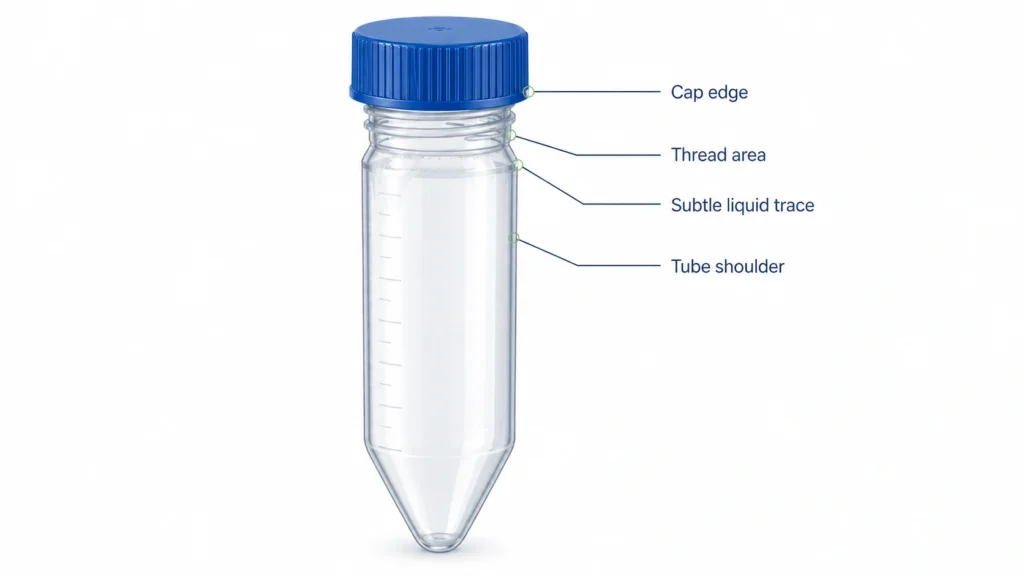
However, leakage does not always begin as a visible spill. In many routine workflows, the earliest signs are much smaller: a slight wet mark near the cap edge, residue around the thread area, moisture trapped between the cap and tube shoulder, or a recovery volume that is slightly lower than expected. These signs are easy to mistake for filling droplets, condensation after cold handling, pipetting variation, or sample behavior, especially when the tube still looks properly closed.
For this reason, leakage should not be evaluated only by asking whether liquid has spilled into the rotor. A more useful question is whether liquid is repeatedly reaching the closure area when it should not. Wet cap edges, thread residue, unusual moisture near the shoulder, or unexplained recovery differences are worth checking, particularly in workflows involving sensitive samples, volatile reagents, low-volume recovery, or downstream quantitative analysis.
Common Causes of Centrifuge Tube Leakage
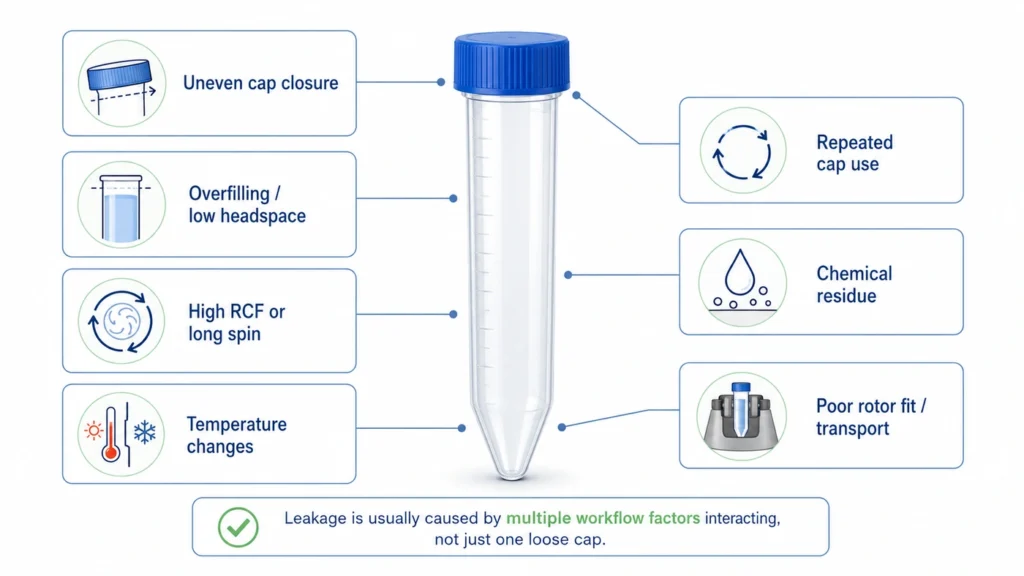
1. Incomplete or Uneven Cap Closure
The most direct cause of centrifuge tube leakage is incomplete or uneven closure. In practice, this does not always mean the cap is visibly loose. A tube may look closed from the outside while the sealing surface is not seated evenly enough to remain stable during centrifugation.
In screw-cap centrifuge tubes, the thread must guide the cap into a consistent position so the cap and tube opening contact each other evenly. If the cap is cross-threaded, tightened at a slight angle, or stopped before full seating, it may feel acceptable by hand but fail to maintain a uniform seal during acceleration and braking.
Snap-cap tubes can show a similar problem. A cap may appear closed, but if the rim is not fully engaged or the hinge area is under uneven tension, it may loosen slightly during vortexing, transport, or centrifugation. The result is often not a dramatic spill, but wetness around the cap, residue near the closure, or inconsistent recovery after the same spin.
2. Overfilling the Tube or Leaving Too Little Headspace
Overfilling can cause centrifuge tubes to leak even when the cap has been closed correctly. During centrifugation, liquid does not remain as a quiet static volume below the cap. Acceleration, braking, rotor angle, foam formation, sample density, and vibration can all move liquid toward the upper tube area.
The risk becomes higher when the sample is viscous, foamy, volatile, or recently vortexed. Foam, droplets, or liquid film may remain near the upper wall before centrifugation begins. If the tube is filled close to the closure area, these residues have little space to settle and may be driven into the cap interface during the run.
A safer approach is to follow the manufacturer’s recommended fill volume and avoid filling tubes up to the cap area, especially for high-speed centrifugation, volatile reagents, foaming samples, or workflows involving temperature changes.
3. Exceeding the Tube’s Recommended RCF or Spin Conditions
Centrifuge tube leakage can occur when the tube is used beyond the conditions it was designed to tolerate. RCF rating is the obvious factor, but spin conditions also include rotor type, spin duration, acceleration and deceleration settings, sample density, fill volume, and tube support.
During centrifugation, force is distributed through the tube wall, shoulder, lower cone, and cap interface. When the spin condition is too demanding, the cap seal may become less stable even before the tube shows visible deformation or cracking. Leakage can therefore be an early sign that the closure is being pushed beyond its reliable operating range.
If leakage appears after higher RCF, longer spin times, rapid braking, dense samples, or certain rotor positions, the tube rating, rotor compatibility, fill level, and tube support should be reviewed together.
If the tube format, material, or RCF rating needs to be reviewed from the selection stage, our centrifuge tubes guide provides a broader overview of tube types, sizes, and selection factors.
4. Cap or Thread Wear After Repeated Opening and Closing
Repeated opening and closing can gradually reduce sealing consistency, especially when the same tube is used across multiple processing steps. The issue is not only whether the cap can still close, but whether it continues to seat in the same reliable way each time.
In screw-cap tubes, threads may feel less smooth, catch slightly, or require uneven force after repeated use. In snap-cap tubes, rim engagement, hinge flexibility, and closing tension may change after repeated flexing. These small differences can become visible as minor leakage or residue during centrifugation, vortexing, transport, or temperature change.
For high-speed centrifugation, sterile samples, volatile reagents, clinical materials, or quantitative downstream analysis, tubes showing changes in cap feel should be replaced rather than tightened harder or reused in demanding conditions.
5. Temperature Changes and Cold-Handling Stress
Temperature changes can make leakage harder to interpret because they affect both tube behavior and moisture appearance around the closure. A tube that seals normally at room temperature may behave differently after storage on ice, refrigerated centrifugation, frozen handling, or return to the bench after cold exposure.
At lower temperatures, some plastics become less flexible. Even without visible cracking or deformation, reduced flexibility can influence how the cap and tube opening contact each other. Cold-to-room-temperature transitions can also create condensation, which may be mistaken for leakage.
Condensation should not automatically dismiss every sign of moisture. If liquid appears repeatedly at the cap edge, thread area, or closure line after the same workflow, especially with recovery changes, leakage should still be considered. Temperature rarely causes leakage by itself; more often, it exposes weaknesses such as insufficient headspace, worn caps, uneven closure, or inappropriate storage practice.
6. Chemical Exposure at the Cap Interface
Chemical compatibility is often discussed in relation to the tube body, but leakage can also be influenced by what happens at the cap interface. The rim, thread area, hinge, and closure line are exposed to liquid contact, residue, evaporation, repeated tightening, and mechanical pressure.
Many routine workflows involve alcohols, detergents, chaotropic salts, extraction buffers, or other chemical mixtures. Polypropylene centrifuge tubes resist many standard laboratory reagents, but compatibility still depends on reagent type, concentration, exposure time, temperature, and whether chemical contact is combined with centrifugation or storage.
Residue near the rim or thread can interfere with how evenly the cap seats. Some liquids also move more easily along narrow gaps than water-based buffers, especially if they have lower surface tension or leave slippery residue. When leakage appears mainly with certain reagents or sample preparations, the entire tube-and-cap system should be reviewed, not only the tube material.
7. Poor Rotor Fit, Tube Support, or Handling During Transport
Leakage is not always caused by the cap alone. The way a tube is supported during centrifugation and handled before or after the run can also affect whether the closure remains reliable. Even a properly closed tube may become more vulnerable if it sits unevenly in the rotor, lacks suitable adapter support, or is exposed to unnecessary movement during transport.
Rotor fit matters because centrifugation places force on the entire tube. If a tube does not sit securely in the rotor cavity or adapter, support around the wall and shoulder may be uneven, increasing vibration or stress near the upper tube region.
Handling before and after centrifugation can also make leakage visible. A tube that has just been vortexed may have droplets, foam, or liquid film near the upper wall. If it is then spun immediately, tilted, transported loosely, or laid horizontally after the run, liquid may reach the cap area even when the tube did not obviously fail during centrifugation.
Why Leakage May Appear Only Sometimes
One of the most confusing aspects of centrifuge tube leakage is that it may not happen every time. The same tube type may perform normally in one run, but show wetness around the cap in another. A sample may remain contained during bench handling, yet leak after centrifugation, vortexing, cold storage, or transport. This inconsistency can make leakage look random when it is actually condition-dependent.
Intermittent leakage usually means that the tube is close to the limit of what the workflow is asking it to tolerate. Under mild conditions, the cap seal may still be adequate. When several stress factors occur together — such as higher fill volume, increased RCF, rapid braking, cold handling, vortexing, transport, or repeated cap use — the same closure may no longer remain fully reliable.
This is why leakage often appears only under certain combinations of conditions. A tube may not leak with a simple water-based buffer, but may show residue when used with a foamy, viscous, volatile, or low-surface-tension sample. It may remain dry after a short spin, but show moisture after a longer centrifugation step. It may seal well when new, but become less consistent after repeated opening, closing, freeze–thaw exposure, or chemical contact.
For troubleshooting, the important point is not whether leakage occurs in every tube or every run. A repeated pattern under similar conditions is more meaningful than an isolated incident. If leakage appears mainly with fuller tubes, higher speeds, specific reagents, older tubes, certain rotor positions, or cold-handled samples, the workflow is already providing useful clues. Instead of asking only whether the cap was closed, laboratories should ask what changed between the runs: fill volume, sample type, spin condition, temperature history, tube age, rotor support, or handling after centrifugation.
How to Pinpoint the Cause of Leakage
When centrifuge tube leakage appears repeatedly, the key question is not simply “Was the cap closed?” It is whether the leakage comes from the tube itself, the way it is being used, or the interaction between both. Because these factors often overlap, troubleshooting should focus on repeated patterns rather than one isolated observation.
Compare New and Used Tubes
A practical first step is to compare newly opened tubes with tubes that have already been exposed to the same workflow. Fill both groups with the same volume of water, buffer, or a non-critical test solution, close them in the same way, and process them under the same centrifugation or handling conditions.
After the run, inspect the cap edge, thread area, tube shoulder, and outside wall. If used tubes show more residue, wetness, cap condensation, or recovery variation than new tubes, tube condition may be contributing to the leakage risk. For low-volume or sensitive workflows, a simple weight comparison before and after the suspected leakage step can also help confirm minor liquid loss.
Check Cap Feel and Closure Consistency
Cap feel should be checked directly rather than judged by appearance alone. For screw-cap tubes, notice whether the cap rotates smoothly, catches on the thread, requires uneven force, or stops before it seats fully. For snap-cap tubes, check whether the cap closes with a clear and consistent snap.
Also check whether liquid or residue is already present near the rim before closure. Droplets on the upper wall, thread, or sealing surface can be spread into the cap interface during closing, making later leakage more likely even if the tube itself is not defective.
Review Fill Volume and Sample Behavior
Fill volume should be reviewed whenever leakage appears near the cap. A tube filled close to the closure area has less room to tolerate liquid movement during acceleration, braking, vortexing, or transport.
Sample behavior also matters. Foaming samples, viscous suspensions, volatile liquids, or detergent-containing reagents may leave films, bubbles, or droplets near the upper wall. If leakage appears mainly with nearly full tubes, recently vortexed samples, or specific reagents, the workflow is likely contributing to the problem. Reducing fill volume, allowing foam to settle, or using a tube format with stronger sealing performance may be more effective than simply tightening the cap harder.
Inspect Tube Seating in the Rotor
Rotor fit should be checked when leakage appears after centrifugation. A tube may look compatible with a rotor or adapter, but still sit with slight movement, uneven support, or poor contact around the shoulder or lower body.
Before the run, confirm that the tube sits upright and evenly in the rotor cavity or adapter. It should not wobble, tilt, or require force to insert. If leakage appears more often in certain rotor positions, with certain adapters, or at higher speeds, the support system should be reviewed together with the tube and cap.
Look for Repeated Patterns
No single check can explain every leakage event. A wet mark near the cap may come from condensation, filling residue, true leakage, or post-spin handling. The stronger evidence comes from repeated patterns.
If leakage appears more often with used tubes than new tubes, with fuller tubes than partially filled tubes, with one reagent type, after cold handling, or in a specific rotor setup, the cause becomes easier to narrow down. In practice, leakage troubleshooting works best when laboratories evaluate the tube and the workflow together: cap condition, fill volume, sample behavior, spin setting, rotor support, temperature history, and handling after centrifugation.
How to Prevent Centrifuge Tube Leakage in Routine Lab Work
Preventing centrifuge tube leakage is usually more effective than trying to explain it after sample loss has already occurred. In most routine workflows, leakage risk can be reduced by controlling the conditions that affect cap sealing: tube selection, fill volume, closure consistency, spin settings, sample behavior, temperature exposure, and handling practice.
A practical prevention approach starts with matching the tube to the actual workflow. The tube should be rated for the intended RCF, compatible with the rotor or adapter, and suitable for the expected spin duration. For higher-speed centrifugation, dense samples, long spin times, volatile reagents, or sensitive samples, the tube should not be selected only because it physically fits the rotor.
Before centrifugation, fill volume and cap condition deserve particular attention. Tubes filled close to the cap leave little room for liquid movement during acceleration, braking, vortexing, or transport. Screw caps should tighten smoothly and seat evenly, while snap caps should close with clear, consistent tension. The rim, thread, and cap interface should also be free from liquid or reagent residue before closure.
Sample and handling conditions should be controlled as much as possible. Foaming, viscous, volatile, or detergent-containing samples may leave droplets or films near the upper wall. After vortexing or vigorous mixing, allowing foam to settle and keeping tubes upright can reduce the chance that liquid reaches the closure area. For workflows involving cold handling, chemical exposure, or repeated processing, unnecessary tube reuse should be avoided, especially when sealing reliability matters.
A practical prevention checklist includes:
- Use centrifuge tubes rated for the intended RCF, rotor type, and spin duration.
- Avoid filling tubes close to the cap; leave suitable headspace for liquid movement.
- Match cap design to sealing demand, especially for high-speed spins, volatile samples, transport, or storage.
- Check that screw caps tighten smoothly and snap caps close with consistent tension.
- Keep the rim, thread, and cap interface free from liquid or reagent residue before closure.
- Allow foam or droplets from vortexing to settle before centrifugation.
- Use proper rotor adapters and confirm that tubes sit evenly without wobbling.
- Keep tubes upright during loading, transfer, and post-spin handling whenever possible.
- Avoid unnecessary reuse in high-speed, sterile, quantitative, or sensitive workflows.
- Replace tubes showing stress whitening, deformation, cap looseness, thread damage, or repeated liquid traces.
The goal is not to create a complicated inspection routine for every tube. In low-risk workflows, many checks are quick and intuitive. But when leakage would affect sample recovery, contamination control, or downstream results, these small prevention steps help ensure that the tube remains reliable under the conditions it actually faces.
When Should a Leaking Centrifuge Tube Be Replaced?
A leaking centrifuge tube should not be judged only by how severe the leakage looks. In routine laboratory work, even a small but repeated sign of liquid movement around the cap can indicate that the tube is no longer sealing consistently under the conditions of the workflow. The decision to replace a tube should depend on both the visible sign and the risk level of the sample or process.
Visible leakage after centrifugation is the clearest reason to discard a tube. If liquid appears on the outside wall, around the cap, inside the rotor, or on the tube rack after a spin, the tube should not be reused for the same workflow. Even if the tube remains physically intact, the closure has already failed under operating conditions, and reuse may increase the risk of sample loss, contamination, or rotor cleanup problems.
Repeated liquid traces near the cap should also be taken seriously. A single wet mark may come from filling residue, condensation, or handling, but recurring wetness around the same closure area suggests unreliable sealing. This is especially concerning when the pattern appears with the same cap feel, fill volume, reagent, rotor setup, or post-spin handling condition.
Cap behavior and tube condition should be checked at the same time. A screw cap that tightens unevenly, catches on the thread, or does not seat firmly should not be used for high-speed centrifugation or sensitive samples. A snap cap that closes with reduced tension is also a warning sign. Stress whitening, deformation, unstable rotor seating, or inconsistent sample recovery further reduce confidence that the tube will remain reliable under later stress.
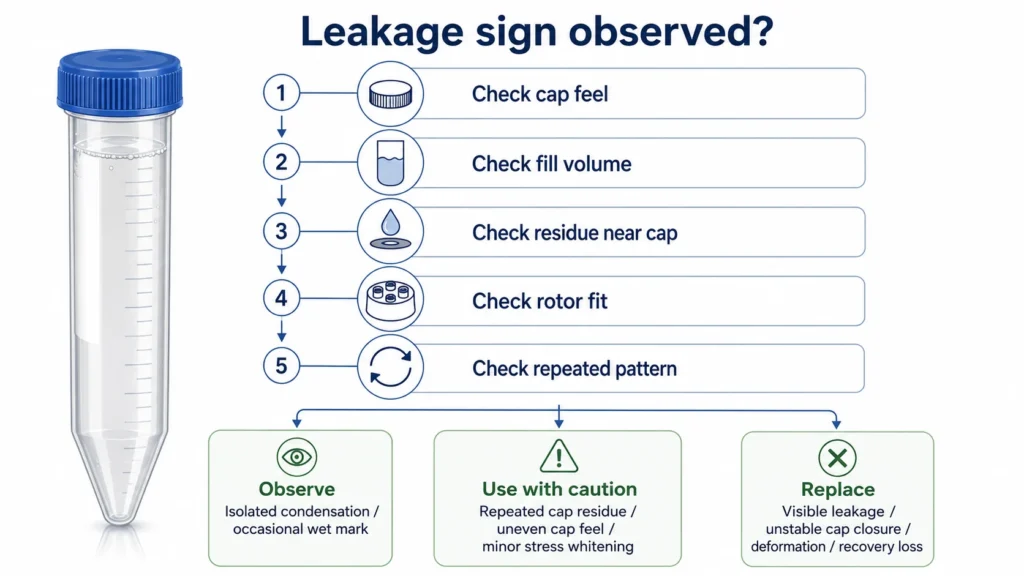
A Practical Severity Check
Not every leakage-related sign carries the same level of risk. A single minor sign may justify closer observation in a low-speed, non-critical workflow, while repeated signs or combined warning signals should move the tube out of demanding applications.
- Observe: isolated condensation, an occasional wet mark, or a slight change in cap feel with no repeated recovery issue.
- Use with caution: repeated cap residue, uneven cap feel, minor stress whitening, or small recovery variation under the same protocol.
- Replace: visible leakage, unstable cap closure, tube deformation, repeated recovery loss, or any leakage associated with high-speed, sterile, volatile, clinical, or quantitative workflows.
In practice, replacement is justified when any of the following signs appear:
- Visible leakage after centrifugation
- Repeated wet marks or residue around the cap
- Liquid traces in the thread area or closure line
- A screw cap that tightens unevenly or catches on the thread
- A snap cap that closes with reduced tension
- Stress whitening near the shoulder, cone, hinge, thread, or cap area
- Tube deformation after centrifugation or cold exposure
- Unstable seating in the rotor, rack, or storage box
- Inconsistent sample recovery under the same protocol
- Leakage associated with sensitive, sterile, high-speed, volatile, or quantitative workflows
For low-risk, non-critical, low-speed applications, minor uncertainty may sometimes be monitored more flexibly. But for high-speed centrifugation, volatile reagents, sterile samples, clinical materials, valuable samples, or downstream quantitative analysis, replacing the tube at the first repeated sign of sealing inconsistency is usually the safer decision. A centrifuge tube is inexpensive compared with the sample, the experiment, and the time required to repeat a failed workflow.
Choosing Tubes for Workflows Where Leakage Risk Matters
Some laboratory workflows can tolerate minor handling variation better than others. A short, low-speed clarification step with a non-critical buffer places a different demand on a centrifuge tube than high-speed centrifugation, sample transport, cold handling, volatile reagents, or downstream quantitative analysis. When leakage risk matters, tube selection should be based on the real sealing demands of the workflow, not only on nominal size or basic rotor fit.
Closure design is usually the first factor to review. Screw-cap centrifuge tubes are often more suitable for workflows involving extended centrifugation, transport, volatile components, temporary storage, or higher sealing demand, provided that the cap seats smoothly and evenly. Snap-cap formats can still be useful for short, low-stress steps where rapid access is important, but they should not be treated as interchangeable with screw caps when leakage would compromise the sample.
RCF rating, rotor compatibility, material behavior, and packaging format should be evaluated together. A tube that physically fits the rotor is not necessarily appropriate for every spin condition. For higher speed, longer run time, dense samples, repeated centrifugation, cold handling, sterile samples, or sensitive downstream analysis, the tube should match both the mechanical demand and the contamination-control needs of the workflow.
In leakage-sensitive workflows, laboratories can evaluate centrifuge tubes by asking several practical questions:
- Does the tube have an appropriate RCF rating for the actual spin condition?
- Does the cap design match the sealing demand of the workflow?
- Does the tube sit securely in the rotor or adapter without wobbling?
- Is the material compatible with the sample, reagent system, and temperature exposure?
- Is there enough headspace for liquid movement, foam, or temperature-related expansion?
- Does the packaging format support the required sterility or contamination-control level?
- Does the tube remain reliable after the handling steps used in the real workflow?
The goal is not to choose the strongest or most expensive tube for every task. It is to avoid using a low-demand tube format in a high-demand workflow. When leakage would affect sample recovery, contamination control, or downstream reliability, centrifuge tubes should be selected as part of the workflow system rather than as generic containers.
Conclusion
Centrifuge tube leakage is often treated as a simple cap problem, but in routine laboratory work it is rarely that isolated. A tube may look properly closed, fit the rotor, and show no visible damage before centrifugation, yet still leak when fill volume, RCF, temperature change, sample behavior, chemical exposure, cap wear, or transport conditions place additional stress on the closure.
This is why leakage should be evaluated as a workflow issue rather than only as a tube defect or a handling mistake. Obvious spills are easy to identify, but many leakage problems begin with smaller signs: wetness near the cap edge, residue in the thread area, unusual moisture around the closure, or inconsistent recovery under the same protocol. These signals matter most when they appear repeatedly under similar conditions.
A practical response starts with pattern recognition. If leakage appears mainly with fuller tubes, higher-speed spins, cold-handled samples, specific reagents, older tubes, or certain rotor setups, the workflow is already pointing toward the likely cause. In these cases, laboratories should review tube condition and operating conditions together rather than treating each leakage event as an isolated accident.
Ultimately, a centrifuge tube should not be viewed as a passive container. Its performance depends on how well the tube, cap, sample, centrifugation conditions, and handling steps work together. When laboratories evaluate leakage through this workflow lens, they can identify problems earlier, reduce sample loss, and maintain more consistent results across routine centrifugation work. Similar workflow-based thinking also applies when selecting routine laboratory plasticware for storage, transfer, and sample preparation.
For pricing information or configuration consultation, please contact us.
Frequently Asked Questions About Centrifuge Tube Leakage
Why do centrifuge tubes leak during centrifugation?
Centrifuge tubes may leak when the cap cannot maintain a consistent seal under the actual spin conditions. Common causes include incomplete closure, overfilling, excessive RCF, poor rotor support, cap or thread wear, temperature changes, chemical exposure, or residue near the sealing area. Leakage is often caused by several workflow conditions acting together.
Can an overfilled centrifuge tube leak even if the cap is closed?
Yes. A centrifuge tube can leak even when the cap appears closed if the liquid level is too close to the closure area. During acceleration, braking, vortexing, or transport, liquid may move toward the cap interface. Foamy, viscous, volatile, or recently mixed samples increase this risk when headspace is limited.
Are screw-cap centrifuge tubes less likely to leak than snap-cap tubes?
Screw-cap centrifuge tubes generally provide stronger sealing control for higher RCF, longer spin times, transport, volatile samples, or temporary storage. Snap-cap tubes are convenient for short, low-stress handling, but they may be less suitable when sealing demand is high. Screw caps can still leak if they are cross-threaded, worn, contaminated with residue, or used beyond recommended conditions.
Why does centrifuge tube leakage happen only sometimes?
Intermittent leakage usually means the tube is close to the limit of what the workflow requires. A tube may perform normally in a short, low-speed spin, but leak when fill volume is higher, RCF is increased, the sample is foamy or volatile, the tube has been cold-handled, or the cap has been opened and closed many times. Repeated leakage under similar conditions should not be dismissed as random.
How can I tell whether moisture near the cap is condensation or leakage?
Condensation usually appears on the outside of a cold tube after it is moved into a warmer environment. True leakage is more likely when liquid or residue appears repeatedly around the cap edge, thread area, or closure line after the same centrifugation or handling step. If moisture appears together with reduced recovery volume or repeated cap residue, the tube should be checked more carefully.
Should leaking centrifuge tubes be reused?
Leaking centrifuge tubes should not be reused for the same workflow, especially if leakage appears after centrifugation or occurs repeatedly near the cap. For high-speed centrifugation, sterile samples, clinical materials, volatile reagents, or quantitative analysis, reuse is not recommended once sealing reliability becomes uncertain. Replacing the tube is safer than trying to compensate by tightening the cap harder.
How can laboratories reduce centrifuge tube leakage?
Laboratories can reduce centrifuge tube leakage by matching the tube to the actual workflow: appropriate RCF rating, secure cap design, suitable headspace, clean closure area, proper rotor support, compatible reagents, and controlled handling before and after centrifugation. For leakage-sensitive workflows, tube selection should be based on sealing demand rather than size alone.