Introduction
Laboratory protocols are designed to describe experimental conditions with clarity and reproducibility in mind. They focus on variables that directly influence biological outcomes—such as media composition, incubation parameters, and timing—while assuming that routine consumables perform as expected. Under these idealized conditions, many aspects of daily laboratory work are intentionally simplified.
In practice, however, experiments are rarely carried out only once or under perfectly controlled circumstances. As workflows become routine, repeated, or scaled, subtle sources of friction begin to surface. Routine cultureware such as Petri dishes often illustrates this shift. Although they are seldom specified in detail within protocols, they tend to become noticeable once experiments move from occasional execution to regular laboratory work.
These issues rarely present as immediate experimental failures. Instead, they tend to appear gradually, affecting handling consistency, workflow efficiency, or operational smoothness over time. Understanding why such problems emerge—and why they are not anticipated at the protocol stage—requires looking beyond experimental design and toward the assumptions that underpin routine laboratory practices.
Why Laboratory Protocols Treat Petri Dishes as Neutral Tools
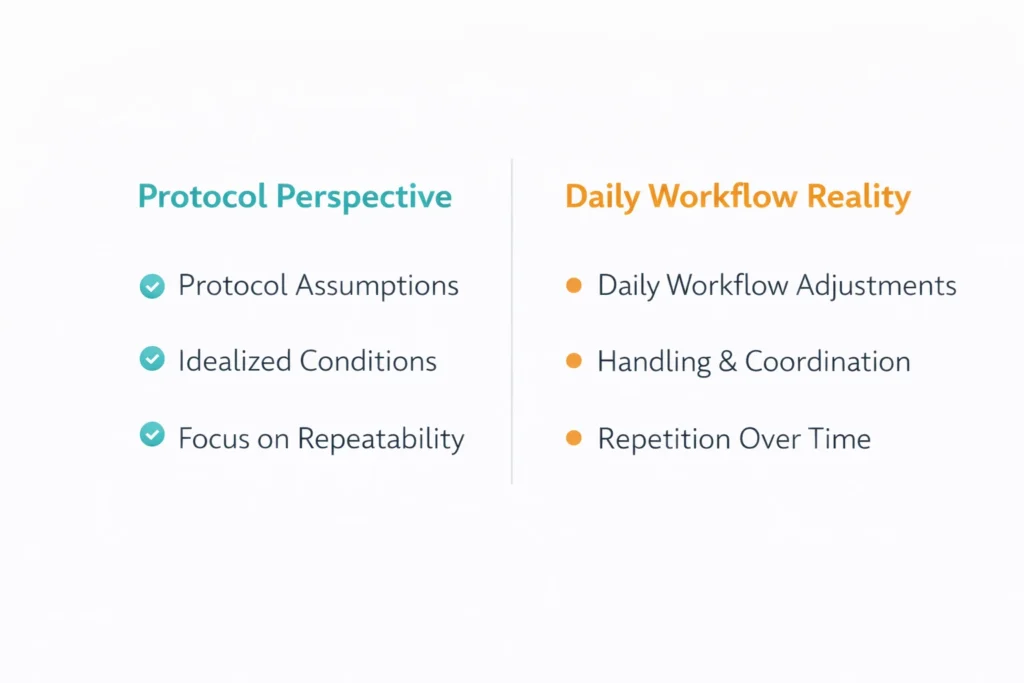
Laboratory protocols are typically written to control variables that have a direct and measurable impact on experimental outcomes. Parameters such as reagents, concentrations, incubation conditions, and timing are specified in detail because deviations in these areas can readily affect results. In contrast, routine cultureware is often treated as a standardized background element rather than an active variable.
This assumption is partly practical. Protocols are intended to be transferable across laboratories with different equipment, suppliers, and operating conditions. By minimizing references to specific consumables, protocol authors reduce the risk that procedural details become overly restrictive or difficult to reproduce elsewhere. As long as basic requirements are met, items such as Petri dishes are implicitly expected to behave consistently, regardless of material or format differences that may become more apparent in routine use.
There is also a conceptual distinction at work. Protocols are primarily concerned with experimental design rather than operational execution. They describe what should happen under idealized conditions, not how every step unfolds in day-to-day laboratory settings. Within this framework, cultureware functions as a neutral container—necessary, but not central to the logic of the experiment itself.
As a result, potential variability introduced through routine handling, repetition, or workflow constraints is rarely addressed at the protocol level. These factors tend to fall outside the scope of formal experimental documentation, even though they may become more relevant once procedures are carried out regularly. This gap helps explain why issues related to Petri dishes often go unnoticed until experiments transition from protocol to practice.
When Petri Dish–Related Issues First Become Noticeable
Issues related to Petri dishes rarely emerge during initial or infrequent experiments. When protocols are followed occasionally and under low workload conditions, most cultureware performs adequately, and minor inconveniences are easily absorbed into the workflow. At this stage, Petri dishes tend to remain invisible as a potential source of concern.
The first signs usually appear when laboratory work becomes routine. As experiments are repeated daily or weekly, small operational details begin to matter more. Tasks such as labeling, stacking, transferring dishes between workstations, or coordinating multiple parallel cultures introduce practical demands that are not reflected in protocol descriptions. Under these conditions, handling consistency and ease of use start to influence how smoothly procedures unfold. Similar patterns have been observed in routine laboratory use scenarios discussed in studies of glass and plastic Petri dishes, where practical handling considerations only become apparent through repeated daily operation.
Increased throughput can further amplify these effects. When several experiments are conducted simultaneously, even minor inefficiencies accumulate. What was once an isolated inconvenience may begin to affect timing, coordination, or overall workflow efficiency. Importantly, these changes are often experienced as operational friction rather than experimental failure.
Because results may still appear valid, such issues are easy to dismiss or normalize. They tend to be attributed to workload, time pressure, or procedural complexity rather than to the consumables themselves. This early normalization helps explain why Petri dish–related issues are often recognized only gradually, setting the stage for why they are rarely identified as the underlying cause in the first place.
Why These Issues Are Rarely Attributed to the Petri Dish Itself
When operational frictions first appear, they are seldom interpreted as being related to the Petri dish itself. In most laboratory settings, consumables are expected to function reliably as long as they meet basic specifications. As a result, attention is more likely to focus on factors that are traditionally viewed as adjustable or controllable.
A common response is to revisit procedural steps rather than to question routine materials. Researchers may modify handling habits, adjust scheduling, or refine protocol details in an attempt to restore smooth workflow. Because these adjustments often lead to partial improvement, the underlying role of cultureware remains obscured. The Petri dish continues to be treated as a neutral background element rather than a contributing variable.
There is also a tendency to normalize minor inefficiencies over time. Small inconveniences—such as extra handling steps or slight inconsistencies—are often absorbed into daily practice without being formally acknowledged. When such issues do not directly compromise experimental results, they are perceived as acceptable trade-offs rather than signals warranting further investigation.
Finally, the effects associated with routine consumables are typically cumulative rather than immediate. Unlike clear protocol deviations, their influence becomes apparent only after repeated use or increased workload. This gradual emergence makes it difficult to establish a direct causal link, reinforcing the assumption that the source of the problem lies elsewhere.
How Small Operational Frictions Accumulate Over Time
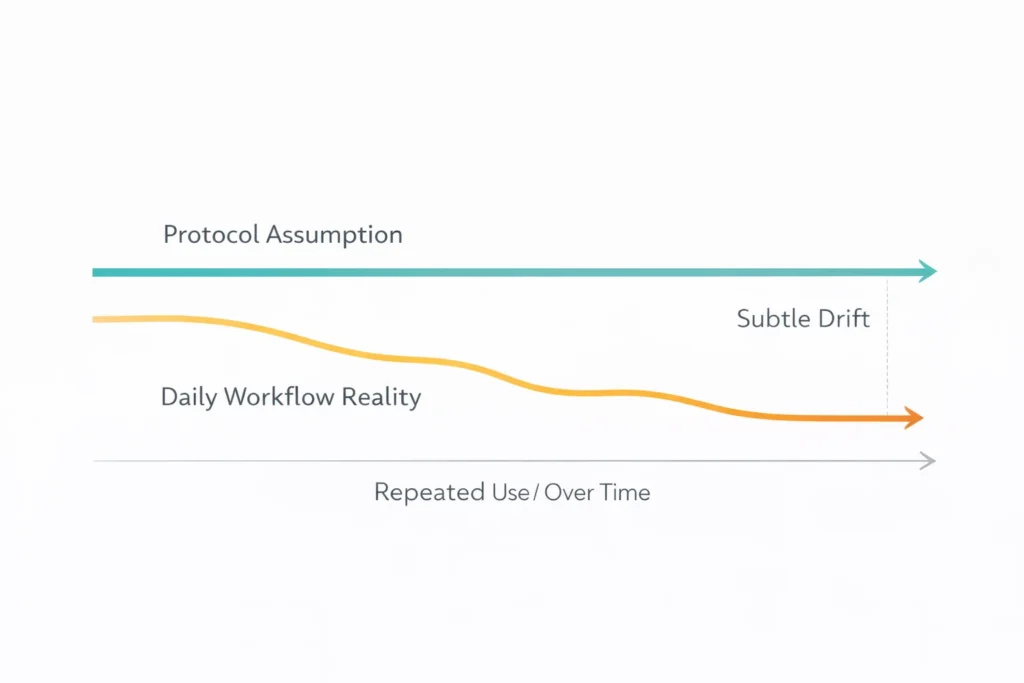
Small operational frictions rarely draw attention when they occur in isolation. In the short term, additional handling steps or minor inconsistencies are often perceived as manageable inconveniences. However, as laboratory work continues over weeks or months, these seemingly trivial factors begin to accumulate.
Repeated procedures place increasing emphasis on consistency. When the same workflow is performed many times, even slight variations in handling can affect timing, coordination, and overall efficiency. Tasks that were once flexible become more constrained, and deviations—however small—start to disrupt established routines. Over time, this can lead to subtle but persistent inefficiencies across multiple stages of daily work, such as longer setup times, increased reliance on informal workarounds, or growing variability between operators performing identical procedures.
Standardization further amplifies this effect. As laboratories formalize workflows to improve reproducibility or throughput, operational tolerance narrows. Under standardized conditions, small sources of friction are less easily absorbed and more likely to surface as recurring issues. What initially appeared to be a matter of convenience gradually becomes a question of reliability and process stability.
Importantly, these accumulated frictions do not necessarily manifest as experimental errors. Results may remain acceptable, while the effort required to achieve them increases. This distinction often delays recognition, as the impact is felt more in workflow strain than in measurable outcomes. Only after patterns become consistent over time does the underlying source of inefficiency begin to warrant closer attention.
Recognizing When Cultureware Stops Being a Neutral Variable
Recognizing when cultureware begins to influence workflow requires a shift in perspective. Rather than looking for obvious failures, the relevant signals are often indirect and process-oriented. These signals tend to emerge when operational strain becomes consistent rather than occasional.
One common indicator is repetition. When the same inefficiencies appear across multiple experiments, operators, or time periods, they are less likely to be incidental. At this stage, adjustments to protocol steps or handling practices may no longer resolve the issue fully. Instead, they offer temporary mitigation without addressing the underlying source of friction.
Another sign is the narrowing of operational flexibility. As workflows become more standardized, there is less room to compensate for minor inconveniences through informal workarounds. When routine procedures begin to feel disproportionately effort-intensive relative to their complexity, it suggests that previously neutral elements may now be shaping the process more actively.
Importantly, this recognition does not imply immediate corrective action. Identifying that cultureware is influencing workflow is a diagnostic step, not a conclusion. It allows laboratories to distinguish between protocol-level limitations and operational constraints, creating space for more informed evaluation rather than reactive change.
How Laboratories Commonly Respond Once Patterns Become Clear
Once recurring patterns become evident, laboratory responses are typically gradual rather than abrupt. Instead of immediately replacing consumables or redesigning workflows, most teams begin by reassessing existing practices. This often involves informal discussion among operators, comparison across experiments, or closer observation of where friction consistently arises.
In many cases, laboratories test small adjustments before committing to broader changes. These may include trialing alternative handling approaches, reallocating tasks within the workflow, or evaluating whether certain steps can be simplified. Such exploratory responses reflect a cautious approach, aimed at understanding the scope of the issue without introducing unnecessary disruption.
As evidence accumulates, decision-making tends to become more structured. Patterns that persist across time, personnel, or experimental setups are more likely to prompt a deliberate review of routine materials. At this stage, cultureware is no longer treated as an interchangeable background element but as one factor among several that shape daily operations.
Importantly, these responses are rarely driven by a single incident. They emerge from repeated observation and comparison, often alongside broader efforts to standardize or optimize workflows. By the time adjustments are made, the decision is typically framed not as a corrective reaction, but as an alignment between routine practices and evolving operational demands.
Conclusion
Petri dishes are rarely the focus of laboratory protocols, yet they play a persistent role in daily experimental work. The issues associated with them tend not to appear as immediate failures, but as subtle sources of friction that surface over time. Because these effects accumulate gradually and often fall outside the scope of formal documentation, they are easy to overlook during protocol design and early implementation.
As laboratory workflows become routine, standardized, or scaled, the assumptions that once held under ideal conditions begin to show their limits. What was initially treated as a neutral background element may start to influence consistency, efficiency, and operational stability. Recognizing this transition is less about identifying defects and more about understanding how routine practices evolve in real working environments.
By distinguishing between protocol-level intent and workflow-level experience, laboratories can better interpret where inefficiencies originate. This perspective does not prescribe immediate change, but it supports more informed evaluation as experimental routines mature. In doing so, it allows routine consumables to be considered within the broader context of daily laboratory work—where their impact, though subtle, can become increasingly relevant over time.
Frequently Asked Questions
Why are Petri dishes rarely specified in laboratory protocols?
Laboratory protocols prioritize variables that directly affect experimental outcomes, such as reagents, incubation conditions, and timing. Routine cultureware is generally assumed to be standardized and interchangeable, which is why it is often not described in detail unless it directly compromises experimental validity.
If experiments produce acceptable results, do Petri dish–related issues really matter?
Even when results remain acceptable, Petri dish–related issues can influence workflow efficiency and handling consistency. These effects tend to impact daily operations rather than experimental outcomes, becoming more noticeable as procedures are repeated or scaled.
Are these issues mainly about convenience rather than experimental reliability?
Initially, many issues present as minor inconveniences. Over time, however, repeated operational friction can affect process stability and repeatability, especially in standardized or high-throughput workflows. The distinction often lies in duration and scale rather than severity.
When should laboratories begin to reassess routine Petri dish choices?
Reassessment is typically warranted when inefficiencies appear consistently across experiments, operators, or time periods. Such patterns suggest that elements previously treated as neutral may be influencing workflow in a more systematic way.
If you are evaluating Petri dish materials for standardization or procurement, and need input aligned with your specific workflow
📩 For quotes, samples, or product recommendations, contact the Kelabscience team → Contact Kelabscience