Introduction
An HDPE chemical compatibility chart helps assess whether high-density polyethylene is a suitable bottle material for a particular reagent. The entries may not match the intended use exactly. For 70% ethanol, for example, the reference guide used for the table below lists ratings for 50% and 100% solutions but provides no separate 70% entry.
In this guide, we compare selected published ratings and work through examples involving methanol, ethanol, acetone, and nitric acid. These examples show how concentration, temperature, rating definitions, and source limitations affect the interpretation—and how to handle missing or conflicting information.
For laboratories and purchasing teams selecting HDPE reagent bottles, the aim is to turn that reading into a practical decision: keep HDPE under consideration, choose another material, or resolve a specific information gap before selecting the bottle and closure.
HDPE Chemical Compatibility Chart: Selected Lab Chemicals
We selected six entries from the Thermo Scientific Nalgene chemical resistance reference guide to compare chemicals, concentrations, and temperatures within one consistent rating system.
These are reference estimates for Nalgene products. They illustrate chart interpretation and do not establish chemical-specific storage specifications for Kelabscience bottles.
| Chemical and concentration as listed | HDPE at 20°C | HDPE at 50°C |
|---|---|---|
| Methanol, 100% | E | E |
| Ethanol, 50% | E | E |
| Ethanol, 100% | E | G |
| Acetone, pure | F | N |
| Nitric acid, 10%† | E | E |
| Nitric acid, 50%† | F | N |
The guide’s rating definitions are summarized below:
- E: No material damage following a continuous 30-day exposure.
- G: Minor or no material damage over the same 30-day period.
- F: Some material effect following a continuous seven-day exposure.
- N: Damage can occur immediately; not recommended for continuous use.
† The guide warns against storing strong oxidizing agents in plastic labware other than FEP or PFA. Read the nitric-acid entries alongside this restriction; a favorable rating alone does not establish suitability for storage.
How to Read an HDPE Chemical Resistance Chart
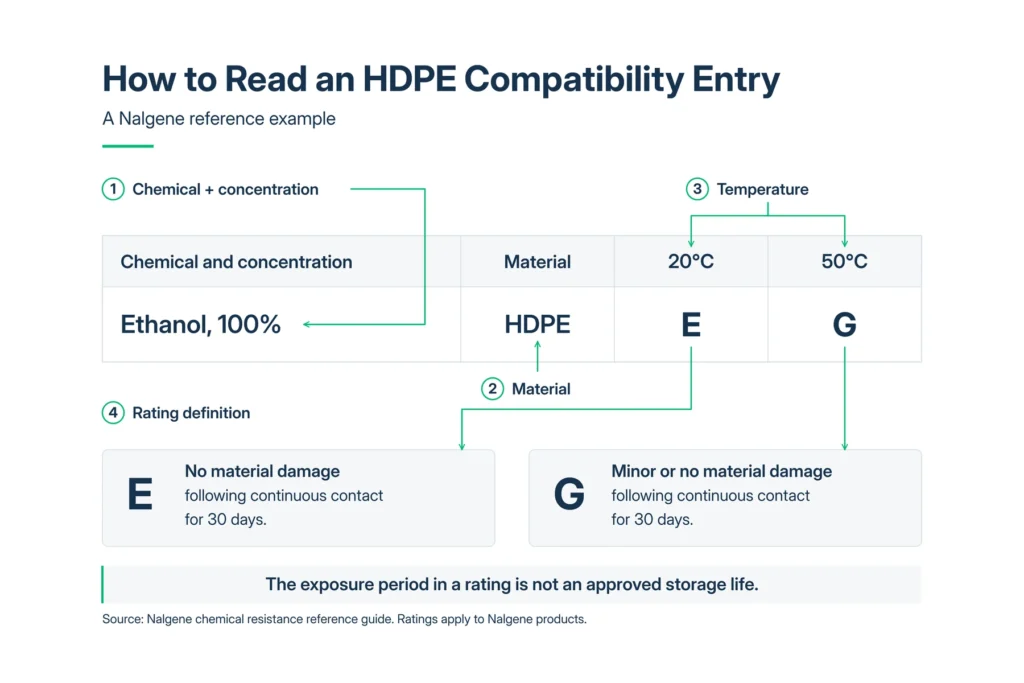
When reading an entry, we first identify exactly what it describes: the chemical, material, and conditions attached to the rating. The following checks help keep that interpretation precise.
Match the Chemical, Concentration, and Material
Locate the complete chemical name and concentration before moving across to the material column. A CAS number helps identify a substance, but it does not distinguish the different concentrations listed for that substance.
For percentage concentrations, check whether the source specifies a basis, such as % w/w or % v/v. If the basis is unspecified, preserve that uncertainty when comparing the entry with your formulation.
Keep the material designation equally precise. The guide used for the table above lists HDPE, LDPE, and fluorinated HDPE (FLPE) separately. If another guide labels a column simply “PE,” clarify which polyethylene it covers before applying its ratings to an HDPE bottle.
Read the Rating Together with Its Exposure Conditions
In the guide used for the table above, the first letter of each pair applies at 20°C and the second at 50°C. An E/G entry therefore represents two temperature-specific ratings. These temperatures describe the chart entries; they do not establish an operating-temperature range for every HDPE bottle.
The exposure periods belong to the rating definitions. A category referring to 30 days of contact does not establish suitability for several months of storage. Similarly, an F rating does not certify an effect-free period before day seven.
Check the Legend, Footnotes, and Scope
Each guide needs its own key. The DWK Chemical Compatibility Guide, for example, uses A–D ratings and a dash for unknown compatibility. It specifies room-temperature conditions without giving an exposure period in its key.
When comparing the guides, we keep those definitions separate. A DWK “A” cannot be assigned Nalgene’s 30-day interpretation simply because both ratings indicate favorable resistance.
Finally, check the document’s product scope, application exclusions, and storage warnings. A restriction still applies when an individual rating is copied out of the table. Keep relevant notes beside the entry so that the comparison retains the conditions that qualify it.
Three Worked Examples for Lab Bottle Storage
Methanol and Ethanol: Reading Beyond “Alcohol Resistance”
For an enquiry involving 100% methanol at approximately 20°C, the reference table above provides a matching entry: E for HDPE. It also lists E at 50°C. For 70% ethanol, the match is less direct: 50% ethanol is E/E and 100% ethanol is E/G, with no separate 70% entry.
Thermo Fisher’s broader HDPE bottle guidance also identifies aliphatic alcohols as a favorable application category. Together, these references give us a reasonable basis for keeping HDPE under consideration for both enquiries.
The distinction is in the supporting evidence. The methanol concentration matches a published entry, while the 70% ethanol formulation remains outside the selected chart’s exact coverage. For the ethanol enquiry, record the actual formulation and storage conditions rather than assigning it a rating inferred from neighboring concentrations.
Acetone: Why a Rating Is Not a Storage-Time Allowance
Now consider a request to hold pure acetone in an HDPE bottle for 24 hours at approximately 20°C. The reference table above lists an F rating for HDPE at that temperature. The seven-day reference in its definition does not establish a 24-hour storage allowance.
DWK’s container compatibility guide provides further reason to question this choice: it rates HDPE as not resistant to acetone at room temperature, while glass receives a resistant rating. Based on these references, we would start with a glass solvent bottle whose closure is also specified for acetone.
That recommendation follows the cited container guidance. The next section examines how to handle another published chart that gives acetone a more favorable HDPE rating.
Nitric Acid: Reading Concentration and Storage Warnings Together
An enquiry for “bottles for nitric acid” needs a concentration before material selection can proceed. The reference table above lists 10% nitric acid as E/E and 50% nitric acid as F/N. The favorable dilute entry cannot support a recommendation for the 50% application.
Oxidizing behavior also matters. Thermo Fisher’s care-and-use guidance warns that concentrated nitric acid can make many plastics brittle. A broad description such as “resistant to acids” therefore provides insufficient guidance for this reagent.
For 50% nitric acid, these references point toward seeking a container expressly recommended for that concentration and intended storage period. For 10%, the favorable entry supports further consideration of HDPE, with the reagent’s storage instructions and the guide’s oxidizer precautions retained in the assessment.
When the Chart Does Not Match Your Application
A missing concentration, a formulated reagent, and conflicting ratings call for different follow-up questions.
When Concentration or Temperature Is Missing
Ratings such as E, G, F, and N are categories. Averaging them cannot produce a rating for an unlisted concentration or temperature.
Nearby entries can help identify a candidate material, while the actual application conditions remain separate from those references. For example, a liquid filled warm and then stored at room temperature exposes the bottle to both conditions. Record the filling temperature, subsequent storage temperature, and relevant contact periods so that the recommendation addresses the full exposure.
When the Liquid Is a Mixture
Checking individual ingredients can reveal a potential incompatibility, but favorable ratings for separate components do not establish compatibility for the finished formulation. The guide used for the six-entry table also notes that mixing or dilution can change chemical behavior and temperature.
The reagent’s SDS helps define the application. Section 3 provides disclosed composition information, Section 7 addresses handling and storage, and Section 10 covers stability, reactivity, and incompatible materials. Ingredient ranges or withheld details may limit how precisely the formulation can be identified from the SDS alone.
For a proprietary reagent, include its product name, product code, and current SDS in the enquiry. Container guidance from the reagent manufacturer can then address the specific formulation and inform the discussion about a suitable bottle and closure.
When Published Sources Disagree
Acetone provides a useful example of a real difference between published guides:
| Source | Chemical entry | Published HDPE rating and conditions |
|---|---|---|
| Nalgene | Pure acetone | F at 20°C; N at 50°C. |
| DWK | Acetone | D, meaning not resistant, at room temperature. |
| INEOS | Acetone | S, meaning satisfactory, at both 21°C and 60°C. |
INEOS limits its guide to general chemical resistance and identifies permeation, environmental stress cracking, and container design as additional compatibility factors. Its favorable rating therefore leaves questions about the complete bottle application.
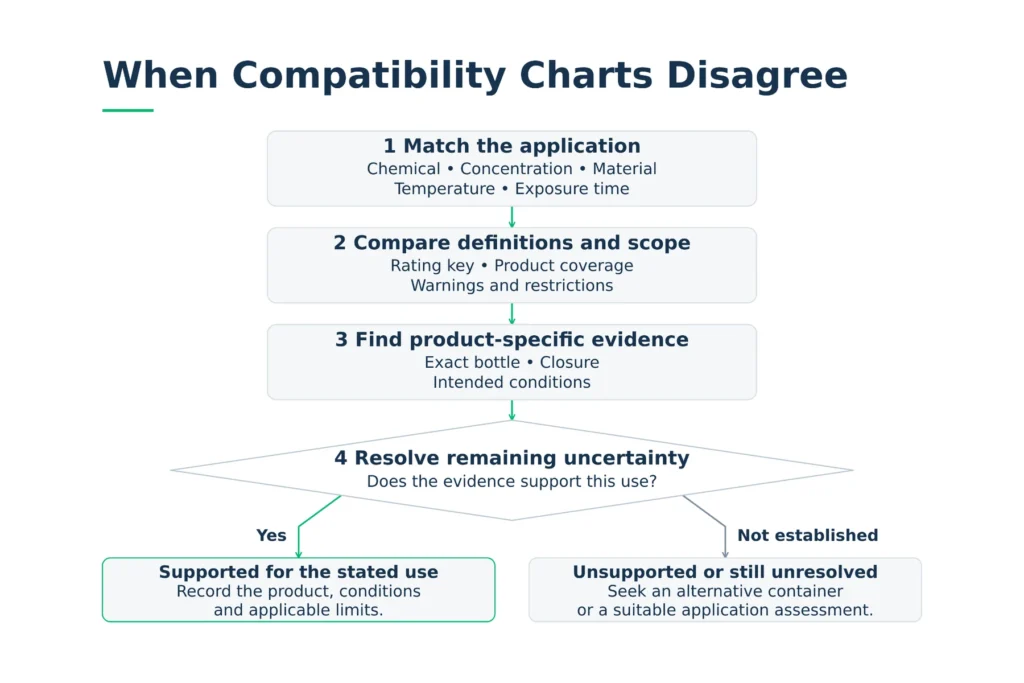
To work through conflicting entries, we use the following sequence:
- Match the application conditions. Compare the chemical, concentration, material, temperature, and exposure period. Mark omitted details as unspecified. Entries covering different conditions should not be treated as directly contradictory.
- Compare the definitions and scope. Read each rating’s meaning and determine which materials or products the guide covers. The DWK key and INEOS guide do not specify exposure periods, so neither can be assigned Nalgene’s time-based interpretation.
- Look for evidence covering the proposed bottle. Ask the manufacturer to identify the bottle and closure covered by its recommendation, the applicable conditions, and the supporting technical information. Read that guidance alongside the reagent’s storage requirements.
- Resolve the remaining uncertainty before routine use. If suitability remains unsupported, keep the application unconfirmed. Seek an alternative container with relevant supporting guidance, or an appropriate application-specific assessment. Choosing the more favorable letter does not resolve the disagreement.
For the acetone enquiry, we retain the glass solvent bottle with a closure specified for acetone as the starting point. The available documents do not establish why the HDPE ratings differ, and a favorable general entry alone is insufficient to change that selection.
Applying Chart Data to an HDPE Reagent Bottle
When HDPE remains a candidate, the next step is to connect the material assessment to a specific bottle configuration and the requirements of the stored reagent.
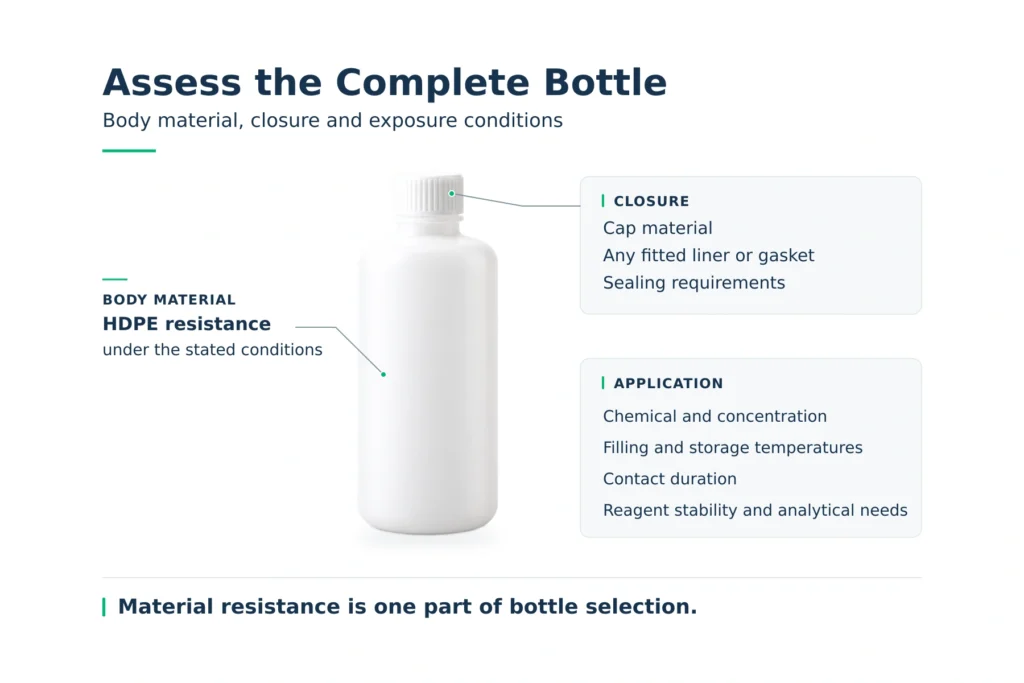
Does the Information Cover the Complete Bottle?
To assess the complete bottle, we identify the cap material and any fitted liner or gasket alongside the HDPE body. Check each component’s material against the reagent and intended exposure conditions. A change in cap or liner may affect suitability even when the bottle body remains the same.
Sealing performance needs its own supporting information. Check which test liquid and conditions support a leakproof claim, and whether that evidence covers the intended reagent and use.
If maintaining concentration or limiting analytical contamination is critical, include those requirements in the enquiry. A favorable resin rating alone does not establish reagent stability or analytical suitability throughout storage.
Our reagent bottle storage problems guide discusses evaporation, leakage, and contamination in existing laboratory workflows.
What Should Buyers Include in an Application Enquiry?
A concise enquiry can follow this format:
We need [capacity] reagent bottles for [chemical name or reagent product/code] at [concentration, including % w/w, % v/v, or other units]. The filling temperature is [temperature], followed by storage at [temperature or range] for [duration]. Please advise on a suitable bottle and closure configuration. Additional requirements are [application-specific requirements], and the estimated order quantity is [quantity].
Include any temporary exposure conditions and their duration where relevant. Attach the SDS and the chart reference used in the material assessment.
Our standard HDPE reagent bottles are available in sizes from 8 mL to 1000 mL, with wide-mouth and narrow-mouth designs, natural (white) and amber options, and screw-cap closures. The product page lists available SKUs and bulk packaging.
The plastic reagent bottle selection guide covers routine choices such as capacity and mouth design. To request a quotation, send us your application details and expected order quantity so we can review the proposed configuration and supply requirements.
Conclusion
HDPE chemical compatibility charts are most useful when they lead to a clear next step. The published information may support keeping HDPE as a candidate, point toward another material, or leave a specific question to resolve before selecting a bottle.
We would carry the relevant source, exposure conditions, and application limits into the bottle specification. This preserves the reasoning behind the choice and connects the material assessment to the complete bottle and closure. Laboratory users and purchasing teams can then see what supports the selection and when a change in reagent or storage conditions calls for another review.
Frequently Asked Questions
Is HDPE compatible with methanol?
The six-entry reference table lists an E rating for HDPE with 100% methanol at both 20°C and 50°C. We would use this as supporting evidence when considering HDPE, while checking that the recommendation covers the selected bottle, closure, and storage conditions.
Can HDPE bottles be used for 70% ethanol?
HDPE is a reasonable candidate, but the guide used for the six-entry table does not provide a separate 70% ethanol entry. Its 50% and 100% entries offer reference points. They do not establish an exact rating for the intermediate concentration or a storage duration for a particular bottle.
Can acetone be stored in HDPE bottles?
We would avoid ordinary HDPE bottles for routine acetone storage. DWK rates HDPE as not resistant to acetone at room temperature, while glass receives a resistant rating. A glass solvent bottle with a closure specified for acetone is a more appropriate starting point.
Does a 30-day compatibility rating support long-term storage?
A 30-day rating does not establish suitability for several months or define a reagent’s shelf life. The duration belongs to the chart’s rating definition. Longer storage needs supporting information covering the intended period and the complete bottle configuration.
Can LDPE or fluorinated polyethylene data be used for HDPE?
These ratings should not be transferred directly to HDPE. Match the material designation to the proposed bottle; if another source labels a column only “PE,” clarify which polyethylene it covers.
Is an SDS enough to confirm bottle compatibility?
Not necessarily. Sections 3, 7, and 10 provide disclosed composition, handling and storage information, and stability and reactivity guidance. Use them to identify relevant requirements. If the SDS does not specify suitable container materials and conditions, bottle and closure compatibility still need to be established.