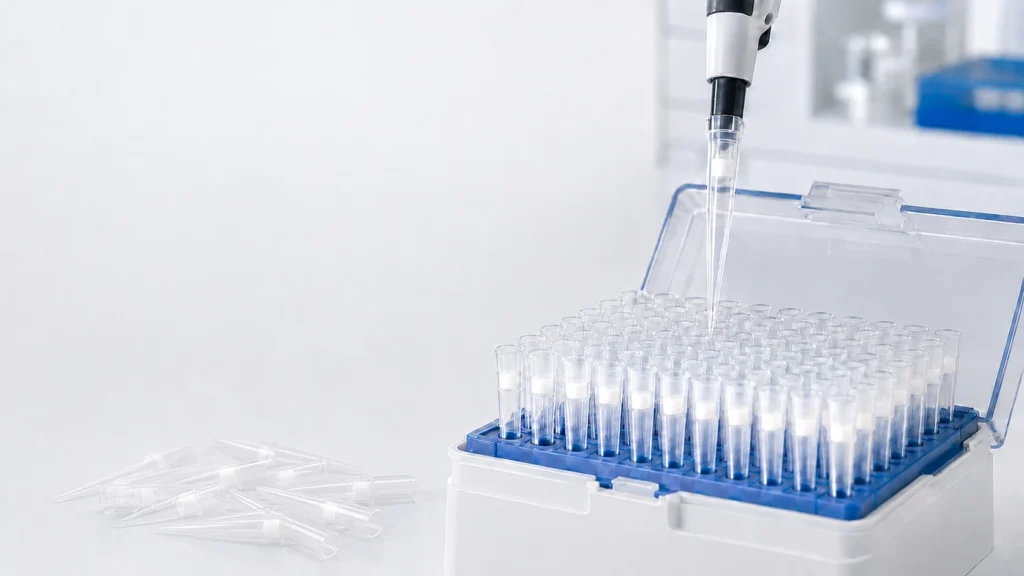
Why Filter Pipette Tip Selection Matters
Filter pipette tips are often treated as small, routine consumables, but their role in laboratory work is more important than their size suggests. In PCR, qPCR, molecular biology, cell culture, and other sensitive workflows, the pipette tip is the direct contact point between the pipette, the operator, and the sample. If the wrong tip is used, the problem may not appear immediately, but it can gradually affect pipetting consistency, contamination control, and the reliability of experimental results.
A filter pipette tip is designed with an internal barrier, often called an aerosol barrier, near the upper part of the tip. This barrier helps reduce the risk of aerosols or liquid droplets entering the pipette shaft during aspiration. In sensitive applications, this can help protect both the pipette and future samples from carryover contamination. This is especially relevant when handling DNA, RNA, PCR reagents, clinical samples, volatile liquids, or high-value materials.
However, choosing filter pipette tips is not only about deciding whether a filter is present. Laboratories also need to consider volume range, sterility, DNase/RNase-free requirements, low-retention performance, packaging format, and compatibility with the pipettes they already use. A tip that works well on one pipette may not seal properly on another. A sterile tip may not automatically meet nuclease-free requirements. A low-retention tip may be useful for some liquids but unnecessary for routine buffer transfer.
For this reason, filter pipette tip selection should be based on workflow conditions rather than price or appearance alone. A routine teaching lab, a molecular biology lab, and a diagnostic sample preparation workflow may all use filter tips, but their requirements are not exactly the same.
This guide explains how to choose filter pipette tips for PCR, qPCR, and routine laboratory work by looking at the practical factors that affect contamination control, pipetting consistency, and procurement decisions.
For laboratories comparing product formats, Kelabscience provides filter pipette tips for contamination-sensitive pipetting workflows.
What Filter Pipette Tips Actually Do
Filter pipette tips are standard pipette tips with a porous barrier placed inside the upper part of the tip. This barrier is usually made from hydrophobic polyethylene or a similar porous polymer. Its main purpose is not to filter the liquid sample itself, but to reduce the movement of aerosols, droplets, and liquid splashback toward the pipette shaft.
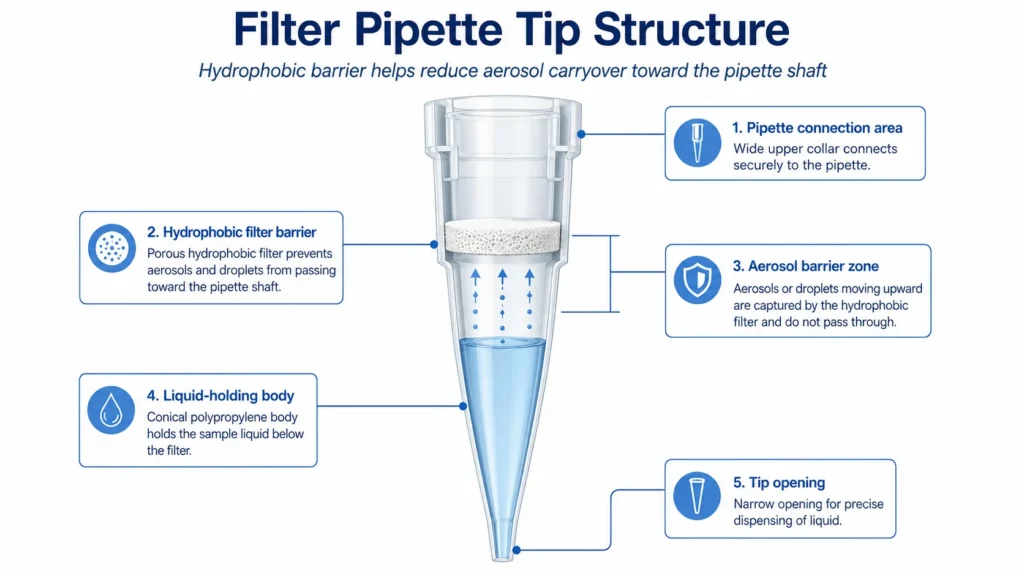
Suggested image placement: Filter pipette tip structure diagram
A simple cross-section diagram can be placed here to show the basic structure of a filter pipette tip. The image should label:
- Tip collar or connection area, where the tip attaches to the pipette
- Filter position, located near the upper part of the tip as an aerosol barrier
- Tip body, where the liquid is held during aspiration
- Tip opening, where liquid enters and leaves the tip
The filter is positioned between the liquid-holding area and the pipette connection area. This design means that aerosols or droplets moving upward inside the tip must pass through the filter before reaching the pipette shaft, helping reduce the risk of internal pipette contamination.
This distinction is important. In normal pipetting, liquid should remain in the lower part of the tip and should not reach the pipette body.
However, in real laboratory work, several situations can increase the risk of contamination: fast aspiration, accidental over-pipetting, viscous samples, volatile liquids, foaming solutions, or repeated handling of samples with high nucleic acid concentration. When this happens, aerosols or small droplets may move upward inside the tip.
The filter barrier helps create a physical separation between the sample side and the pipette side. This can reduce the chance that sample residues enter the pipette shaft and later contaminate another sample. It also helps protect the internal parts of the pipette from liquids that may affect performance over time.
Why hydrophobic filter materials are used
Filter barriers are commonly made from hydrophobic polyethylene or similar porous materials. Hydrophobic means the material does not easily become wetted by water-based liquids. In practical terms, aqueous droplets are less likely to pass through or spread across the filter pores.
This property matters because filter pipette tips still need to allow normal air movement during aspiration and dispensing. A hydrophobic porous filter can help block liquid droplets and aerosols while allowing air to pass through the barrier. This supports normal pipetting function while reducing the risk of liquid entering the pipette shaft.
By contrast, a hydrophilic material would be more easily wetted by liquid. Once wetted, the filter pores may become blocked, or liquid may spread through the material more easily. This could affect aspiration behavior and increase the risk of volume inconsistency. For this reason, hydrophobic filter design is commonly used as a physical aerosol barrier in filter pipette tips.
For PCR and qPCR workflows, this protection is especially valuable. Even a small amount of carryover nucleic acid can become a contamination source in amplification-based assays. Filter pipette tips are therefore commonly used during PCR master mix preparation, template addition, qPCR setup, and other steps where contamination control matters.These steps are often used together with clean PCR consumables such as PCR tubes during small-volume reaction setup.
Filter tips are also useful outside PCR. They are often selected when handling clinical samples, biological samples, infectious materials, volatile reagents, or high-value samples that cannot easily be replaced. In these cases, the filter is part of a broader contamination-control strategy, together with proper pipetting technique, clean work areas, fresh tips between samples, and suitable packaging.
It is also important not to overstate what filter pipette tips can do. They do not make poor pipetting technique safe, and they do not guarantee contamination-free results. They help reduce certain contamination risks, especially aerosol-related and pipette-shaft-related risks, when used correctly in the right workflow.
Filter Tips vs Non-Filter Tips: When to Use Each
Both filter and non-filter pipette tips can be suitable in laboratory work, but they are not used for the same level of contamination control. The choice should depend on the sample type, workflow sensitivity, and the possible consequence of aerosol carryover or liquid entering the pipette shaft.
Non-filter tips are commonly used for routine liquid transfer, buffer preparation, gel loading, and other tasks where the contamination risk is relatively low. They are usually more economical and may be sufficient when the sample is not sensitive, hazardous, volatile, or used in amplification-based workflows.
Filter pipette tips are often selected when the workflow requires better control of aerosol-related carryover, pipette-shaft contamination, or sample-to-sample contamination risk. The internal filter barrier helps reduce the chance of aerosols or droplets reaching the pipette shaft. This makes filter tips especially useful for PCR, qPCR, nucleic acid work, clinical sample preparation, and other contamination-sensitive applications.
| Selection Factor | Filter Pipette Tips | Non-Filter Pipette Tips |
|---|---|---|
| Contamination control | Help reduce aerosol and pipette-shaft contamination | Limited protection against aerosol carryover |
| Pipette protection | Better protection if splashback or over-aspiration occurs | Higher risk if liquid enters the pipette shaft |
| Typical applications | PCR, qPCR, DNA/RNA work, clinical samples, contamination-sensitive workflows | Buffer transfer, gel loading, routine non-sensitive tasks |
| Cost | Usually higher | Usually lower |
| Best use logic | Use when aerosol carryover risk or sample value is high | Use when the workflow is routine and low-risk |
For many laboratories, the most practical approach is not to replace every tip with a filter tip. Instead, filter tips should be reserved for workflows where they provide clear value. For example, a lab may use sterile filter pipette tips for PCR setup, qPCR preparation, or biological sample handling, while using non-filter tips for simple buffer transfer or general teaching demonstrations.
The key is to avoid treating all pipetting steps as equal. A 10 µL template addition step in qPCR carries a different level of risk from transferring 800 µL of buffer into a tube. Matching the tip type to the workflow helps laboratories control cost without ignoring contamination-sensitive steps.
Sterile, DNase/RNase-Free, and Low-Retention: Don’t Mix Them Up
When choosing filter pipette tips, many laboratories focus first on whether the tips are sterile. Sterility is important in many workflows, but it is not the only cleanliness-related specification to check. Sterile, DNase/RNase-free, non-pyrogenic, and low-retention describe different properties, and they should not be treated as the same requirement.
Sterile filter pipette tips are treated to reduce viable microorganisms. They are commonly used in cell culture, clinical sample preparation, microbiology-related workflows, and other applications where microbial contamination may affect the sample or downstream process. If the workflow involves living cells, biological samples, or aseptic handling, sterile packaging is usually a practical requirement.
DNase/RNase-free filter tips are designed for nucleic acid workflows where enzyme contamination could degrade DNA or RNA. This is especially important for PCR, qPCR, RT-qPCR, RNA extraction, and molecular biology sample preparation. A tip may be sterile but not clearly specified as DNase/RNase-free, so laboratories should check the product documentation rather than assume the two are equivalent.
Non-pyrogenic tips are relevant when endotoxin contamination may matter, especially in some cell culture, pharmaceutical, or sensitive biological workflows. This specification is separate from sterility and nuclease-free status. For cell culture, sterility is usually the first requirement, while non-pyrogenic status may also be important depending on the sensitivity of the cells and the application.
Low-retention filter tips are designed to reduce liquid adhesion on the inner surface of the tip. They can be useful when handling viscous liquids, protein-containing solutions, enzyme mixes, detergents, or small-volume samples where residual liquid may affect transfer consistency. Low-retention performance is not mainly about sterility or contamination control; it is about improving liquid recovery and dispensing consistency in suitable workflows.
| Specification | What It Means | Typical Use |
|---|---|---|
| Sterile | Treated to reduce viable microorganisms | Cell culture, clinical samples, aseptic workflows |
| DNase/RNase-free | Tested or manufactured to reduce nuclease contamination risk | PCR, qPCR, RT-qPCR, DNA/RNA work |
| Non-pyrogenic | Controlled for endotoxin-related concerns | Sensitive biological or cell-based workflows |
| Low-retention | Surface designed to reduce liquid residue | Viscous liquids, enzymes, protein solutions, small-volume transfer |
The practical point is simple: choose the specification according to the workflow, not according to a single label. For PCR and qPCR, DNase/RNase-free filter pipette tips are usually more relevant than sterility alone. For cell culture, sterile tips are often essential, and non-pyrogenic status may be needed for more sensitive cell-based applications. A filter barrier may also be useful when aerosol-related carryover, biological sample handling, or pipette protection is a concern, but not every cell culture transfer step automatically requires a filter tip.
A good procurement decision starts by separating these requirements clearly. This helps avoid both under-specification, which may increase experimental risk, and over-specification, which can raise cost without adding meaningful value to routine work.
Choose the Right Volume and Tip Format
After deciding whether filter tips are needed, the next step is to choose the correct volume range and tip format. This may seem straightforward, but mismatched tip capacity is one of the easiest ways to create avoidable pipetting variation.
A pipette tip should match both the pipette model and the working volume. In practice, accuracy and repeatability are usually better when the selected pipette and tip are used within an appropriate operating range, rather than at the extreme low end or near the maximum capacity. For example, using a 1000 µL filter tip for a very small-volume transfer is usually not ideal, even if the liquid can technically be aspirated. The air cushion, liquid contact area, and residual volume may all become less favorable.
Common filter pipette tip sizes include 10 µL, 20 µL, 200 µL, 300 µL, and 1000 µL formats. Some laboratories also use extended-length tips or special formats for deep-well plates, narrow tubes, or workflows where reaching the bottom of a vessel matters.For plate-based PCR or qPCR workflows, tip format should also be considered together with PCR plates and instrument compatibility.
| Tip Size | Common Applications | Selection Notes |
|---|---|---|
| 10 µL filter tips | qPCR setup, small-volume PCR, enzyme mixes, template addition | Useful for precise low-volume work; low-retention design may help with small samples |
| 20 µL filter tips | Molecular biology setup, small reagent transfer | Suitable when routine volumes are above the very low microliter range |
| 200 µL filter tips | PCR preparation, sample dilution, buffer and reagent transfer | One of the most common sizes for routine lab work |
| 300 µL filter tips | Multichannel pipetting, plate-based workflows | Check compatibility with multichannel pipettes and plate formats |
| 1000 µL filter tips | Larger sample transfer, buffer handling, extraction workflows | Seal fit and tip length should be checked carefully |
For PCR and qPCR, small-volume filter tips are often used because many reaction components are added in microliter volumes. In these workflows, low-retention design, clear manufacturing consistency, and pipette compatibility can be more important than simply choosing the lowest-cost option.
For routine sample preparation, 200 µL and 1000 µL filter pipette tips are common. The best choice depends on the actual transfer volume, sample type, and vessel format. If the work involves deep tubes, reagent reservoirs, or narrow containers, tip length and shape may affect handling comfort and liquid recovery.
The tip format should also match the workflow. Standard tips are suitable for most routine transfers. Extended-length tips may help reduce contact with tube walls or allow easier access to deep vessels. Graduated tips can support quick visual checks, although they should not replace proper pipette calibration or accurate volume setting.
In procurement, it is useful to map tip sizes to actual workflows instead of buying one format for everything. A molecular biology lab may need 10 µL and 200 µL sterile filter tips for PCR setup, while a sample preparation area may use more 1000 µL filter tips for buffer and extraction steps. Matching volume range to real usage helps reduce waste, improve handling consistency, and avoid unnecessary inventory complexity.
Check Pipette Compatibility and Seal Fit
Pipette compatibility is one of the most practical factors in choosing filter pipette tips. A tip may have the correct volume range and cleanliness grade, but if it does not fit the pipette properly, pipetting accuracy and handling consistency can still be affected.
Most laboratories use pipettes from different brands or different series. Although many suppliers describe their products as universal filter pipette tips, universal does not always mean identical performance on every pipette. Pipette shafts vary slightly in shape, diameter, taper, and sealing design. These small differences can influence how firmly the tip attaches and how well it seals during aspiration.
A poor seal can allow air leakage between the pipette shaft and the tip. When this happens, the pipette may aspirate less liquid than expected, or dispensing may become inconsistent. In sensitive workflows such as PCR, qPCR, or serial dilution, this can create variation that is difficult to trace back to the tip.
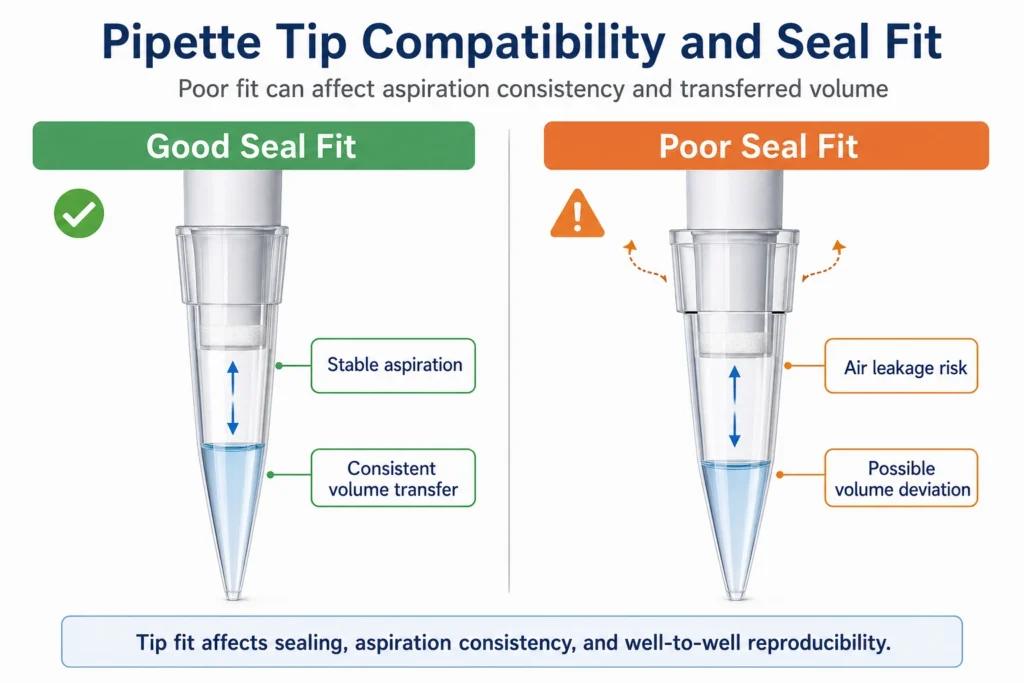
Potential impact of poor tip fit
When a pipette tip does not seal properly, the actual transferred volume may deviate from the set volume. The size of this deviation depends on the pipette model, tip design, liquid properties, working volume, and user technique. In some cases, poor fit or air leakage can lead to volume deviation of several percent.
For example, a 5% deviation in a 2 µL transfer equals 0.1 µL, meaning the actual transfer could be around 1.9 µL or 2.1 µL instead of the intended 2.0 µL. In a 100 µL transfer, the same relative deviation equals 5 µL.
This difference may look small in a single transfer, but it can become more important in qPCR setup, serial dilution, standard curve preparation, or repeated dispensing across multiple wells. In these workflows, small volume errors may accumulate and affect well-to-well consistency or dilution accuracy.
Fit also affects daily handling. If a tip requires too much force to attach, users may need to press or twist the pipette repeatedly. This can increase hand fatigue, especially when using multichannel pipettes. If the tip fits too loosely, it may drip, wobble, or detach during operation. Neither situation is ideal for routine laboratory work.
Multichannel pipettes require extra attention. All tips on the same pipette should load evenly and form a consistent seal across every channel. If some tips attach more tightly than others, liquid uptake may vary between wells. In plate-based workflows, this can affect well-to-well consistency, especially during reagent addition or sample transfer.
Before purchasing filter pipette tips in bulk, laboratories should test them with the pipettes they actually use. A simple compatibility check can include:
| Check Point | What to Look For |
|---|---|
| Tip attachment | Tip loads smoothly without excessive force |
| Seal fit | No visible dripping or inconsistent aspiration |
| Ejection | Tip ejects cleanly without sticking |
| Multichannel loading | All channels attach evenly |
| Routine handling | Comfortable use during repeated pipetting |
For supplier selection, compatibility information is useful, but in-lab testing is still valuable. The same filter pipette tip may perform well with one pipette model and feel less stable with another. If a laboratory uses several pipette brands, it may need to confirm compatibility across the main models before standardizing one tip type.
In short, pipette compatibility should not be treated as a minor detail. A good filter pipette tip should not only meet the required cleanliness and volume specifications; it should also seal reliably, load consistently, and support comfortable daily use with the pipettes already in the laboratory.
Match Packaging to the Workflow: Rack, Bulk, or Refill
Packaging is not only a purchasing detail. For filter pipette tips, the packaging format can affect contamination control, handling efficiency, storage space, and overall cost. The right choice depends on how the tips will be used, how sensitive the workflow is, and how much manual handling the lab can reasonably control.
Racked filter pipette tips are pre-loaded in boxes or racks. They are often preferred for PCR, qPCR, molecular biology, clinical sample preparation, and other workflows where clean handling matters. Because the tips are arranged individually in a rack, users can pick up tips directly with the pipette without touching them by hand. Sterile racked filter tips are especially useful when the workflow requires both aerosol barrier protection and reduced handling contamination.
Bulk filter pipette tips are supplied loose in bags. They are usually more economical and suitable for high-volume routine consumption, especially when sterility is not required or when tips are used for general laboratory transfer. However, bulk packaging involves more manual handling. If tips are transferred into boxes or racks in an uncontrolled area, the risk of environmental or contact contamination may increase.
Refill filter tips are designed to reduce packaging waste while keeping handling more organized than loose bulk tips. They may be supplied as stacked inserts or refill systems that can be placed into reusable racks. This format can be useful for laboratories that want a balance between cost control, storage efficiency, and cleaner handling. However, refill systems still require proper handling practices to avoid contamination during loading.
| Packaging Format | Best For | Main Advantage | Main Limitation |
|---|---|---|---|
| Racked filter tips | PCR, qPCR, sterile workflows, clinical sample handling | Clean handling and easy pipette pickup | Higher packaging cost and more storage space |
| Bulk filter tips | Routine transfer, non-sterile work, high-volume use | Lower cost and compact storage | More manual handling and higher contamination risk |
| Refill filter tips | Routine labs balancing cost, storage, and cleanliness | Less packaging waste and organized loading | Requires careful refilling practice |
For sensitive workflows, racked packaging is usually the safer choice. It reduces unnecessary contact with the tips and supports more consistent daily handling. This is why many laboratories prefer racked sterile filter pipette tips for PCR setup, qPCR preparation, and other contamination-sensitive workflows. For cell culture, sterile racked tips are often important, while the need for a filter barrier depends on the handling risk and laboratory practice.
For routine non-sensitive applications, bulk filter tips may be acceptable when the lab has clear handling procedures and does not require sterile packaging. They can help control costs, especially when large numbers of tips are used every day. Still, they should be stored properly and protected from dust, moisture, and unnecessary handling.
When choosing between rack, bulk, and refill packaging, laboratories should consider not only unit price but also workflow risk. A cheaper packaging format may not be the best choice if it increases handling time, contamination exposure, or user frustration. For procurement, the best packaging choice is the one that matches the cleanliness requirement, daily usage volume, storage conditions, and working habits of the lab.
Practical Selection Checklist for Lab Procurement
When purchasing filter pipette tips, it is useful to evaluate them as part of the whole workflow rather than as a single consumable item. A tip that looks suitable on a specification sheet may still cause problems if it does not match the pipette, sample type, packaging requirement, or daily handling pattern in the lab.
Before placing a bulk order, laboratories should first define where the tips will be used. PCR setup, qPCR preparation, cell culture, routine buffer transfer, clinical sample handling, and extraction workflows do not always require the same specification. Some applications need sterile and DNase/RNase-free filter tips, while others may only need standard non-sterile filter tips with reliable fit and consistent manufacturing quality.
A practical procurement checklist can include the following points:
| Selection Item | What to Confirm |
|---|---|
| Volume range | 10 µL, 20 µL, 200 µL, 300 µL, 1000 µL, or other required formats |
| Application | PCR, qPCR, molecular biology, cell culture, clinical sample preparation, or routine transfer |
| Filter requirement | Aerosol barrier filter for contamination-sensitive workflows |
| Sterility | Sterile packaging if required for aseptic or biological workflows |
| DNase/RNase-free status | Needed for DNA/RNA handling, PCR, qPCR, and RT-qPCR |
| Low-retention surface | Useful for viscous liquids, enzyme mixes, protein solutions, and small-volume transfer |
| Pipette compatibility | Fit with the main pipette brands and models used in the lab |
| Packaging format | Rack, bulk, or refill depending on cleanliness, cost, and handling needs |
| Documentation | Batch information, certificates, or quality documents if required |
| Supply conditions | MOQ, lead time, carton packing, labeling, and long-term availability |
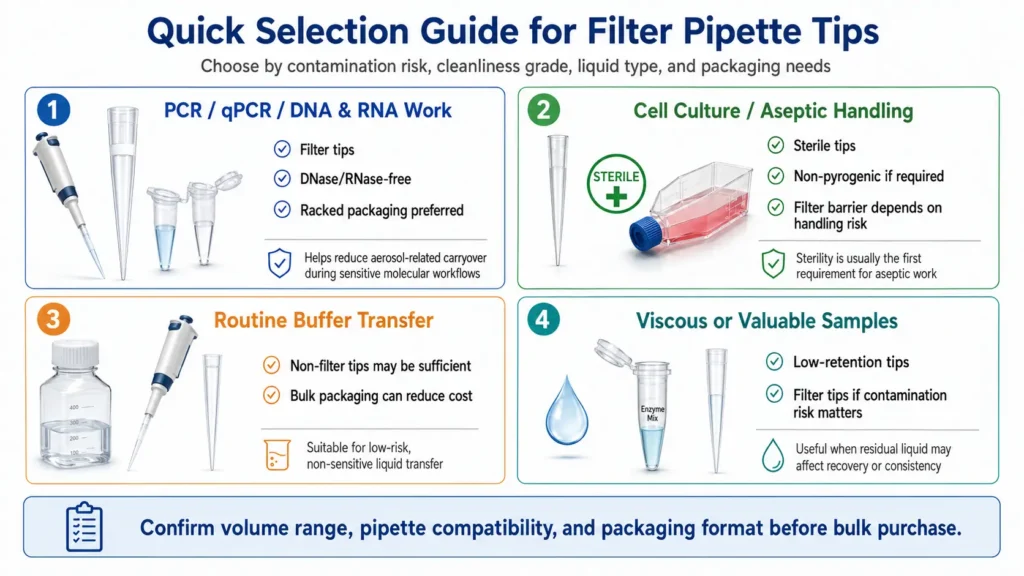
Quick Selection Decision Guide
Use the following questions to narrow the selection:
| Question | If Yes | If No |
|---|---|---|
| Is the workflow sensitive to aerosol-related carryover, such as PCR, qPCR, nucleic acid work, or clinical sample preparation? | Choose filter pipette tips | Non-filter tips may be sufficient for routine low-risk transfer |
| Does the workflow require aseptic handling, such as cell culture, sterile sample handling, or microbiology work? | Choose sterile packaging | Non-sterile packaging may be acceptable if sterility is not required |
| Does the workflow involve DNA, RNA, PCR, qPCR, RT-qPCR, or enzyme-based molecular biology work? | Choose DNase/RNase-free tips | Standard cleanliness may be sufficient for non-nucleic-acid work |
| Are you handling viscous liquids, enzyme mixes, protein solutions, detergents, or small valuable samples? | Consider low-retention tips | Standard tips may be sufficient for routine aqueous liquids |
| Will the tips be used with multichannel pipettes or several pipette brands? | Request samples and check seal fit before bulk purchase | Standard compatibility information may be enough for simple single-pipette use |
In simple terms, PCR, qPCR, and nucleic acid workflows usually require filter tips with DNase/RNase-free control and clean racked packaging. Cell culture workflows usually prioritize sterile packaging, and the need for a filter barrier depends on the specific handling risk. Routine buffer transfer may not require filter tips if contamination risk is low. For viscous liquids or small valuable samples, low-retention tips may improve liquid recovery and transfer consistency.
For laboratories with multiple workflows, one type of filter tip may not be enough. A molecular biology area may require sterile DNase/RNase-free racked filter tips, while a general preparation area may use bulk filter tips for routine transfer. Separating these needs helps avoid both overbuying premium tips for low-risk work and under-specifying tips for sensitive applications.
It is also helpful to request product samples before standardizing a supplier, especially when switching brands or purchasing large quantities. During evaluation, users should check tip loading, seal fit, liquid aspiration, dispensing consistency, ejection, and comfort during repeated use. For multichannel pipettes, consistency across all channels should be checked carefully.
Price should be considered, but it should not be the only deciding factor. In daily laboratory work, poor fit, inconsistent sealing, excessive residual liquid, or unsuitable packaging can create hidden costs through repeated work, wasted samples, and user frustration. A well-chosen filter pipette tip should support stable operation, appropriate contamination control, and reliable supply over time.For broader purchasing, laboratories can also review related filter consumables when standardizing pipetting supplies.
For B2B procurement, the most practical question is not simply “Which tip is cheapest?” but “Which tip specification fits our laboratory use with the least unnecessary risk?” That approach usually leads to a more stable purchasing decision.
Final Advice: Choose Filter Pipette Tips by Workflow, Not by One Specification
Choosing filter pipette tips should not start and end with volume size or price. In real laboratory work, the better approach is to look at the full workflow: what type of sample is being handled, how sensitive the downstream result is, whether aerosol-related carryover is a concern, and which pipettes will be used every day.
For PCR, qPCR, RT-qPCR, and nucleic acid sample preparation, filter pipette tips are often a practical choice because they help reduce pipette-shaft contamination and sample carryover risk. In these workflows, DNase/RNase-free status, reliable packaging, and pipette compatibility may be just as important as the filter barrier itself.
For routine liquid transfer, buffer preparation, and other low-risk tasks, laboratories may not need the highest specification for every step. This is where cost control can be reasonable, as long as the selected tips still fit the pipettes properly and perform consistently.
In short, filter pipette tips should be selected as part of the complete laboratory workflow, not as a generic consumable. When volume range, cleanliness grade, surface property, compatibility, and packaging are considered together, the final choice is usually more stable, more practical, and easier to justify for routine use.
FAQ
What are filter pipette tips used for?
Filter pipette tips are used to reduce the risk of aerosol and liquid carryover entering the pipette shaft during aspiration. They are especially useful in PCR, qPCR, DNA/RNA work, clinical sample preparation, biological sample handling, and other workflows where contamination control matters.
The filter does not mainly work by filtering impurities out of the liquid sample. Its more practical role is to act as an aerosol barrier between the sample and the pipette.
Are filter pipette tips necessary for PCR and qPCR?
For PCR and qPCR, filter pipette tips are generally recommended, especially during master mix preparation, template addition, and positive control handling. Amplification-based assays are sensitive to carryover contamination, so reducing aerosol-related risk is important.
For less sensitive routine liquid transfer, filter tips may not always be necessary. The choice should depend on the workflow risk, sample value, and contamination-control requirements.
Are sterile filter tips the same as DNase/RNase-free tips?
No. Sterile and DNase/RNase-free describe different requirements.
Sterile tips are treated to reduce viable microorganisms. DNase/RNase-free tips are controlled for nuclease contamination, which is important for DNA and RNA workflows. A sterile tip should not automatically be assumed to be DNase/RNase-free unless the supplier clearly states it.
Can filter pipette tips be autoclaved?
Some filter pipette tips or refill systems may be autoclavable, but this depends on the product design, packaging, and manufacturer’s instructions. Pre-sterilized racked filter tips are generally intended to be used as supplied.
If autoclaving is required, laboratories should confirm whether the specific tip, rack, and filter material can tolerate the autoclave process without deformation, filter damage, or packaging issues.
Should I choose racked or bulk filter pipette tips?
Racked filter pipette tips are often preferred for PCR, qPCR, sterile workflows, and contamination-sensitive work because they reduce manual handling and make tip pickup easier.
Bulk filter tips are more economical and may be suitable for routine, non-sterile liquid transfer. However, they involve more handling and should be stored carefully to avoid contamination. For many labs, a practical approach is to use racked sterile filter tips for sensitive work and bulk tips for general routine tasks.
Can filter pipette tips be reused?
No. Filter pipette tips are designed for single use. Reusing them can affect both contamination control and pipetting consistency.
After use, liquid residue, aerosols, or sample material may remain inside the tip or on the filter barrier. The filter may also become partially wetted or blocked, which can affect airflow during aspiration and dispensing. In PCR, qPCR, RNA work, clinical samples, and other sensitive applications, a fresh tip should be used for each sample or transfer step where contamination risk matters.
How do I know whether filter pipette tips are compatible with my pipette?
The most reliable method is to test the tips on the pipettes actually used in the lab. Supplier compatibility information is a useful starting point, but real handling can vary between pipette brands, models, and even multichannel pipettes.
During testing, check whether the tip loads smoothly, seals without wobbling or dripping, aspirates consistently, and ejects cleanly. For multichannel pipettes, all channels should load evenly and form a consistent seal. If the tip requires excessive force or feels loose, it may not be the best choice for routine use.