Microcentrifuge tubes are used throughout small-volume laboratory work. They may hold a reagent aliquot for a few minutes, collect a pellet after centrifugation, support a DNA or RNA extraction step, or keep a protein sample organized before the next assay. Because they are familiar, inexpensive, and used every day, they are often chosen by size first — usually 1.5 mL or 2.0 mL.
That works for simple handling tasks, but it is not always enough for real sample preparation. A tube that performs well for a buffer aliquot may not be the best choice for vortexing, bead-based extraction, heating, high-speed microcentrifugation, or contamination-sensitive molecular biology work. In these situations, printed capacity is only one part of the decision. Working volume, headspace, cap stability, tube material, rack fit, rotor compatibility, cleanliness level, and sample recovery can all affect how reliably the tube performs.
This becomes more important when samples are limited, valuable, or difficult to repeat. With low-volume samples, even a small amount of evaporation, leakage, residue near the cap, pellet loss, or inconsistent recovery can influence the next step of the workflow. The tube may still look normal from the outside, but if it does not match how the sample is mixed, spun, heated, labeled, stored, or transferred, it can become a hidden weak point in the process.
For this reason, microcentrifuge tubes should be selected as part of the full sample preparation workflow, not as isolated plastic containers. The better question is not only “Which tube size do we need?” but “Will this tube provide enough working space, closure stability, accessory compatibility, and cleanliness for the way the sample is actually handled?”
This guide explains how to choose microcentrifuge tubes for routine laboratory sample preparation, with a focus on 1.5 mL microcentrifuge tubes, 2.0 mL alternatives, tube racks, holders, rotor compatibility, and bulk purchasing considerations.
What Are Microcentrifuge Tubes Used For?
Microcentrifuge tubes are mainly used for small-volume sample handling. Compared with 15 mL or 50 mL centrifuge tubes, they are chosen when the sample volume is lower, the handling step is more precise, and the process requires frequent opening, closing, mixing, spinning, labeling, or transfer between instruments.
In molecular biology laboratories, microcentrifuge tubes are often used during DNA and RNA extraction, nucleic acid precipitation, enzyme reactions, PCR or qPCR preparation, and spin-column processing. A single preparation sequence may use them to hold lysates, wash buffers, eluates, primers, enzymes, extracted nucleic acids, or other small-volume materials before downstream analysis.
They are also common in protein and cell-related work. A laboratory may use microcentrifuge tubes for small-scale lysate clarification, protein sample preparation, supernatant collection, pellet washing, reagent mixing, or temporary sample storage. When the sample is limited or the downstream measurement is sensitive, tube choice can affect how easily the sample is recovered after centrifugation, pipetting, or incubation.
Beyond molecular biology, these tubes support many routine bench tasks: aliquoting reagents, preparing small working solutions, organizing sample sets, storing short-term intermediates, or moving samples between a bench, centrifuge, heating block, ice bucket, and rack. In these situations, the tube is not only a container. It becomes part of the handling system that keeps the sample organized, accessible, and ready for the next step.
This is why microcentrifuge tube selection should be based on the actual workflow, not only the application name. A tube used for a simple reagent aliquot may not need the same cleanliness level, cap stability, or recovery performance as one used for RNA extraction, bead-based mixing, or high-speed microcentrifugation. A tube that sits well in a bench rack may still need to be checked for rotor fit, cap clearance, or heating block compatibility before it is used in a more demanding step.
For laboratories purchasing microcentrifuge tubes in bulk, this distinction matters. The most suitable tube is not simply the one that matches the expected sample volume. It should also match how the sample will be mixed, centrifuged, stored, labeled, transferred, and recovered throughout the sample preparation process.
Common Sizes: 0.5 mL, 1.5 mL, and 2.0 mL
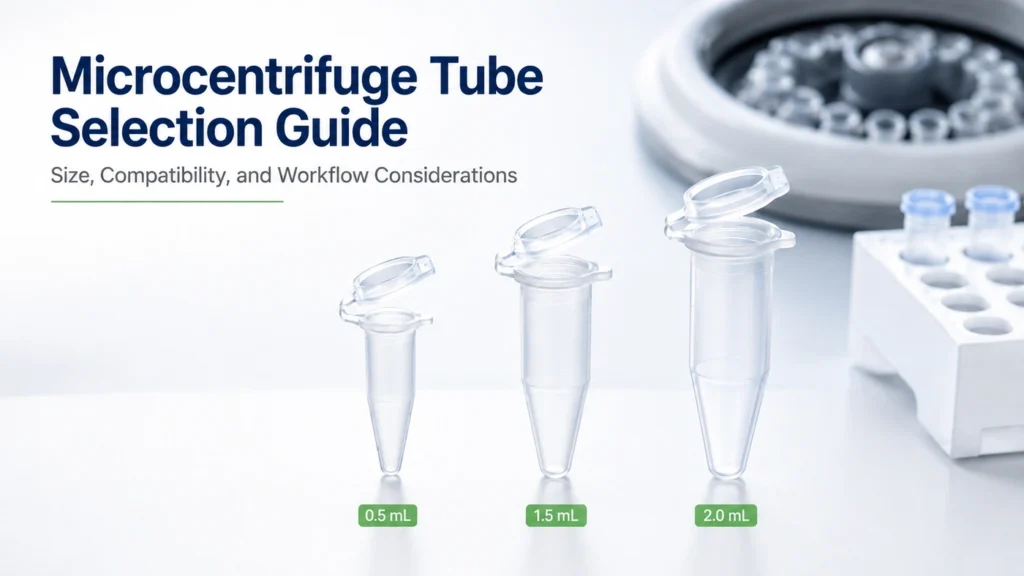
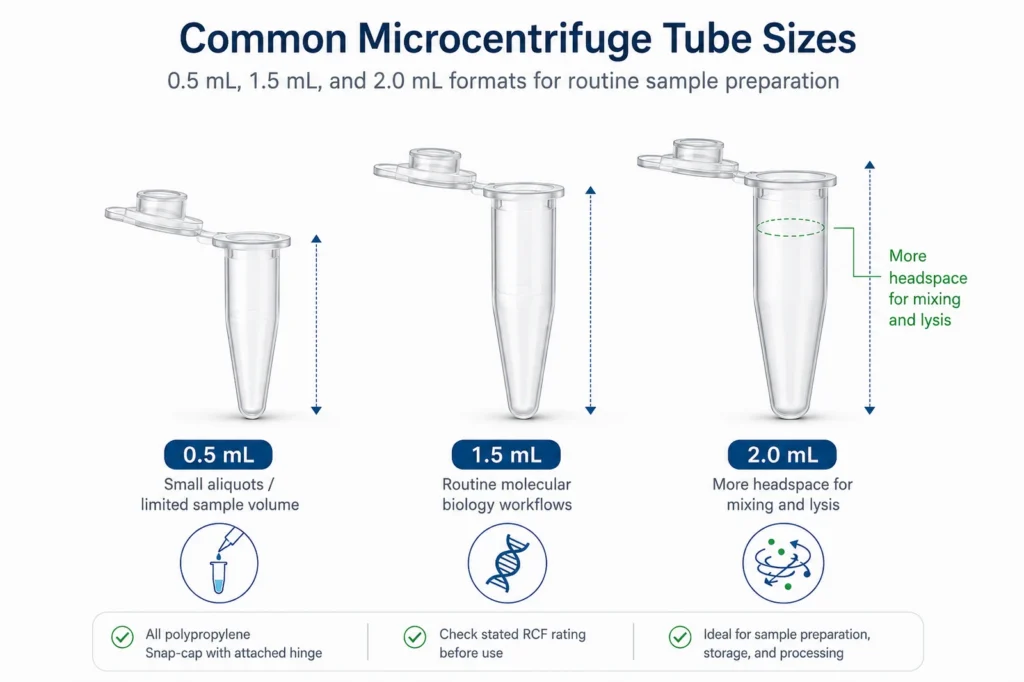
Microcentrifuge tubes are commonly supplied in 0.5 mL, 1.5 mL, and 2.0 mL formats. These sizes may look similar on the bench, but they do not always behave the same in a sample preparation workflow. The right choice depends on the actual liquid volume, required headspace, mixing method, centrifugation step, storage setup, and downstream handling needs.
A 0.5 mL microcentrifuge tube is usually selected for very small samples, reagent aliquots, enzyme handling, or workflows where reducing dead space is useful. It can be practical when only a small amount of liquid needs to be handled or stored. The trade-off is limited working space. If the workflow involves vigorous mixing, beads, foam, bubbles, or liquid movement toward the cap area, a larger tube may be easier to control.
The 1.5 mL microcentrifuge tube is the standard format in many molecular biology and routine sample preparation workflows. It offers enough capacity for common DNA, RNA, protein, buffer, and small-volume centrifugation steps while remaining easy to handle in many standard microcentrifuge racks and rotors. For many laboratories, 1.5 mL tubes become the default choice because they balance usable volume, bench convenience, pellet visibility, and equipment compatibility.
A 2.0 mL microcentrifuge tube is often chosen when the workflow needs more working space rather than simply more nominal capacity. The extra internal volume can be useful for lysis steps, bead-based extraction, vortexing, sample resuspension, or workflows where headspace matters. In some cases, using a 2.0 mL tube is more practical than filling a 1.5 mL tube close to its upper range. However, laboratories should still check rack fit, rotor compatibility, cap clearance, and heating block compatibility before switching formats.
The table below provides a general reference for common microcentrifuge tube sizes. Actual dimensions and RCF ratings may vary by manufacturer, resin grade, wall thickness, cap design, and rotor support, so these values should not replace the supplier’s technical specification.
| Tube Size | Typical Outer Diameter | Typical Height with Cap | Typical RCF Reference Range |
|---|---|---|---|
| 0.5 mL | ~8 mm | ~30–32 mm | Often around 12,000–20,000 × g |
| 1.5 mL | ~10–11 mm | ~38–40 mm | Often around 12,000–20,000 × g |
| 2.0 mL | ~10–11 mm | ~40–45 mm | Often around 12,000–20,000 × g |
These ranges are only a starting point for comparison. Before using microcentrifuge tubes for higher-speed centrifugation, laboratories should confirm the stated maximum RCF, rotor compatibility, fill volume guidance, and any application limits provided by the supplier.
The main point is that tube size should be judged by practical working volume, not printed capacity alone. A tube marked as 1.5 mL or 2.0 mL should not automatically be treated as suitable for that full volume under every condition. Mixing, centrifugation, heating, freezing, transport, and reagent behavior can all change how much usable space is appropriate.
For routine small-volume work, 1.5 mL microcentrifuge tubes are often efficient and widely compatible. For very small aliquots, 0.5 mL tubes can reduce unnecessary space. For workflows that involve stronger mixing, higher working volume, or bead-based processing, 2.0 mL tubes may provide a more comfortable margin. The best size is the one that fits how the sample is actually handled, not just how much liquid the tube can hold.
Why 1.5 mL Microcentrifuge Tubes Are Common in Routine Labs
The 1.5 mL microcentrifuge tube has become the default format in many routine laboratories because it matches the way small-volume samples are usually handled. It is large enough for many preparation steps, but still compact enough for bench racks, ice buckets, storage boxes, and microcentrifuge rotors. In daily work, that balance often matters more than the printed capacity itself.
Many molecular biology samples are handled well below the full volume of the tube. DNA and RNA eluates, enzyme mixtures, protein samples, cell lysates, wash fractions, and small reagent aliquots often need room for pipetting, brief mixing, centrifugation, and temporary storage, but not enough volume to justify a larger tube. A 1.5 mL tube gives enough space for these steps while keeping the sample easy to see, access, and recover.
Accessory compatibility is another reason this size is so common. Standard microcentrifuge racks, tube holders, floating racks, ice bucket inserts, benchtop organizers, and many microcentrifuge rotors are designed around the 1.5 mL format or a closely related size range. When a laboratory processes many samples at once, this compatibility reduces small but real interruptions: unstable tubes, awkward pipetting angles, unclear labeling, or unnecessary transfers between containers.
The geometry of a 1.5 mL tube can also help with small pellets and low-volume recovery. If the tube is much larger than the sample requires, a small pellet may be harder to locate, rinse, or resuspend. A familiar 1.5 mL format often gives a practical balance between handling space and sample concentration at the bottom of the tube, which is useful for routine pellet recovery, supernatant removal, and sample transfer.
Still, 1.5 mL tubes should not be treated as a universal answer. Protocols involving vigorous vortexing, bead-based extraction, larger lysis volume, heating, or frequent handling near the upper working range may require more space. In those cases, a 2.0 mL tube can be worth considering, provided that rack fit, rotor compatibility, and cap clearance are also checked.
For bulk purchasing, the standard size is a good starting point, not the whole decision. Laboratories should still confirm cap closure, material, cleanliness level, RCF rating, rack fit, rotor compatibility, packaging format, and application requirements before ordering. A familiar tube size is only reliable when it also matches the workflow conditions in which it will be used.
Working Volume, Headspace, and Cap Handling
When choosing microcentrifuge tubes, nominal volume is only the starting point. A tube marked as 1.5 mL or 2.0 mL indicates its approximate capacity, but it does not define the most suitable working volume for every workflow.
In real sample preparation, the more useful question is how much usable space remains after mixing, centrifugation, heating, pipetting, and cap closure are considered.
Headspace is part of that usable space. During vortexing, pipetting, inversion, heating, transport, or centrifugation, liquid may move along the tube wall or toward the cap area.
Simple aqueous buffers may be easy to manage, but foamy, viscous, detergent-containing, volatile, or recently mixed samples often need more room. A tube may physically hold a certain volume and still be inconvenient if the liquid sits too close to the closure during actual handling.
This is why 2.0 mL microcentrifuge tubes are sometimes selected even when the liquid volume is below 1.5 mL. The extra internal space can provide a better margin for lysis buffers, bead-based extraction, vigorous mixing, sample resuspension, or workflows where the sample may foam, expand, or move during processing.
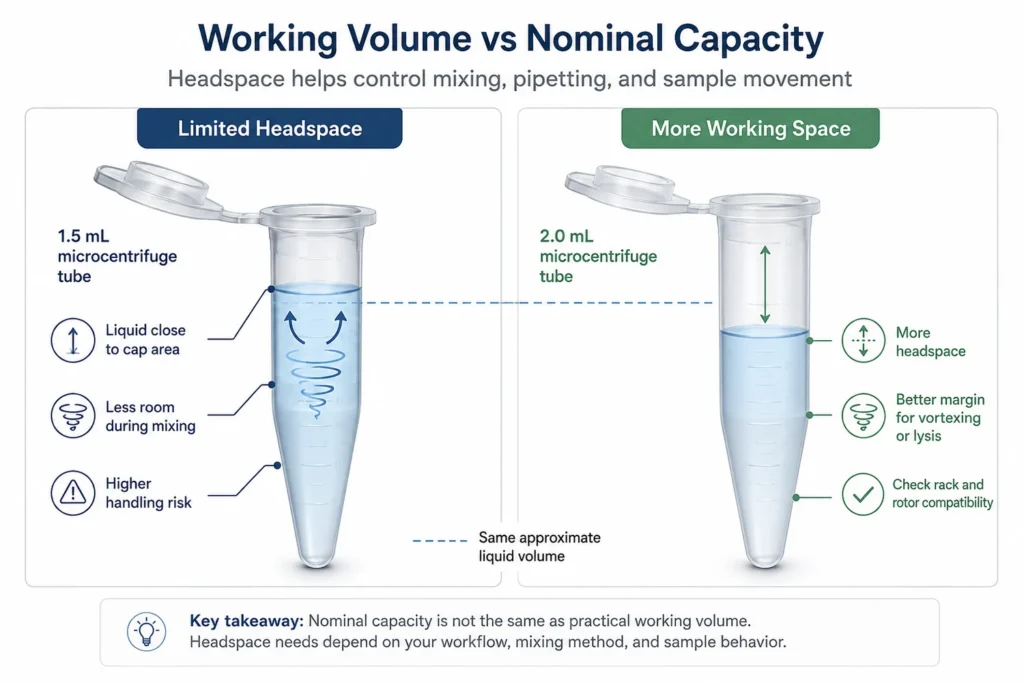
In these cases, the purpose of a larger tube is not to fill it to the top, but to give the sample enough room to move without making the workflow harder to control.
Cap handling is closely connected to working volume. Most microcentrifuge tubes use snap caps because they are convenient for frequent opening and closing during bench work. This is useful when a workflow involves repeated pipetting, reagent addition, incubation checks, or sample transfer.
Convenience still needs to be balanced with closure consistency. The cap should close firmly, sit evenly, and remain suitable for the intended centrifugation, heating, storage, or handling step.
For simple aliquoting or short-term storage, cap demands may be relatively low. For vortexing, heating, bead beating, high-speed microcentrifugation, or valuable samples, cap stability becomes more important.
A cap that feels loose, closes unevenly, or becomes less consistent after repeated opening should not be ignored, especially when sample recovery or contamination control matters. For related causes of leakage during centrifugation or handling, see our guide on why centrifuge tubes leak.
Headspace also affects pipetting and recovery. If a tube is filled too close to the top, inserting a pipette tip, mixing the sample, or removing supernatant can become less controlled. Residue near the cap area may increase the chance of carryover, contamination, or volume inconsistency.
At the same time, using a tube that is much larger than needed may make very small pellets harder to locate or recover. The right tube size should leave enough room for safe handling without creating unnecessary dead space.
Microcentrifuge tubes should therefore be chosen by working volume, not nominal volume alone. For low-volume aliquots and routine sample preparation, 1.5 mL tubes are often efficient and widely compatible. For workflows involving stronger mixing, bead-based processing, higher liquid movement, or operation near the upper working range, 2.0 mL tubes may provide a better handling margin.
In both cases, cap fit, tube quality, and supplier specifications should be checked before the tubes are used in demanding workflows.
Material, Cleanliness, and Molecular Biology Requirements
Most routine microcentrifuge tubes are made from polypropylene. For small-volume sample preparation, polypropylene is widely used because it offers a useful balance of flexibility, durability, and chemical resistance. It is suitable for many common buffers, salts, alcohol-containing solutions, and molecular biology reagents, although compatibility should still be checked when the workflow involves strong solvents, unusual reagents, long exposure times, or elevated temperatures.
Material matters because a microcentrifuge tube is rarely used for simple static storage only. In the same workflow, it may be vortexed, centrifuged, placed on ice, moved into a heating block, opened repeatedly, or exposed to extraction buffers. The tube material needs to tolerate these handling conditions without creating problems for sample recovery, closure behavior, or downstream analysis.
Not all polypropylene microcentrifuge tubes are produced for the same level of use. General-purpose polypropylene tubes may be suitable for routine buffer aliquoting, sample organization, and non-critical centrifugation. For molecular biology, clinical, low-recovery, or contamination-sensitive workflows, buyers may need to review whether the product is described as molecular biology grade, medical grade, sterile, DNase/RNase-free, low-retention, or supported by relevant quality documentation. These descriptions should be checked against the supplier’s actual product information rather than assumed from the tube size alone.
For molecular biology workflows, cleanliness level can be just as important as tube size. DNA and RNA work may require tubes supplied as DNase-free and RNase-free. Protein workflows may need low-binding or low-retention options when adsorption to the tube wall could affect recovery or measurement consistency. Cell-related, clinical, or contamination-sensitive applications may require sterile packaging or additional quality documentation. These features should not be assumed from the product name alone.
The same 1.5 mL microcentrifuge tube size may be available in different grades. A general-purpose tube may work well for simple aliquoting or routine sample handling, but it may not be appropriate for RNA extraction, enzyme handling, low-concentration protein samples, or contamination-sensitive assays. In those workflows, surface properties, cleanliness claims, and packaging format become part of the selection decision.
Sterility should also be matched to the application. Sterile microcentrifuge tubes may be needed for cell culture materials, clinical samples, microbial workflows, or other processes where contamination could affect the result. Non-sterile tubes may be acceptable for general laboratory tasks, reagent preparation, or workflows where sterility is not required. For bulk purchasing, buyers should confirm whether tubes are sterile or non-sterile, whether they are supplied in bulk bags, racks, boxes, or individual packaging, and whether the packaging format fits the way the tubes will be used.
Low-retention or low-binding tubes should be selected when the application actually benefits from them. They may be useful for low-volume nucleic acid samples, dilute protein solutions, enzymes, peptides, or other materials where sample loss on the tube wall could affect recovery. However, not every routine workflow needs low-retention tubes, and not every microcentrifuge tube has the same surface behavior. The requirement should come from the sample type and downstream assay, not from the assumption that a more specialized tube is always better.
In practice, material and cleanliness should be chosen according to workflow sensitivity. Standard polypropylene tubes may be enough for simple sample handling. DNA, RNA, protein, cell-related, or contamination-sensitive workflows require closer review of DNase/RNase-free status, sterility, low-retention options, packaging format, and relevant quality information before purchasing. In small-volume sample preparation, these details can directly affect recovery, contamination control, and confidence in the final result.
Microcentrifuge Tube Rack, Holder, and Rotor Compatibility
Microcentrifuge tubes are rarely used by themselves. During routine sample preparation, they move between tube racks, holders, ice buckets, heating blocks, storage boxes, and microcentrifuge rotors. For this reason, tube selection should not stop at volume, material, or cap style. A tube that looks suitable on the product page can still create daily handling problems if it does not fit the accessories and instruments used in the workflow.
A microcentrifuge tube rack is one of the simplest accessories in the lab, but it has a direct effect on sample organization and pipetting stability. A good rack keeps tubes upright, separates sample positions, supports labeling, and allows users to open caps, pipette, mix, and transfer samples without unnecessary movement. When the rack fit is poor, tubes may tilt, rotate, sit too loosely, or become harder to identify during batch handling. These small issues can increase the risk of pipetting error, sample mix-up, cap contamination, or avoidable sample transfer.
Tube diameter and height are the first details to check. Many racks are designed for common 0.5 mL, 1.5 mL, or 2.0 mL microcentrifuge tubes, but not every rack supports every format equally well. A rack that holds 1.5 mL tubes securely may not provide the same stability for taller or wider 2.0 mL tubes. Some racks are made for mixed sizes, while others are optimized for one tube format. If a laboratory uses both 1.5 mL and 2.0 mL tubes, rack fit should be tested before bulk purchasing.
A microcentrifuge tube holder is often used for smaller sample sets, quick bench organization, short transport, or temporary positioning during pipetting. Compared with a full rack, a holder is usually chosen when only a limited number of tubes need to stay accessible. The same basic requirements apply: the tube should sit upright, remain stable during pipetting, allow the cap to open without interference, and keep labels or written marks visible enough for accurate sample identification.
Rack and holder design also matters in cold handling and incubation steps. Tubes may be placed in ice buckets, floating racks, chill blocks, or heating blocks during sample preparation. In these situations, compatibility is not only about whether the tube fits into an opening. The tube should sit at a suitable depth, make appropriate contact with the block or support surface, and leave the cap accessible. If the tube sits too high, too low, or too loosely, temperature control and handling consistency may become less reliable.
Rotor compatibility should be checked separately. A tube that fits a bench rack does not automatically fit a microcentrifuge rotor correctly. Rotor fit depends on tube shape, bottom profile, cap clearance, wall support, maximum RCF rating, and the rotor manufacturer’s recommendations. Poor support may lead to uneven seating, vibration, cap interference, deformation, or inconsistent sample recovery during centrifugation. For higher-speed microcentrifugation, laboratories should check both the tube’s stated RCF rating for centrifuge tubes and its suitability for the intended rotor.
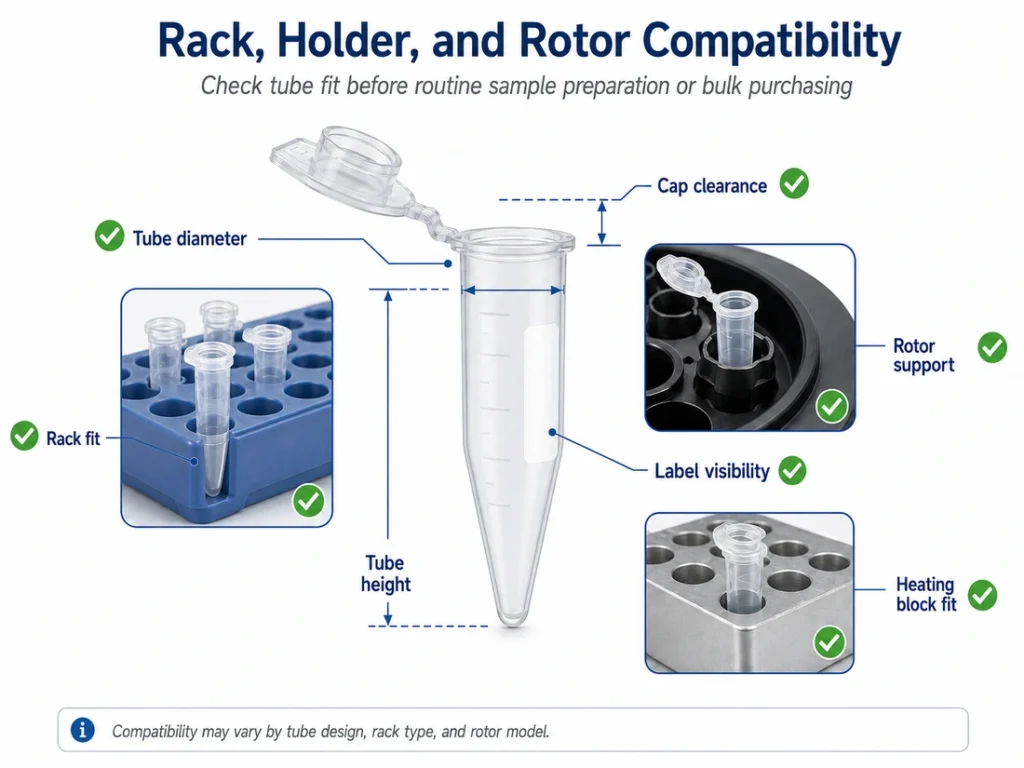
Cap clearance is another practical detail, especially when switching from standard 1.5 mL tubes to 2.0 mL tubes or to tubes with larger cap designs. A cap that touches a rotor lid, blocks neighboring positions, or interferes with one-hand opening in a rack can slow down the workflow even if the tube volume is correct. This becomes more noticeable when many samples are processed at the same time.
Label visibility should also be considered. In sample preparation workflows, tubes may be marked on the cap, sidewall, or label area. A suitable rack or holder should allow users to read position numbers, tube markings, and sample labels without repeatedly removing tubes. This is especially useful in DNA/RNA extraction, protein preparation, clinical sample handling, or any workflow where sample identity must be maintained across several steps.
For bulk purchasing, microcentrifuge tubes should be selected with the accessory system in mind. Laboratories should check whether the tube fits the rack, holder, heating block, cold block, storage box, and rotor used in daily work. Stable rack fit improves bench efficiency, while correct rotor support helps maintain centrifugation safety and consistency. Checking these details before purchase can prevent sample handling problems that are difficult to fix after the tubes arrive.
How to Choose Tubes for Different Sample Preparation Workflows
Different sample preparation workflows place different demands on microcentrifuge tubes. A tube used for simple reagent aliquoting does not need the same specifications as one used for RNA extraction, bead-based mixing, protein recovery, heating, or high-speed microcentrifugation. The more sensitive or stressful the workflow is, the more carefully the tube’s cleanliness level, headspace, cap stability, surface properties, and equipment compatibility should be reviewed.
Quick Selection Guide
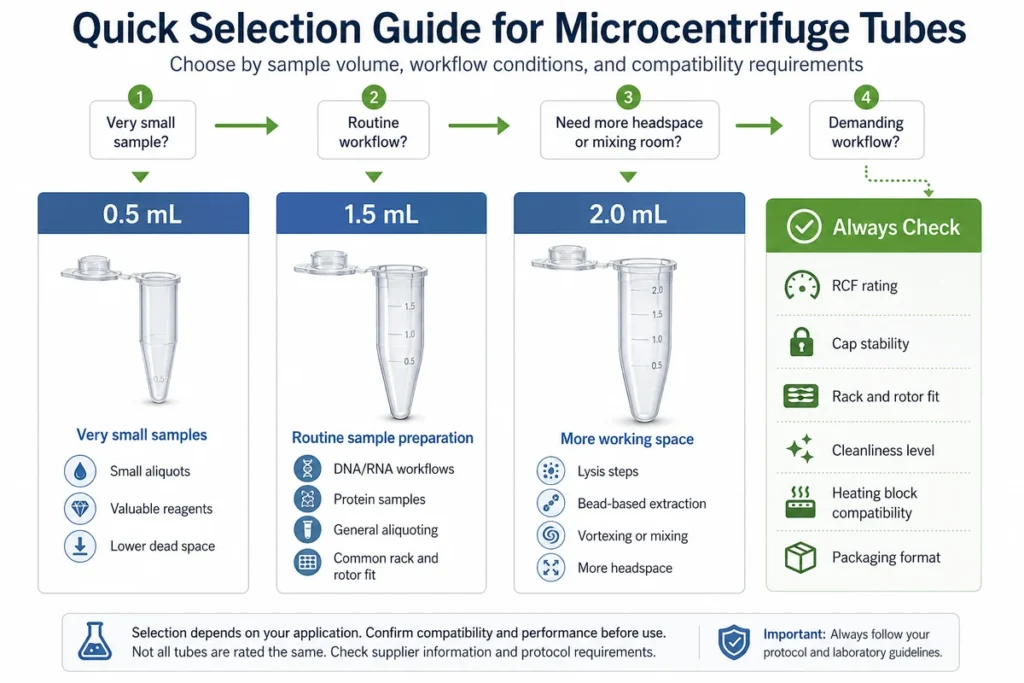
For a quick preliminary choice, laboratories can start with the sample volume and handling method:
- Very small samples or valuable reagents: 0.5 mL tubes may reduce unnecessary dead space and keep low-volume samples easier to manage.
- Routine DNA/RNA, protein, buffer, and general sample preparation: 1.5 mL tubes are often the most practical starting point because they are widely compatible with standard racks, holders, and rotors.
- Bead-based extraction, lysis, vigorous vortexing, or workflows needing more headspace: 2.0 mL tubes may provide a better working margin.
- Heating, high-speed centrifugation, or contamination-sensitive workflows: tube size alone is not enough; cap stability, RCF rating, cleanliness level, and accessory compatibility should also be checked.
This guide should not replace the protocol or supplier specification, but it helps narrow the selection before comparing detailed tube options.
For routine aliquoting and general sample organization, convenience is usually the main priority. The tube should be easy to open and close, stable in a rack, clear enough for checking approximate liquid level, and suitable for labeling or marking. Standard 1.5 mL microcentrifuge tubes are often practical for these tasks because they fit many common racks and holders while providing enough space for small working solutions, buffers, and temporary sample sets.
DNA and RNA extraction place more emphasis on cleanliness and contamination control. Laboratories should confirm whether the tubes are supplied as DNase-free and RNase-free, especially when samples are low concentration, difficult to replace, or used for sensitive downstream analysis. Tube compatibility with spin-column steps, alcohol-containing buffers, repeated pipetting, and short centrifugation steps should also be considered. In RNA workflows, minimizing unnecessary transfer and contamination risk may matter more than choosing the lowest-cost tube.
Protein sample preparation may require closer attention to recovery and surface interaction. Standard polypropylene tubes are suitable for many routine protein workflows, but low-binding or low-retention options may be worth considering for dilute proteins, enzymes, peptides, or small-volume samples where adsorption to the tube wall could affect measurement consistency. This requirement should come from the application itself and be supported by product specifications, rather than assumed for every microcentrifuge tube.
Bead-based extraction, lysis, and vigorous mixing create a different set of concerns. These workflows may involve vortexing, shaking, bead movement, foaming, or higher mechanical stress than simple aliquoting. A 2.0 mL microcentrifuge tube may provide a better working margin when the liquid volume, beads, and mixing movement need additional space. In these cases, the tube should close securely, leave enough headspace, and remain compatible with the intended rack, holder, mixer, or rotor.
Heating, incubation, and temperature-change steps also deserve caution. The tube should fit the heating block or temperature-control device properly, and the cap should remain stable under the intended conditions. Not all microcentrifuge tubes are suitable for every heating, freezing, or autoclaving condition, so temperature use should be checked against supplier information. If the workflow involves heating close to the cap area, limited headspace, volatile reagents, or repeated temperature cycling, tube selection should be more conservative.
For small-volume centrifugation, the tube should match the intended RCF, rotor type, fill volume, and sample behavior. Many microcentrifuge tubes are used for quick spins, pellet collection, lysate clarification, or recovery after extraction steps. However, the maximum RCF rating should not be treated as the only selection factor. Rotor support, cap clearance, tube seating, sample density, and spin duration can all influence whether the tube remains reliable in the actual workflow.
Short-term storage and transfer steps may look simple, but they still affect sample handling quality. The tube should remain upright, be easy to identify, and reduce unnecessary opening or transfer between containers. If samples are sensitive to contamination, evaporation, adsorption, or temperature exposure, laboratories should choose a tube and packaging grade that matches those risks instead of using the same general-purpose tube for every step.
In practice, microcentrifuge tube selection should follow the workflow risk level. Low-risk aliquoting may only require a standard tube with good rack fit and convenient handling. Molecular biology, protein recovery, bead-based processing, heating, or high-speed centrifugation may require closer confirmation of cleanliness level, surface properties, headspace, cap stability, RCF rating, and equipment compatibility. The more sensitive the downstream result, the more important these small tube-related details become.
Procurement Checklist for Bulk Microcentrifuge Tubes
When laboratories purchase microcentrifuge tubes in bulk, the decision should be more structured than choosing a familiar size or the lowest available price. Small differences in tube volume, cap fit, cleanliness level, packaging, and accessory compatibility may not seem important during ordering, but they can affect daily sample preparation once the tubes are in routine use.
Start with the tube volume. Many laboratories use 1.5 mL microcentrifuge tubes as the standard format, but this does not make them the best choice for every workflow. Larger lysis volumes, bead-based processing, vigorous mixing, or repeated handling near the upper working range may justify 2.0 mL tubes. Very small aliquots or limited sample volumes may be better handled in 0.5 mL tubes. For purchasing, the key is to match the tube to the practical working volume, not only the nominal capacity.
Material and cleanliness level should be reviewed before ordering. Polypropylene is commonly used for routine microcentrifuge tubes, but applications involving unusual reagents, temperature exposure, centrifugation, or storage conditions may require closer review. For molecular biology, clinical, cell-related, or contamination-sensitive work, buyers should confirm whether the tubes are sterile or non-sterile, DNase-free, RNase-free, pyrogen-free, low-retention, or supplied with relevant documentation.
Cap design is another practical detail. Snap-cap microcentrifuge tubes are convenient for routine bench handling, but workflows involving vortexing, heating, centrifugation, transport, or valuable samples require more attention to closure consistency. The cap should close firmly, open without excessive force, and remain suitable for repeated handling if the protocol requires frequent access.
Centrifugation use should be checked from both the tube and equipment side. The stated RCF rating should match the intended microcentrifuge conditions, but the rating should not be read in isolation. Tube seating, rotor support, fill volume, spin duration, cap clearance, and sample type can all influence practical performance. Laboratories using tubes for higher-speed centrifugation should avoid treating maximum RCF as the routine working target for every protocol.
Accessory compatibility is also part of bulk purchasing. The tube should fit the microcentrifuge tube rack, tube holder, cold block, heating block, storage box, and rotor used in the laboratory. If both 1.5 mL and 2.0 mL tubes are being purchased, buyers should check whether existing racks and rotors support both formats. A tube that does not sit securely in the rack or rotor can slow down sample preparation and increase handling risk.
Packaging format should match how the laboratory actually consumes tubes. Bulk bags may be efficient for high-throughput routine work, while racked, boxed, sterile, or individually wrapped formats may be preferred for cleaner workflows or controlled sample handling. Buyers should also review carton quantity, inner packaging, lot traceability, shelf-life information if applicable, MOQ, lead time, and shipping requirements.
Before placing a bulk order, laboratories can use the following checklist:
- Confirm tube volume: 0.5 mL, 1.5 mL, 2.0 mL, or other required formats.
- Check practical working volume and headspace requirements.
- Confirm tube material, usually polypropylene for routine microcentrifuge tubes.
- Decide whether sterile or non-sterile supply is required.
- Confirm DNase-free and RNase-free status for molecular biology workflows.
- Consider low-retention or low-binding options if sample recovery is critical.
- Review cap type, cap fit, and closure consistency.
- Check maximum RCF rating and intended centrifugation conditions.
- Confirm rack, holder, heating block, cold block, storage box, and rotor compatibility.
- Check labeling area, cap marking, or sidewall writing space.
- Confirm packaging format, carton quantity, MOQ, lead time, and available documentation.
For B2B purchasing, the best microcentrifuge tube is not simply the cheapest tube that matches the required size. It is the tube that fits the laboratory’s sample preparation workflow, quality requirements, accessory system, packaging preference, and purchasing schedule. Confirming these details before ordering helps reduce specification mismatches, handling problems, and avoidable interruptions after the tubes arrive. For related troubleshooting points, see our guide to common centrifuge tube problems.
Final Advice: Choose Microcentrifuge Tubes as Part of the Workflow
Microcentrifuge tubes may look like simple consumables, but they sit at many important points in small-volume sample preparation. A tube may be used for aliquoting, mixing, centrifugation, heating, extraction, pellet recovery, temporary storage, labeling, or transfer between different accessories and instruments. For that reason, the best tube choice is rarely based on volume alone.
A familiar 1.5 mL microcentrifuge tube is often the most efficient option for routine laboratory work because it fits many common racks, holders, rotors, and sample preparation steps. When a protocol needs more headspace, stronger mixing tolerance, bead-based processing, or larger lysis volume, a 2.0 mL tube may provide a better working margin. For very small aliquots, a 0.5 mL tube may reduce unnecessary dead space.
The same logic applies to material, cleanliness, and compatibility. Sensitive molecular biology or protein workflows may require DNase/RNase-free, sterile, low-retention, or other specified tube options. Centrifugation, heating, cold handling, and storage steps may require closer attention to cap stability, RCF rating, rack fit, rotor support, and packaging format.
A practical way to choose microcentrifuge tubes is to start from the workflow and work backward. Identify the sample volume, mixing method, centrifugation condition, temperature exposure, cleanliness requirement, rack or holder system, and packaging preference. Then select the tube size and specification that fit those conditions.
For bulk purchasing, the final question is simple: will this tube remain practical and consistent across the way the laboratory actually prepares samples? If the answer is yes, the tube is more likely to support smooth sample preparation, reliable handling, and fewer avoidable interruptions in routine laboratory work.
If you need to compare microcentrifuge tube sizes, packaging options, cleanliness levels, or compatibility requirements for bulk purchasing, contact our team for product specifications and quotation support.
FAQ
What are microcentrifuge tubes used for?
Microcentrifuge tubes are used for small-volume sample preparation, including DNA and RNA extraction, protein handling, reagent aliquoting, short centrifugation steps, pellet recovery, spin-column workflows, and temporary sample storage. They are useful when samples need to be mixed, spun, labeled, transferred, or organized in small volumes. Tube selection should match the actual workflow, including working volume, cap stability, rack fit, rotor compatibility, and cleanliness requirements.
What is the most common microcentrifuge tube size?
The 1.5 mL microcentrifuge tube is one of the most common formats in routine laboratories. It fits many standard sample preparation workflows, microcentrifuge racks, tube holders, and rotors. It is widely used for DNA, RNA, protein samples, reagent aliquots, and short centrifugation steps. However, 1.5 mL tubes are not suitable for every workflow. When extra headspace, larger lysis volume, or stronger mixing is needed, 2.0 mL tubes may be more practical.
What is the difference between 1.5 mL and 2.0 mL microcentrifuge tubes?
The main difference is practical working space. A 1.5 mL microcentrifuge tube is commonly used for routine small-volume handling because it is widely compatible with standard racks, holders, and rotors. A 2.0 mL microcentrifuge tube provides more headspace, which can be useful for bead-based extraction, vortexing, lysis steps, sample resuspension, or workflows where liquid movement is expected. The choice should be based on working volume and workflow conditions, not printed capacity alone.
Can 1.5 mL and 2.0 mL microcentrifuge tubes use the same rack?
It depends on the rack design. Some microcentrifuge tube racks are made with compatible wells for both 1.5 mL and 2.0 mL tubes, while others are optimized mainly for one format. Because 2.0 mL tubes may be taller or slightly different in cap profile, laboratories should test rack fit, tube stability, cap opening space, and label visibility before using both sizes in the same rack for routine work.
Do microcentrifuge tubes need a special rack or holder?
Microcentrifuge tubes should be used with racks or holders that match their size, diameter, height, and handling requirements. A suitable microcentrifuge tube rack keeps tubes upright, improves sample organization, supports labeling, and makes pipetting more stable. Some racks are designed mainly for 1.5 mL tubes, while others can hold 0.5 mL, 1.5 mL, and 2.0 mL formats. Before bulk purchasing, laboratories should also check compatibility with heating blocks, cold blocks, storage boxes, and rotors.
Are microcentrifuge tubes DNase-free and RNase-free?
Some microcentrifuge tubes are supplied as DNase-free and RNase-free for molecular biology workflows, but this should not be assumed for every product. Laboratories working with DNA, RNA, enzymes, low-concentration samples, or contamination-sensitive assays should confirm the cleanliness level through supplier specifications, certificates, or product documentation. Sterile, non-sterile, low-retention, pyrogen-free, and other quality options may also vary by product and packaging format.
Can microcentrifuge tubes be centrifuged at high speed?
Many polypropylene microcentrifuge tubes are designed for routine microcentrifugation, including short high-speed spins, but the actual maximum RCF depends on tube design, material, cap structure, rotor support, fill volume, and supplier specification. Laboratories should confirm the stated RCF rating before use and avoid treating the maximum rating as a routine working target. For demanding workflows, rotor compatibility, cap clearance, spin duration, sample density, and working volume should also be reviewed.
Can microcentrifuge tubes be reused?
Most microcentrifuge tubes are intended for single use, especially in molecular biology, protein, clinical, or contamination-sensitive workflows. Reuse may increase the risk of sample residue, cross-contamination, reduced cap consistency, unclear labeling, or tube wall damage after centrifugation or heating. For low-risk non-critical tasks, some laboratories may reuse tubes under internal procedures, but this should be evaluated carefully. For RNA extraction, quantitative assays, protein recovery, clinical samples, or high-speed centrifugation, using new tubes is the safer choice.