

Introduction
In many molecular biology workflows, PCR tubes are easy to overlook. Most technicians focus on optimizing enzymes, reaction mixes, or cycling conditions, assuming the tube itself is a fixed and neutral component. Yet anyone who routinely runs PCR or qPCR knows that small differences in tube construction—how uniform the walls are, how the cap seals, or how clear the plastic appears under the instrument—can subtly shift the behavior of a reaction. These effects aren’t dramatic, but they are consistent enough that labs often compare tube types when they notice unusual ramping efficiency or variability across replicates. Understanding how different formats and materials influence heat transfer and optical performance helps ensure that each run starts from stable, predictable conditions rather than avoidable sources of noise.
What Are PCR Tubes?
PCR tubes are thin-walled polypropylene vessels built to withstand the rapid temperature shifts that define thermal cycling. Although the design looks straightforward, the geometry and material quality play a larger role than many expect. A tube that transfers heat efficiently from the block or heated lid helps the reaction mix reach denaturation, annealing, and extension temperatures without unnecessary lag—something you notice quickly when comparing results across different tube brands. Medical-grade polypropylene is used for most tubes because it offers the chemical inertness and mechanical stability required for reliable enzyme activity.
In terms of structure, PCR tubes usually have a conical lower chamber that pools the reaction mixture and a cap engineered to seal evenly across the rim. This small interface becomes surprisingly important for preventing evaporation during long or high-temperature cycles. Depending on how a lab works, tubes may be used individually in the standard 0.2 mL size, in low-profile 0.1 mL formats, or as linked strip tubes that make high-throughput setups easier to handle. For qPCR specifically, optical clarity and cap flatness matter just as much as thermal performance, since even minor imperfections can affect fluorescence detection and downstream quantification.
Types of PCR Tubes

PCR tubes coPCR tubes come in several formats, each addressing a slightly different set of thermal, optical, or workflow requirements. They all serve the same purpose—providing a stable microenvironment for amplification—but in practice the shape, volume, and cap design of a tube can influence everything from heat transfer to how smoothly a run is set up. Most labs end up using more than one format depending on the type of assay and the number of samples they handle on a given day.
0.2 mL Individual PCR Tubes
The 0.2 mL tube is the default choice in many labs simply because it fits most cyclers and accommodates the reaction volumes used in standard PCR. It’s a practical option for routine cloning, genotyping, and endpoint assays where throughput is moderate. Many technicians appreciate the flexibility of individual tubes—when only a few reactions are needed, you can set them up without committing to a full strip or wasting additional wells.
Low-Profile / 0.1 mL PCR Tubes
Low-profile tubes are a different story. By reducing the headspace between the reaction mix and the heated lid, they help reactions reach target temperatures more quickly and uniformly. This often becomes noticeable in qPCR, where small temperature differences can affect fluorescence curves or Ct values. With volumes typically at 10–20 µL, the fast heat transfer of 0.1 mL tubes tends to produce more consistent amplification, especially in rapid-cycling protocols.
PCR Strip Tubes
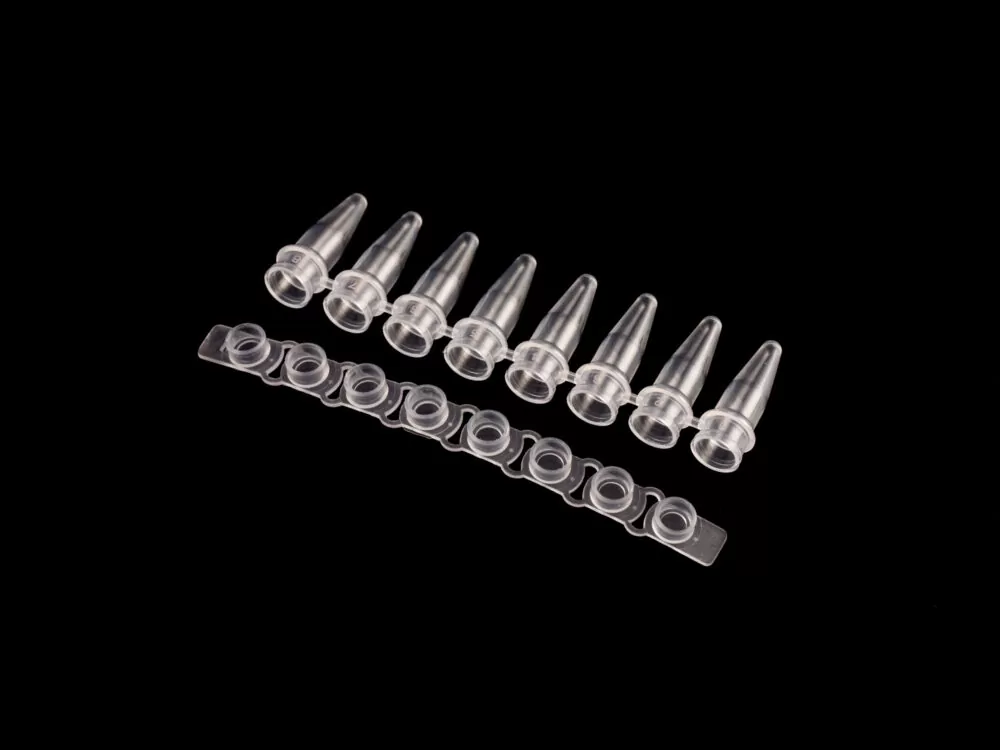
Strip tubes connect multiple reaction chambers into a single piece, which simplifies high-throughput setups and reduces pipetting variation across large batches. They’re a common sight in diagnostic workflows or screening experiments where dozens of samples must move through the protocol at the same pace. One practical benefit is that tubes within a strip often experience more uniform heating than individually placed tubes, particularly near the edges of the block.
For labs that routinely process many samples in parallel, PCR tubes(Kelabscience) offer a convenient and consistent format for maintaining workflow efficiency and reproducibility.
PCR Tubes with Attached Caps
Attached-cap tubes are mainly about convenience and contamination control. Keeping the cap tethered to the tube reduces the chance of mixing up lids or exposing open tubes to aerosols—issues that frequently arise in teaching labs or shared environments. These tubes can also make fast-paced setups smoother, since users don’t have to match each cap with its corresponding reaction.
Flat Caps vs. Domed Caps
Cap geometry has more impact than most new users expect.
- Domed caps allow the heated lid to apply slightly more even pressure, which can help with thermal contact in standard PCR.
- Flat caps are preferred for qPCR because they provide a uniform, optically clear surface for fluorescence readings and are compatible with sealing films.
The choice typically comes down to what the assay prioritizes: heat efficiency or optical performance.
Materials and Construction
PCR tubes are almost always made from medical-grade polypropylene (PP), a material chosen because it stays stable across wide temperature swings and doesn’t interact with enzymes or nucleic acids. But the polymer itself is only part of the story. In day-to-day laboratory use, differences in molding precision often matter more than the raw material. High-quality tubes come from tightly controlled injection-molding processes that keep wall thickness consistent and produce smooth internal surfaces, reducing the chance of uneven heat transfer or localized hotspots.
Thin walls are essential for proper cycling performance. Even small variations—barely noticeable to the eye—can change how quickly the reaction mix responds to block temperature changes. This becomes especially apparent in fast-cycling protocols or assays that rely on narrow annealing windows. To minimize setup variability, many labs pair their PCR workflows with filter pipette tips(Kelabscience), which help prevent aerosol contamination during reaction preparation and support more reproducible sample handling. Modern tubes are therefore engineered with micrometer-scale uniformity to help reactions reach their target temperatures without unnecessary lag.
For qPCR, optical characteristics become just as important as thermal ones. Tubes used for fluorescence detection need to be highly transparent and exhibit minimal background autofluorescence; otherwise, the instrument may misread weak signals or generate additional noise. Flat caps and optical-grade cap strips are typically produced with enhanced clarity to support stable, cycle-to-cycle quantification.
Cap integrity is another part of the construction that has practical consequences. A cap that seals evenly across the rim helps maintain reaction volume and reduces the risk of concentration drift during long or high-temperature runs. Small differences in hinge flexibility or closure angle can change how well the cap engages the tube, which is why consistent molding tolerances are important for reproducible results across multiple batches.
Performance Considerations for PCR and qPCR
The performance of PCR tubes ultimately depends on how well they support rapid heat transfer, preserve reaction volume, and meet the optical demands of real-time detection. These characteristics all trace back to materials and molding precision, but their influence becomes most visible once the tubes are placed in a cycler and subjected to repeated temperature transitions.
Thermal Uniformity and Heat Transfer
Efficient amplification requires enzymes to transition between temperature steps quickly and predictably. Tubes with consistently thin walls help minimize the delay between block temperature and reaction temperature, something you notice most clearly during fast-cycling protocols. Even small variations in wall thickness can create localized gradients that affect annealing or extension efficiency. When protocols rely on narrow annealing windows, these differences become more noticeable in the quality of amplification curves.
Cap Integrity and Evaporation Control
The cap–rim seal plays a large role in maintaining reaction concentration throughout the run. A cap that closes with even pressure helps limit evaporation during extended holds or high-temperature steps. When the seal is inconsistent, small changes in volume can shift fluorescence baselines or alter the apparent efficiency of the reaction—issues that tend to appear first in qPCR assays where variability across replicates is easy to detect. Good cap design reduces these problems by keeping the reaction mix stable from cycle to cycle.
Optical Performance for qPCR Detection
qPCR introduces requirements that do not matter in endpoint PCR. Clear, uniform plastic is essential for accurate fluorescence measurement, especially at low template concentrations. Flat caps or optical-cap strips made with higher-clarity materials help ensure that emitted light reaches the detector without distortion. Many workflows pair these tubes with PCR, qPCR optical sealing films(Kelabscience) to maintain clarity and reduce signal variability across replicates. Surface haze, curvature irregularities, or residual autofluorescence can all interfere with quantification, which is why qPCR-compatible tubes typically use enhanced optical-grade polymers or cap geometries tailored for consistent light transmission.
Tube Geometry and Reaction Efficiency
Tube geometry also affects cycling behavior in subtle ways. Low-profile tubes reduce headspace and bring the reaction mix closer to the heated lid, which improves thermal responsiveness and can shorten overall cycling times. Standard-profile tubes offer more flexibility and broader compatibility across instruments, but slight differences in block design may influence how evenly they heat. In practice, labs often test both formats to see which aligns best with their workflow and instrument setup.
Applications of PCR Tubes
PCR tubes play a role in many molecular biology workflows, often in ways that highlight different aspects of their design. Some applications depend heavily on thermal uniformity, while others are more sensitive to optical clarity or reaction volume stability. Because of this, the same tube format rarely fits every task; most laboratories end up switching formats depending on their assay demands.
Standard PCR amplification is still the most common use case. Here, tubes need to deliver reliable heat transfer across dozens of cycles to support consistent denaturation and extension. These runs form the backbone of routine cloning, genotyping, mutation screening, and everyday verification of DNA constructs. When the cycling profile is straightforward and throughput moderate, individual 0.2 mL tubes usually provide a convenient balance between handling and performance.
In qPCR and other quantitative workflows, priorities shift toward optical performance. Flat-cap or optically clear tubes allow instruments to detect small fluorescence changes with greater accuracy, which directly affects the precision of gene expression measurements, viral load estimation, or template quantification. In these settings, transparency and low background fluorescence become almost as important as thermal responsiveness.
PCR tubes also see regular use in reverse transcription and one-step RT-qPCR protocols, where enzymes are more sensitive to thermal variability. Thin-wall tubes help maintain smoother transitions between the reverse transcription and amplification phases, reducing the chances of inconsistent reaction behavior across replicates.
For sequencing preparation, microbial identification, and diagnostic screening, strip tubes often become the preferred format. Their linked design reduces pipetting variability and helps ensure that all samples in a batch experience similar thermal conditions. This consistency can make a noticeable difference when dozens or hundreds of reactions are run side by side.
Across all of these applications, the same core expectations remain: tubes must maintain reaction volume, transfer heat efficiently, and avoid introducing optical noise. Whether the goal is endpoint analysis or high-resolution quantification, these factors determine how reproducible and interpretable the final results will be.
How to Choose the Right PCR Tubes
Selecting the right PCR tubes comes down to balancing reaction volume, detection method, throughput, and the quirks of the instrument you use every day. While these factors are often considered separately, a more systematic, workflow-based approach can help align tube selection with real laboratory conditions. A more detailed discussion can be found in our guide on PCR tube selection for routine laboratory workflows, which explores how these factors interact in practice.
A good starting point is the reaction volume and tube profile. Standard 0.2 mL tubes work well for conventional PCR and remain the default in many workflows. For qPCR or fast-cycling chemistries, however, low-profile 0.1 mL tubes often perform better, particularly when comparing low profile and standard PCR tubes across different workflow conditions. Their reduced headspace improves heat transfer and helps the reaction track the programmed temperatures more closely, which can make a noticeable difference when volumes drop below 20 μL.
Cap choice should follow the detection method. Domed caps generally seal well under the heated lid and are suitable for endpoint PCR. Flat caps or optical-cap strips are preferred for qPCR because they provide a uniform, transparent surface for fluorescence detection. When the goal is accurate quantification, clarity and minimal background fluorescence matter just as much as tube geometry.
Throughput is another practical consideration. Strip tubes are useful when many reactions need to be prepared in parallel, since they reduce pipetting variability and help ensure that all samples in a batch experience similar thermal conditions. For small numbers of reactions, individual tubes remain more flexible and easier to handle.
Instrument compatibility is often overlooked but can influence results more than expected. Thermal cyclers differ in block height, well shape, and heated-lid pressure, and tubes that work well in one system may seal differently in another. Matching tube geometry to the specific cycler helps avoid issues like uneven heating or borderline sealing that only become obvious after several runs.
For workflows involving sensitive nucleic acids or quantitative measurements, it can also be worth prioritizing DNase/RNase-free certification, optical-grade materials, and tighter molding tolerances. These features do not guarantee better results on their own, but they reduce sources of technical noise and make performance more reproducible from batch to batch. Considering these factors in the context of the assay usually leads to a tube choice that supports, rather than limits, the reliability of the amplification.
| Primary Requirement | Recommended Tube Type | Key Technical Notes |
|---|---|---|
| Standard PCR, ≥20 μL reaction volumes | 0.2 mL standard-profile tubes, domed caps | Ensure proper fit with block height and heated-lid pressure to maintain uniform thermal contact. |
| qPCR, fast-cycling protocols, low-volume reactions | 0.1 mL low-profile tubes, flat/optical caps | Optical clarity and cap flatness are essential for accurate fluorescence detection and consistent quantification. |
| High-throughput workflows, parallel batch processing | 8-strip or 12-strip tubes | Reduces pipetting variability across replicates; confirm strip rigidity and block compatibility. |
| Contamination control, shared instruments, teaching labs | Attached-cap tubes | Look for consistent sealing pressure, minimal evaporation, and durable hinges to reduce handling errors. |
FAQ
1. Can 0.2 mL PCR tubes be used for qPCR?
Yes. Most real-time instruments accept standard 0.2 mL tubes. However, many labs prefer 0.1 mL low-profile tubes because the reduced headspace improves heat transfer and often results in more uniform fluorescence curves. The best choice depends on the geometry of your specific cycler block.
2. What is the difference between flat caps and domed caps?
Flat caps provide a smooth, optically clear surface required for accurate fluorescence detection, so they are typically used for qPCR. Domed caps allow more even heated-lid pressure and are commonly chosen for standard endpoint PCR where optical measurement is not required.
3. Are PCR tubes autoclavable?
Some polypropylene PCR tubes can be autoclaved, but not all will maintain their rigidity or cap integrity afterward. Because heat deformation can compromise sealing, many labs prefer purchasing pre-sterilized, DNase/RNase-free tubes instead of autoclaving them in-house.
4. Are strip tubes compatible with any thermal cycler?
Most 8-strip and 12-strip tubes are designed for standard 0.2 mL blocks, but small variations in block depth, spacing, and heated-lid pressure can influence performance. Checking compatibility with the specific cycler model helps prevent issues like uneven sealing or inconsistent thermal contact.
5. Can PCR tubes be used with optical sealing films for qPCR?
Yes. Individual tubes and strip tubes with flat caps can be used with optical sealing films. However, fluorescence accuracy depends on cap clarity and curvature. For sensitive qPCR assays, many users choose high-clarity flat caps or optical cap strips to ensure clean signal transmission.
Ready to source high-quality lab consumables?
📩 For quotes, samples, or product recommendations, contact the Kelabscience team → Contact Kelabscience
