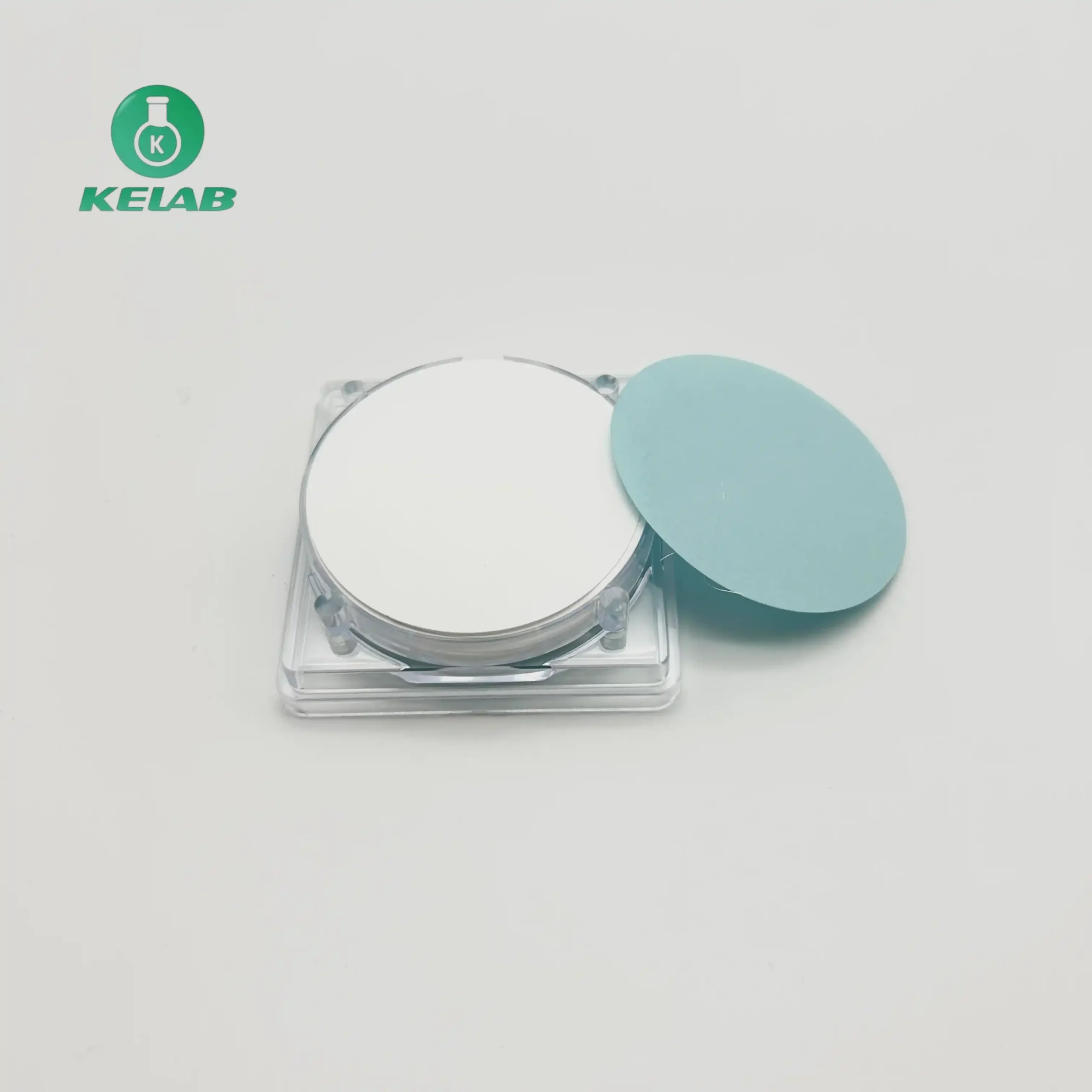
Membrane Filters

Kelabscience membrane filters are circular discs for laboratory liquid filtration, available in PES, PTFE, PVDF, nylon, MCE and CA. All 13 disc diameters, from 13 to 400 mm, are available with nominal pore sizes of 0.22 and 0.45 µm. The 47 mm and 50 mm discs also come in 0.8, 1.2 and 5 µm.

Product Info

Kelabscience supplies these membranes as unmounted discs for use in compatible laboratory filter holders. If you are replacing a membrane in an existing setup, start with the disc diameter specified for your holder. The holder’s support and seal determine how much of the membrane surface is available for filtration.

For a ready-to-use filter that connects directly to a syringe, see our syringe filters.

Available Membrane Materials

Membrane material Selection notes
Polyethersulfone (PES) A common choice for aqueous buffers. For protein-containing samples, check recovery with the formulation you intend to filter.
Polytetrafluoroethylene (PTFE) Often selected for compatible organic solvents. For water-based samples, confirm the wetting characteristics of the specific membrane.
Polyvinylidene fluoride (PVDF) If your method calls for hydrophilic or hydrophobic PVDF, specify the required surface treatment when ordering.
Nylon Used with aqueous samples and compatible solvent mixtures. Membrane adsorption can matter when measuring compounds at low concentrations.
Mixed cellulose esters (MCE) Commonly used to collect suspended particles on the membrane. Check compatibility with any solvents or additives in the sample.
Cellulose acetate (CA) Often considered for aqueous samples when protein adsorption is a concern. For solvent mixtures, check compatibility with the actual formulation.

Applications

These discs can be used to clarify buffers and reagents, prepare liquid samples for analysis, or collect suspended solids. When the filtrate will be analysed, consider whether the membrane could bind the compound you need to measure. When collecting particles on the disc, select the nominal pore size specified by your method.

Bulk Supply and Ordering

To request a quote, please include the number of boxes you need and either the product code or the membrane material, disc diameter and pore size.

Specification

Available membrane materials: PES, PTFE, PVDF, nylon, MCE and CA.

Disc diameter (mm) Available nominal pore sizes (µm) Discs per box
13 0.22, 0.45 100
25 0.22, 0.45 50
35 0.22, 0.45 50
40 0.22, 0.45 50
47 0.22, 0.45, 0.8, 1.2, 5 50
50 0.22, 0.45, 0.8, 1.2, 5 50
60 0.22, 0.45 50
90 0.22, 0.45 100
100 0.22, 0.45 100
150 0.22, 0.45 100
200 0.22, 0.45 100
300 0.22, 0.45 100
400 0.22, 0.45 100

Find Your Product Code

KL-MF[diameter in mm][material code]-[pore size code]

Code element Lookup key
Disc diameter Use the diameter in mm shown in the specification table.
Membrane material P = PES, T = PTFE, F = PVDF, NY = nylon, M = MCE, CA = cellulose acetate
Nominal pore size S = 0.22 µm, L = 0.45 µm, 08 = 0.8 µm, 12 = 1.2 µm, 50 = 5 µm

For example, KL-MF47P-S identifies a 47 mm PES disc with a 0.22 µm pore size, supplied in boxes of 50.

KL-MF50NY-12 identifies a 50 mm nylon disc with a 1.2 µm pore size, also supplied in boxes of 50.

FAQ

Q1. Can I use a 50 mm membrane in a holder specified for 47 mm discs?

Use the 47 mm disc for a holder specified for 47 mm membranes. The 47 mm and 50 mm discs come in the same five pore sizes, but their outside diameters differ. Use a 50 mm disc only if the holder manufacturer also lists that diameter.

Q2. Can I tell from the product code whether a PTFE or PVDF membrane is hydrophilic?

The code identifies the disc diameter, membrane material and nominal pore size. Surface treatment is a separate specification. If your procedure requires hydrophilic PTFE or a particular PVDF surface, include that requirement with the product code when you inquire.

Q3. Are the 0.22 µm membrane filters supplied sterile?

The 0.22 µm designation gives the nominal pore size. If you require sterile supply or individual wrapping, request confirmation for the specific product code before ordering. A method that requires sterilizing-grade filtration also needs product-specific retention data and appropriate process validation.

Q4. What should I check if liquid passes around the edge of the disc?

Check the disc diameter, its position on the support and the condition of the gasket. A crease at the edge of the membrane or a displaced gasket can leave a path for liquid to bypass the disc. Replace a damaged membrane and reassemble the holder according to its manufacturer’s instructions.

Q5. Can I wash a membrane disc and use it for another sample?

Use a fresh disc for a new sample unless your laboratory has validated a cleaning and reuse procedure for that membrane and application. Washing can change the membrane’s wetting characteristics, and material retained from the first sample can carry over into the next.

Request a Quick Quote

Tell us what you need, including product name, specifications, quantity, and delivery destination. Our team typically responds within 1–2 business days.