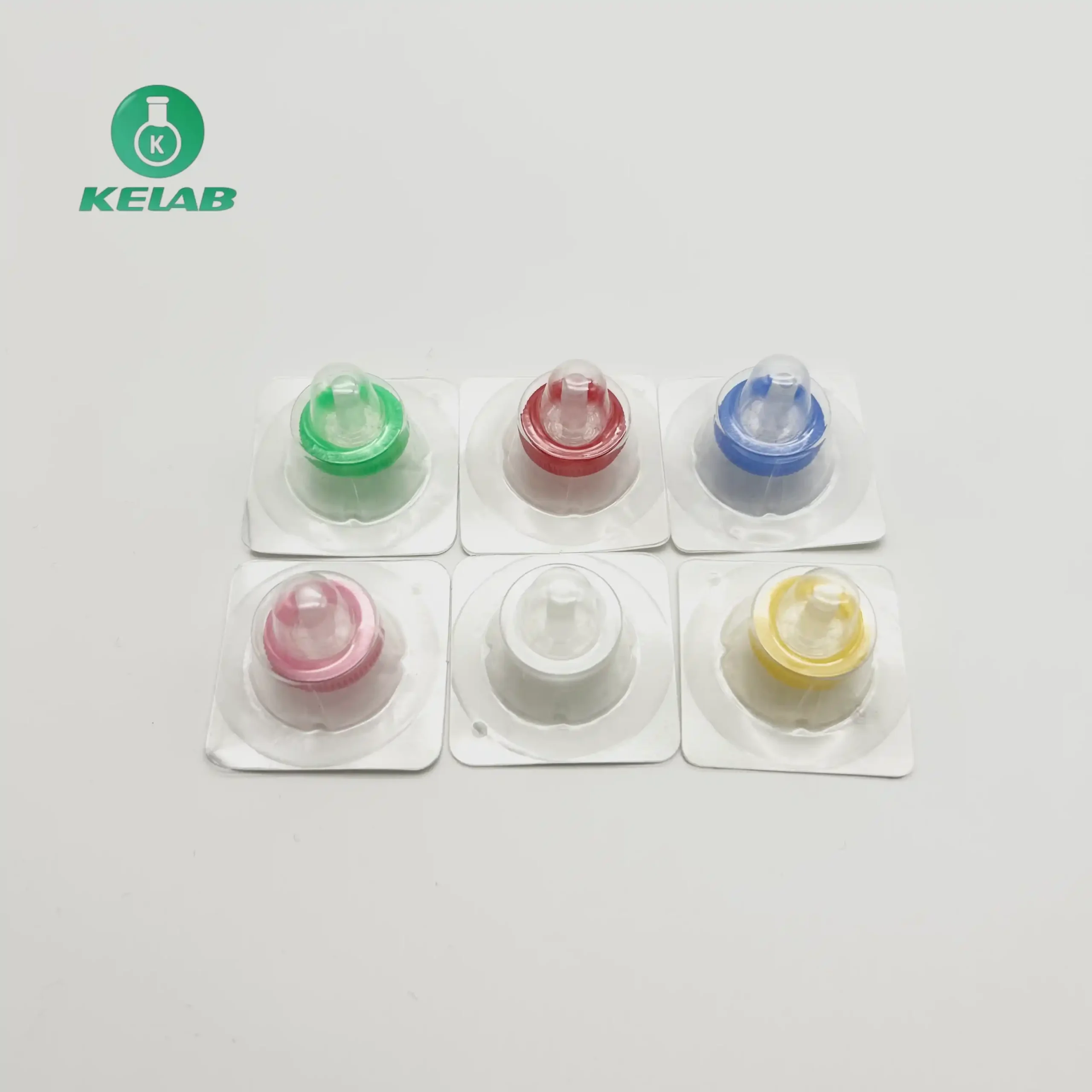
Syringe Filters

Kelabscience disposable syringe filters attach to a syringe through a Luer connection to remove suspended particles before analysis. The range includes 13 mm and 25 mm filters with nominal pore sizes of 0.22 µm and 0.45 µm. Choose from PES, PVDF, PTFE, MCE, Nylon 6 and Nylon 66 membranes. Sterile syringe filters are individually packaged. Non-sterile filters come in boxes of 100.

Product Info

Applications

Use these filters to clarify small volumes of aqueous buffer, water-based reagent or compatible solvent extract before HPLC or other laboratory analyses. For HPLC samples, check that the target compound is recovered after filtration and that the filter contributes no peaks that interfere with the measurement.

If you use a separate filter holder, see our membrane filter discs for available materials and diameters.

Available Membrane Materials

PVDF and PTFE each come in hydrophilic and hydrophobic versions, giving eight membrane options in total. For solvent mixtures, check the full formulation, including additives, against both the membrane and the filter housing.

Membrane Selection notes
PES The hydrophilic membrane in PES syringe filters suits water-based buffers. For protein-containing samples, check recovery of the specific protein being measured.
PVDF Hydrophilic PVDF wets readily with water. When a method specifies hydrophobic PVDF, confirm that the sample solvent wets that membrane.
PTFE Hydrophilic PTFE syringe filters are an option for water-based samples. Hydrophobic PTFE is commonly selected for compatible organic solvents.
MCE Mixed cellulose esters (MCE) are hydrophilic and can be used to clarify compatible aqueous reagents.
Nylon 6 and Nylon 66 Both nylon types are hydrophilic and have separate product codes. When transferring a method, match the specified nylon type and check analyte recovery before substituting the other.

Pore Size and Filter Diameter

Choose 0.45 µm for routine clarification when the analytical method allows it. A 0.22 µm membrane provides finer nominal particle retention and may clog sooner in a sample rich in suspended solids. Sterilizing-grade filtration requires validation for the specific filter and process.

Consider 13 mm when sample volume is limited and liquid retained in the filter could affect yield. Consider 25 mm for a larger volume or a higher particle load. The volume a filter can process depends on the sample and the effective membrane area.

Bulk Supply and Ordering

Find your product code in the specification tables, then specify the quantity and sterile or non-sterile supply. For example, to order two boxes of non-sterile 25 mm hydrophobic PTFE filters with 0.45 µm pores, request “KL-SF25TO-L, non-sterile, 2 boxes (200 filters).”

Specification

Each of the 31 product codes identifies the membrane, filter diameter and nominal pore size. The code stays the same for sterile and non-sterile supply.

General Specifications

Parameter Specification
Product type Single-use syringe filter
Connection Luer
Sterile supply Individually packaged
Non-sterile supply 100 filters per box

13 mm Syringe Filters

Membrane 0.22 µm 0.45 µm
PES KL-SF13P-S KL-SF13P-L
Hydrophilic PVDF KL-SF13FH-S KL-SF13FH-L
Hydrophobic PVDF KL-SF13FO-S KL-SF13FO-L
Hydrophilic PTFE KL-SF13TH-S KL-SF13TH-L
Hydrophobic PTFE KL-SF13TO-S KL-SF13TO-L
MCE KL-SF13M-S KL-SF13M-L
Nylon 6 KL-SF13N6-S KL-SF13N6-L
Nylon 66 KL-SF13N66-S KL-SF13N66-L

25 mm Syringe Filters

Membrane 0.22 µm 0.45 µm
PES KL-SF25P-S KL-SF25P-L
Hydrophilic PVDF KL-SF25FH-S KL-SF25FH-L
Hydrophobic PVDF KL-SF25FO-S KL-SF25FO-L
Hydrophilic PTFE KL-SF25TH-S KL-SF25TH-L
Hydrophobic PTFE KL-SF25TO-S KL-SF25TO-L
MCE KL-SF25M-S KL-SF25M-L
Nylon 6 — KL-SF25N6-L
Nylon 66 KL-SF25N66-S KL-SF25N66-L

For 25 mm Nylon 6, the current range lists the 0.45 µm version only.

FAQ

Q1. Why is the syringe plunger suddenly hard to press?

Stop pressing if resistance rises sharply. Particles may have blocked the membrane, or the sample may not wet it properly. Check the membrane choice, suspended solids and Luer connection before continuing. For a particle-rich sample, preliminary clarification may help if the method permits it.

Q2. Should I discard the first portion of filtrate?

The first portion can differ as the membrane wets or binds some of the analyte. Compare recovery in the first and later portions against a suitable reference. Use those results to decide whether your method needs a discard volume, especially when sample is scarce.

Q3. Could a syringe filter introduce an unexpected HPLC peak?

Yes. A solvent can extract substances from the membrane or housing. Run a blank of the same solvent with and without filtration under the same analytical conditions. An extra peak in the filtered blank is a reason to investigate the filter–solvent combination.

Q4. Can these syringe filters be used for air or other gases?

The specifications here cover liquid samples. Gas filtration requires documentation for the complete filter covering the intended gas, operating pressure and retention requirement. Check those ratings for the exact product code before selecting it for gas service.

Q5. What should I check when a new lot arrives?

Match the code, membrane, diameter, pore size and sterile or non-sterile designation to the purchase order. Check the lot identification and packaging, including the seals on individually packaged filters. For a sensitive assay, compare analyte recovery and analytical background with your laboratory’s acceptance criteria.

Request a Quick Quote

Tell us what you need, including product name, specifications, quantity, and delivery destination. Our team typically responds within 1–2 business days.