Introduction
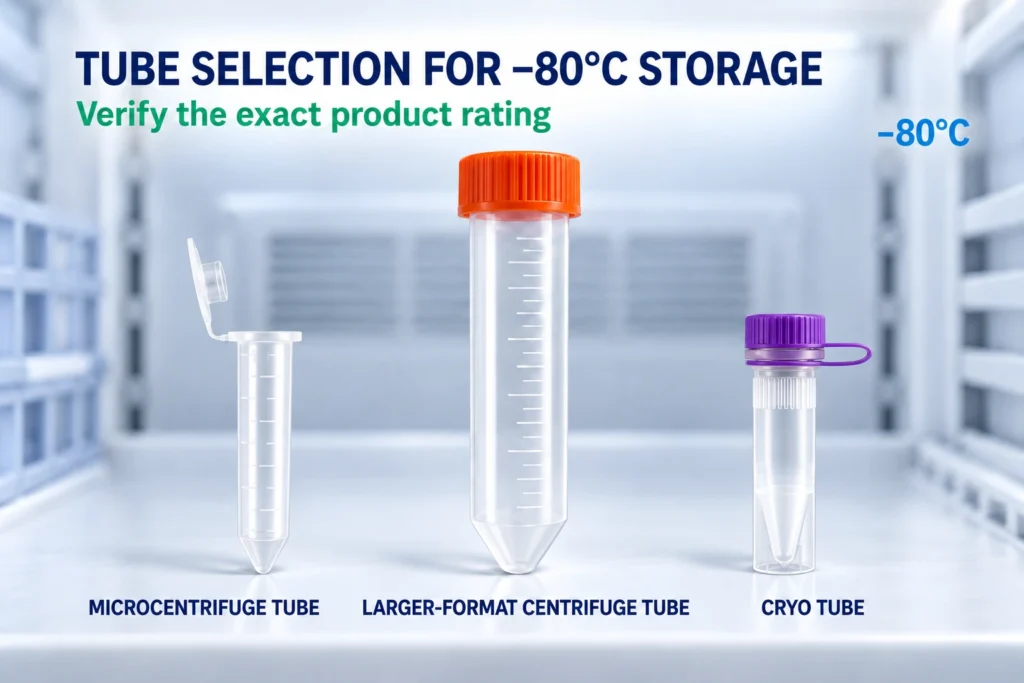
Specific products in all three categories—microcentrifuge tubes, larger-format centrifuge tubes, and cryo tubes—can be used at −80°C when the exact configuration is rated for that condition. A product name or a polypropylene material description is not enough to establish storage compatibility.
When we review a request for “PP tubes for −80°C storage,” we do not begin with the material. We first ask whether the tube is used only during sample preparation or will remain with the sample in the freezer. That one distinction often changes the recommendation.
Consider a common cell workflow. A larger centrifuge tube may be used to collect, wash, pellet, and resuspend the cells. The prepared suspension is then divided into smaller tubes for frozen storage. The first tube must support the centrifugation and handling steps; the second must have a documented rating for the final storage condition. In some workflows, one tube may perform both roles, but only when its specification supports both.
This guide compares microcentrifuge tubes, larger-format centrifuge tubes, and cryo tubes as potential final containers for −80°C sample storage. It explains when each format may be appropriate, what evidence should support the choice, and what information a buyer should confirm before routine or bulk use.
The focus is the container, not the complete sample-freezing protocol. Cooling rate, freezing medium, sample stability, and post-thaw recovery remain separate application-specific considerations.
First Distinguish Sample Processing from Final Frozen Storage
A freezing workflow may involve several tubes, but they do not all need to meet the same requirements. Before comparing materials or cap designs, assign each tube a clear role.
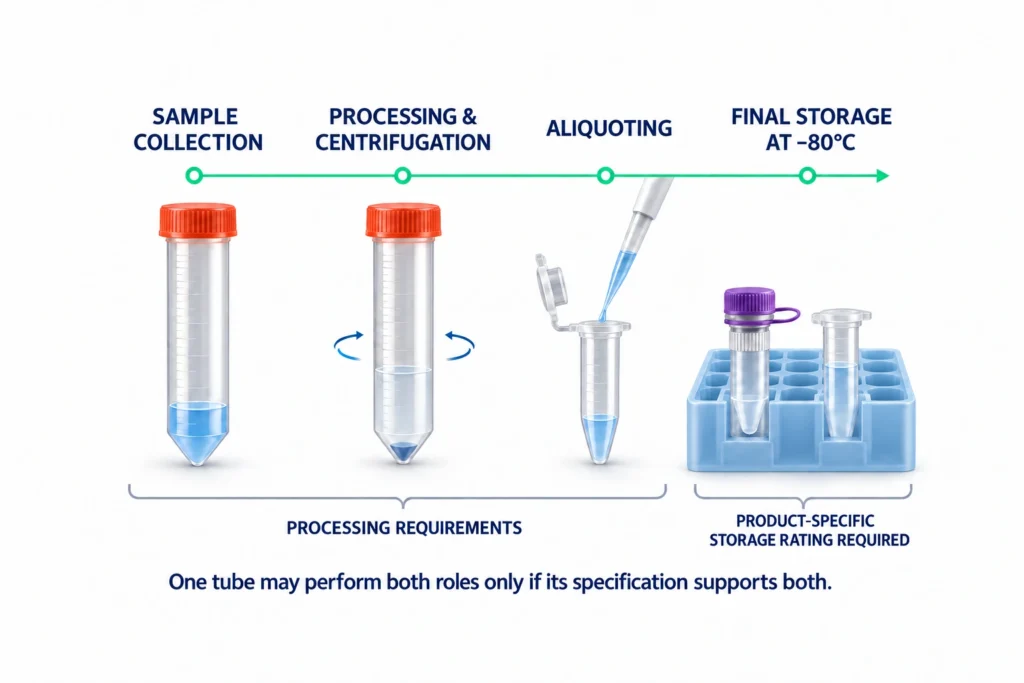
A tube removed before the final step needs to support the operations performed during preparation. The tube that remains with the sample must also be qualified for the intended storage condition. If one tube performs both roles, its specification must cover both.
Tubes Used During Sample Preparation
Larger-format centrifuge tubes are commonly used to collect suspensions, form pellets, remove supernatants, wash cells, and prepare a uniform batch before aliquoting. Depending on the workflow, this may involve common 15 mL and 50 mL formats or another capacity suited to the starting volume.
For smaller samples, microcentrifuge tubes may hold a pellet, counting sample, reagent fraction, lysate, or another intermediate generated during preparation.
At this stage, the practical questions concern working volume, RCF, rotor fit, closure, and the required cleanliness or sterility level. A tube may also be placed on ice or used in a refrigerated centrifuge. None of these operations, however, confirms that it can serve as a final container at −80°C.
The processing role ends when the sample is transferred out. Its selection should be judged against the conditions it actually encounters, rather than against a storage stage it never enters.
Tubes Used as the Final Storage Container
The final container stays closed while the sample freezes, remains at the target temperature, and is later retrieved and thawed. Its tube body, cap, and sealing interface must therefore be covered by a storage rating that matches the intended conditions.
Small biological samples are often divided into separate aliquots, making a rated cryo tube a practical choice. A larger sample may remain in a specifically rated centrifuge tube when dividing it is unnecessary or would interfere with the workflow. Neither decision can be made from tube size alone.
We use a simple checkpoint during product selection: which tube will still contain the sample after preparation is complete? If the answer is “none of these,” those tubes are processing tools. If one of them will remain in the freezer, its exact low-temperature suitability must be confirmed.
Keeping these roles separate prevents a common purchasing mistake: approving a tube for frozen storage because it appears somewhere in a freezing workflow. Once the final container has been identified, its material and product rating can be evaluated properly.
Why Polypropylene Alone Does Not Confirm −80°C Compatibility
Polypropylene is a material description, not a storage rating. It is widely used for laboratory tubes because it combines chemical resistance, flexibility, and mechanical strength, including in many products designed for low-temperature use. That does not mean every finished PP tube performs the same way at −80°C.
Two tubes labeled “PP” may use different resin formulations, wall geometries, cap materials, sealing structures, and manufacturing tolerances. One may carry a defined low-temperature rating, while another is specified only for routine centrifugation and bench handling.
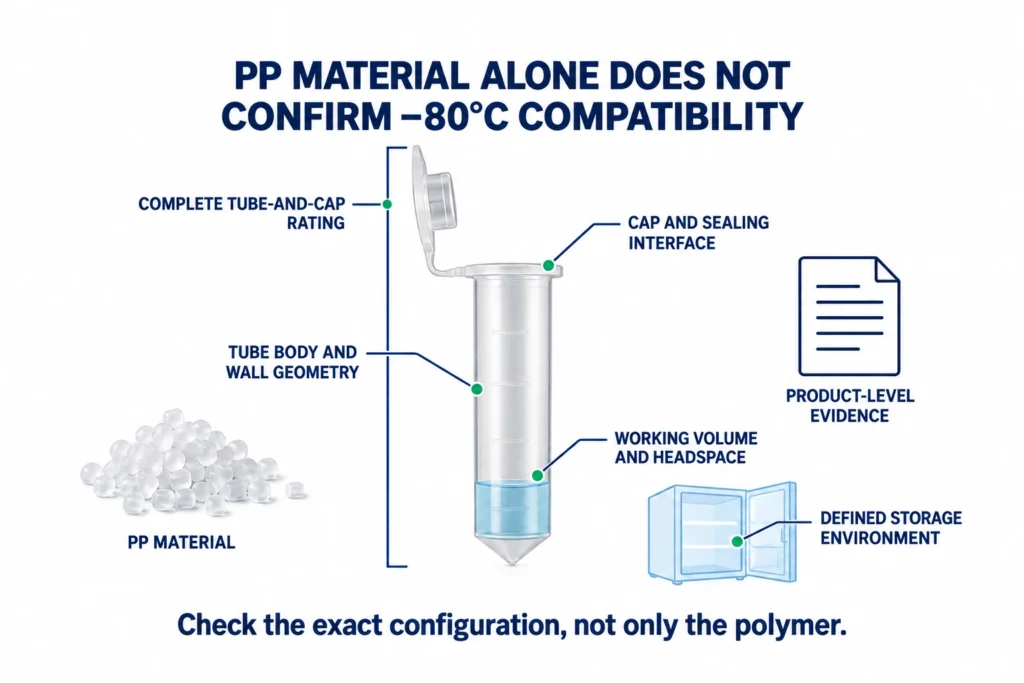
Material Is Only One Part of the Product
Product specifications often place several claims next to one another, but each claim answers a different question.
| Product information | What it confirms | What it does not confirm |
|---|---|---|
| Polypropylene material | The general polymer used for the tube | Performance of the assembled tube at −80°C |
| Maximum RCF | The centrifugal force supported under stated conditions | Suitability for prolonged frozen storage |
| Autoclavable | Tolerance of a defined high-temperature cycle | Low-temperature storage performance |
| Sterile | The supplied microbiological status | Seal integrity or mechanical performance after freezing |
A tube can therefore be autoclavable, sterile, and rated for high-speed centrifugation without having any documented claim for −80°C storage.
If a supplier lists PP but gives no applicable temperature range, the low-temperature use remains unconfirmed. That wording is important: an unconfirmed tube is not guaranteed to fail, but there is not enough product-specific evidence to approve it for valuable or routine frozen samples.
The Rating Must Cover the Complete Tube-and-Cap System
The tube body is only one part of the container. The cap, sealing surface, snap-fit or thread, and any gasket must continue to work together after cooling.
Many aqueous samples expand during freezing, while the tube and closure components respond to the temperature change according to their own designs and materials. Insufficient headspace or an unsuitable closure can place additional stress on the assembled container. A tube body may remain visibly intact even when the cap-to-tube seal is no longer reliable.
A useful low-temperature claim should identify the applicable product, minimum storage temperature, storage environment, and any working-volume or handling restrictions. Terms such as “freezer safe,” “cold resistant,” or “cryogenic” are too broad unless the manufacturer also defines the actual conditions.
The same limit applies in the other direction. A rating for a −80°C mechanical freezer cannot be extended automatically to a lower temperature, vapor-phase liquid nitrogen, or liquid-phase immersion.
Once PP is treated as construction information rather than proof of compatibility, individual microcentrifuge tubes can be evaluated on their published performance instead of their material or familiar appearance.
Can Microcentrifuge Tubes Be Used at −80°C?
Yes, some microcentrifuge tubes can be used at −80°C. The category itself does not provide the answer, because products that look nearly identical may have very different temperature specifications.
A useful example is the Eppendorf Safe-Lock Tube. It uses a hinged snap-cap design, and the manufacturer’s instructions for use list an operating temperature range of −86°C to 100°C. This does not qualify every snap-cap tube for freezer storage. It shows why cap style and appearance cannot replace the specification for the actual product.
When a Rated Microcentrifuge Tube May Be Used
A microcentrifuge tube may remain with the sample at −80°C when the manufacturer’s documentation for the exact tube-and-cap configuration explicitly supports storage under the intended conditions.
This can be practical for small aliquots of DNA or RNA preparations, proteins, enzymes, reagents, lysates, extracts, or reference materials. The tube must still be used within the specified working volume and closure instructions, and the sample’s own stability must be assessed separately.
Living-cell storage requires another layer of judgment. Even when the tube remains physically functional at −80°C, cell recovery also depends on sterility, freezing medium, cooling rate, cell concentration, and the thawing procedure. A temperature-rated container answers the container question; it does not validate the biological protocol.
The closure type remains relevant, but it is not a shortcut. A snap cap can be suitable when the complete product is rated accordingly. A screw cap does not, by itself, confirm suitability; without a matching low-temperature claim for the complete product, the intended use remains unconfirmed.
When Compatibility Should Not Be Assumed
A routine microcentrifuge tube should not be approved for −80°C storage simply because it:
- is made from polypropylene;
- has a high RCF rating;
- is autoclavable;
- feels tightly closed at room temperature;
- is used on ice or in a refrigerated centrifuge;
- survived a short, informal freezer trial.
That last point can be misleading. One tube remaining intact overnight does not address longer storage, different fill volumes, multiple production lots, or repeated freezing and thawing. If the manufacturer gives no relevant temperature range, the application remains unconfirmed rather than proven safe or proven impossible.
Kelabscience’s standard microcentrifuge tube range is intended for routine spin-down, pellet collection, sample preparation, and short-term storage under standard laboratory conditions. Because the current published specifications do not state a −80°C storage rating, these standard models should not be assumed to support that use.
If a buyer specifically requires the microcentrifuge-tube format for −80°C storage, Kelabscience can review the proposed configuration and its supporting low-temperature documentation before ordering. If no rated option can be confirmed, a cryo tube configuration explicitly specified for −80°C storage may be the more direct choice.
This does not mean that microcentrifuge tubes as a category cannot be used at −80°C. Some specific products are designed and rated for that condition. Approval must follow the documentation for the selected product rather than the category name.
The same reasoning applies to larger-format centrifuge tubes, although their use cases and storage volumes are different.
Can Larger-Format Centrifuge Tubes Be Used at −80°C?
Yes, some larger-format centrifuge tubes can be used for storage at −80°C. Capacity does not decide the issue; the temperature rating of the specific product does.
Microcentrifuge tubes are part of the broader centrifuge-tube category. In this section, “larger-format centrifuge tubes” means formats above the typical 0.1–2.0 mL microcentrifuge range. This includes common 15 mL and 50 mL tubes, but the discussion also applies to 5 mL, 10 mL, 25 mL, 100 mL, 120 mL, and other capacities.
Larger-Format Centrifuge Tubes Used Before Freezing
These tubes are often used for cell harvesting, washing, pelleting, media exchange, phase separation, and bulk sample preparation. Their role may end once the prepared material is transferred into its final storage containers.
For this part of the workflow, buyers normally focus on working volume, RCF, rotor support, cap security, sterility, and compatibility with the sample or reagent. A good processing tube does not also need a −80°C rating if it never enters the freezer.
Kelabscience’s standard centrifuge tube range covers 5–120 mL formats for operations such as sample preparation, pelleting, cell washing, temporary storage, and transport. Because the current published specifications do not state a general −80°C final-storage rating, these standard models should not be assumed to support that use.
If a larger-format tube must remain with the sample at −80°C, Kelabscience can review the proposed capacity and configuration against the available low-temperature documentation before ordering.
Larger-Format Centrifuge Tubes Used as Final Storage Containers
When a larger-format centrifuge tube will remain with the sample during −80°C storage, check the documentation for the specific tube-and-cap configuration. Confirm that it supports the intended storage use, then review the permitted working volume, filling instructions, closure requirements, and any restrictions on storage duration.
Take a 30 mL bulk sample that must remain in one container. Dividing it among many small cryo tubes may add handling steps and interfere with the intended workflow. Here, 30 mL is the sample volume—not the required nominal capacity of the tube. Select a container whose documentation supports −80°C storage with a 30 mL working volume and sufficient headspace under the specified filling conditions. The chosen configuration should then be qualified under the intended conditions.
If no matching low-temperature claim is available, the tube should remain within its documented processing or temporary-storage uses. If the claim is available, a larger-format centrifuge tube may be a valid final container without being reclassified as a cryo tube.
The practical conclusion is simple: 15 mL and 50 mL tubes are common examples, not the limit of the discussion. Any capacity may be considered, but approval must follow the rated product rather than the volume printed on its side.
When Is a Cryo Tube the More Appropriate Choice?
A cryo tube is usually the more direct choice when a small-volume sample will remain at −80°C and the buyer needs a product specifically positioned for low-temperature storage. This does not make cryo tubes mandatory for every frozen sample. It means the intended use of the product and the intended use of the laboratory are more closely aligned.
Small-Volume Biological Samples at −80°C
Cryo tubes are commonly selected for individual aliquots of cell suspensions, serum, plasma, biological reagents, and other small-volume samples. They often enter the workflow after collection, centrifugation, washing, or resuspension has been completed in another container.
For example, a laboratory may need to prepare 0.8 mL serum aliquots for a −80°C mechanical freezer. A suitably rated microcentrifuge tube could work if the exact product supports that use. A purpose-specified cryo tube, however, may make procurement simpler because its storage role, temperature range, working volume, and available closure configurations can be checked directly.
Kelabscience Cryo Tubes are specified for −80°C freezer storage. The working volume should remain below the nominal capacity so that sufficient headspace is available during freezing. Capacity, thread type, sealing design, and sterility still need to match the workflow, but those detailed choices are covered in the separate cryo tube selection guide.
For viable mammalian cells, −80°C may be an initial freezing step rather than the intended long-term storage condition. In Thermo Fisher’s cell-freezing protocol, for example, the initial −80°C step is followed by transfer to vapor-phase liquid nitrogen below −135°C. The appropriate storage temperature and duration must follow the protocol for the cells being preserved; they cannot be inferred from the tube’s temperature rating.
Vapor-Phase Liquid Nitrogen Is a Separate Claim
A −80°C freezer rating should not be extended automatically to a liquid nitrogen system. Mechanical freezers, vapor-phase liquid nitrogen, and direct liquid-phase exposure are different storage environments.
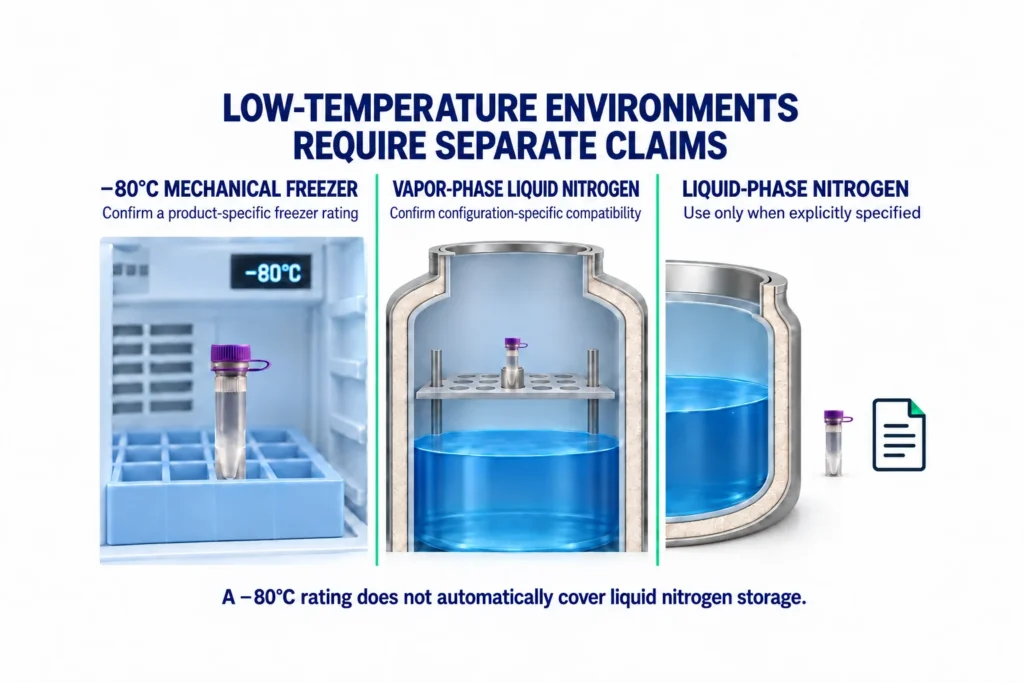
This distinction has practical safety consequences. The Thermo Scientific cryopreservation guide explains that liquid nitrogen entering a vial can become trapped and cause pressure buildup during warming, with a risk of explosion.
For the current Kelabscience range, selected cryo tube configurations may be suitable for vapor-phase liquid nitrogen storage, but compatibility must be confirmed for the specific model, packaging, and handling conditions before ordering. Direct immersion in liquid-phase nitrogen is not recommended unless the product is explicitly specified for it.
If a sample will begin in a −80°C freezer and later move into vapor-phase liquid nitrogen, choosing one configuration documented for both environments may avoid an additional sample transfer.
The practical advantage of a cryo tube is therefore not its name. It is the ability to match a purpose-specified container to the actual storage temperature, phase, sample volume, and workflow with fewer unsupported assumptions.
Quick Selection Guide for Common −80°C Storage Scenarios
The table below is a first-pass decision tool, not a substitute for the manufacturer’s specification. It separates the role of the tube from the evidence needed for final approval.
| Scenario | Recommended approach | Confirm before use |
|---|---|---|
| Small aliquots of cells, serum, plasma, or biological reagents, provided the sample-specific protocol supports −80°C storage | Start with a cryo tube rated for −80°C | Permitted storage duration for the sample; exact tube configuration, working volume, sterility, and −80°C claim |
| A small non-cellular sample is already in a microcentrifuge tube | Keep it in the same tube only if that model supports the intended storage condition; otherwise transfer it | Temperature range, complete cap-and-tube rating, fill limit, and sample compatibility |
| Cells or other material are processed in a 5–120 mL centrifuge tube before aliquoting | Use the larger tube for processing, then move the prepared sample into a rated final container | RCF and handling requirements for the first tube; storage rating for the second |
| A bulk sample must remain in one larger container | Select a larger-format tube explicitly rated for −80°C storage | Exact SKU, working volume, closure, storage duration, and actual sample conditions |
| A sample may later move from −80°C to vapor-phase liquid nitrogen | Choose a tube documented for both environments from the beginning | Separate ratings for the mechanical freezer and vapor-phase storage |
| Only the material is known and no low-temperature specification is available | Request product-level evidence or choose a clearly rated alternative | Do not approve the tube from a PP description, capacity, or cap style alone |
The table does not rank one tube category as universally better. A rated microcentrifuge tube may be suitable for a small non-cellular aliquot, while a purpose-specified cryo tube may provide a clearer path for biological samples. A rated larger-format centrifuge tube may be the correct answer when a bulk sample must remain in one container.
For Kelabscience’s current standard ranges, the product mapping is as follows:
Microcentrifuge Tubes: standard models are intended for routine small-volume processing and short-term storage under standard laboratory conditions. A −80°C requirement calls for a review of the proposed configuration and applicable documentation before ordering.
Centrifuge Tubes: standard models are intended for larger-volume processing, pelleting, washing, temporary storage, and transport. Using a larger-format tube as the final container at −80°C requires the same configuration-specific review.
Cryo Tubes: the current standard range is explicitly specified for −80°C freezer storage. Vapor-phase liquid nitrogen compatibility must be confirmed for the selected configuration.
This mapping describes Kelabscience’s current published standard specifications. It does not predetermine whether another configuration can be reviewed for a specific enquiry, and it should not be applied to every product sold under the same category names by other manufacturers.
Once the likely tube format has been identified, the next task is to verify whether the available evidence actually covers the proposed product and workflow.
How to Verify a Low-Temperature Storage Claim
Verification should connect one identifiable product to one clearly described workflow. Start by checking the product documentation and intended use. Where the sample risk warrants it, the laboratory using the tubes should then carry out an internal qualification under its own storage and handling conditions.
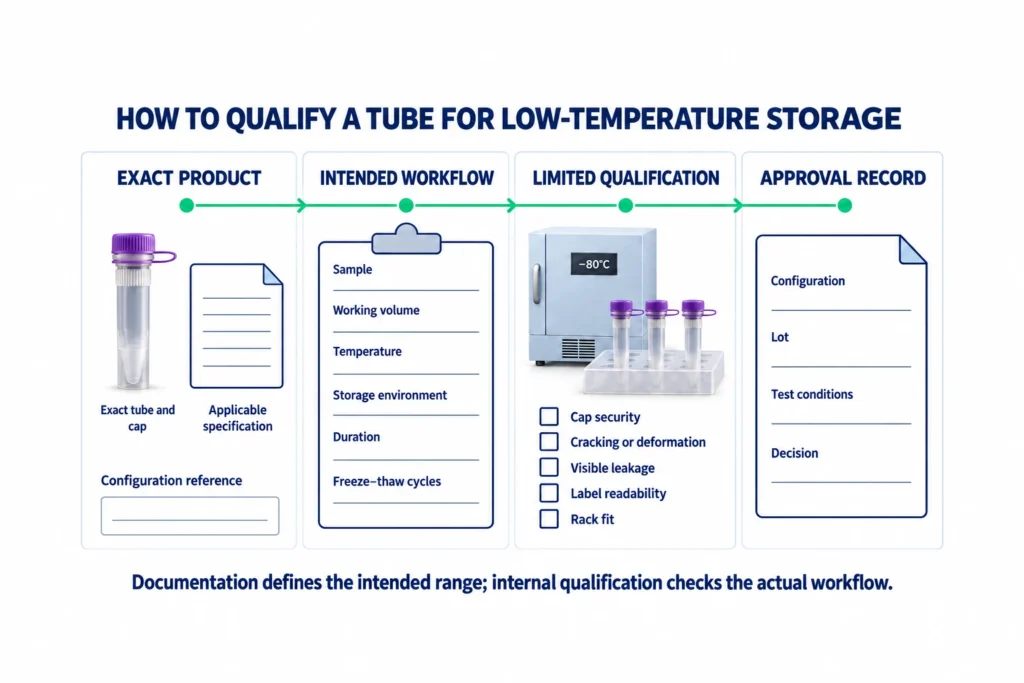
Check the Documentation for the Exact Configuration
Start with the catalog number or proposed configuration, not the general product-family name. Capacities, caps, gaskets, sterility options, and packaging variants within one range may not share the same performance claims.
The most useful sources are the manufacturer’s technical data sheet, instructions for use, official product page, catalog, or written technical confirmation. Together, they should identify:
- the applicable tube and cap;
- the stated storage temperature;
- whether the claim refers to storage or only brief exposure;
- the storage environment, such as a mechanical freezer or vapor-phase liquid nitrogen;
- working-volume or filling restrictions;
- any limits involving duration, repeated freezing and thawing, or handling.
If the only available wording is “freezer safe,” “cold resistant,” or “made from polypropylene,” the claim is still too broad for approval at −80°C.
Confirm the Intended Workflow Before Bulk Ordering
A supplier cannot match the correct tube from a product name alone. When a request says only “PP tubes for −80°C,” we still need to know what the tube will contain, how much will be filled, and whether it is a processing tube or the final storage container.
The following requirement template can be copied into an enquiry or qualification record:
- Tube role: processing / final storage / both
- Sample type:
- Working volume per tube:
- Storage temperature:
- Storage environment: mechanical freezer / vapor-phase LN₂ / other
- Expected storage duration:
- Expected freeze–thaw cycles:
- Required sterility or cleanliness level:
- Requested evidence: exact product reference and applicable low-temperature specification
The supplier’s response should point to an identifiable product and state which part of the requirement it supports. For customized or specially sourced products, the agreed temperature claim and configuration should also appear in the quotation, approved specification, or purchasing record. A sample with the right dimensions is useful for fit and handling checks, but visual similarity does not establish low-temperature performance.
Use Limited Qualification for Critical Samples
Product documentation establishes the intended operating range. Internal qualification then checks whether the rated tube works within the laboratory’s actual workflow.
Use noncritical material or a suitable representative sample before introducing valuable specimens. The qualification conditions should reflect the planned fill volume, temperature, storage orientation, duration, and number of freeze–thaw cycles as closely as practical.
Depending on the application, the laboratory may check:
- cap security before and after storage;
- cracking, deformation, or cap movement;
- visible leakage after thawing;
- label adhesion and readability;
- fit within the intended freezer box or rack;
- sample recovery or another relevant post-thaw measure.
Record the product reference, production lot, test conditions, observations, and acceptance decision. If sample stability matters, evaluate it separately from the physical condition of the tube. An intact container does not by itself confirm cell viability, enzyme activity, nucleic acid quality, or another sample-specific outcome.
Internal qualification cannot create a manufacturer’s rating where none exists, and a successful result for one size or cap configuration should not be extended to an entire product family. Critical or irreplaceable samples should not become the trial material for an undocumented tube.
A defensible selection combines all three layers: an applicable product claim, a clear match to the intended workflow, and internal confirmation proportional to the value and risk of the stored sample.
Final Recommendation
For −80°C storage, choose the container according to the job it will actually do. Processing tubes need to support the steps they encounter before sample transfer. Final storage containers need documentation covering the exact tube-and-cap configuration and the intended temperature, working volume, duration, and environment.
For bulk orders, record the agreed product reference, configuration, and applicable storage conditions in the quotation or approved specification. This keeps the purchasing decision tied to the product that was reviewed.
To discuss a standard or non-standard requirement, contact Kelabscience. Use the enquiry template above so we can review the proposed configuration and available supporting documentation before ordering.
Frequently Asked Questions About Tubes for −80°C Storage
Does polypropylene automatically mean a tube can be stored at −80°C?
No. Polypropylene identifies the base material, not the performance of the finished container. The tube body, cap, seal, working volume, and complete product configuration all affect suitability. Use a temperature claim tied to the applicable product rather than a general PP description.
Can snap-cap microcentrifuge tubes be stored at −80°C?
Yes, some snap-cap microcentrifuge tubes are rated for −80°C or below. A screw cap is not always required, and a snap cap is not automatically unsuitable. Check the temperature range and storage instructions for the complete tube-and-cap system instead of deciding from the closure style alone.
Can 15 mL and 50 mL centrifuge tubes be stored at −80°C?
Some 15 mL and 50 mL centrifuge tubes are specifically rated for −80°C storage, while others are intended only for processing or temporary handling. The same principle applies to other capacities. Confirm the exact product, filling conditions, closure, and applicable storage limitations before using it as the final container.
Is a cryo tube always required for −80°C sample storage?
No. A rated microcentrifuge tube or larger-format centrifuge tube may also be suitable. A cryo tube is often the most direct choice for small biological aliquots because its intended role aligns with frozen storage, but its exact configuration must still carry the relevant temperature claim.
Does a −80°C rating mean the tube is suitable for liquid nitrogen storage?
No. A −80°C mechanical freezer, vapor-phase liquid nitrogen, and direct liquid-phase exposure are different environments. Compatibility with vapor or liquid nitrogen must be stated separately. If the sample may later move into a liquid nitrogen system, include that future step when selecting the tube.