
Low-binding microcentrifuge tubes are most useful for dilute, low-volume, or difficult-to-replace protein and nucleic acid samples when a small surface loss could change the experimental result.
Consider a diluted enzyme that produces a weaker signal after several hours in a microcentrifuge tube. The cap remained closed, the liquid volume looked normal, and the pipetting steps appeared consistent. The missing material may still be on the tube wall. Unlike leakage or evaporation, molecular adsorption can reduce the amount available for analysis without leaving an obvious visual sign.
Standard polypropylene tubes remain suitable for many routine tasks, including buffer preparation, short transfers, and handling concentrated samples. The need for a specialized tube arises when the total amount of analyte is limited, plastic contact is substantial, and the downstream method cannot tolerate even a modest change in recovery. A concentrated stock transferred once and a dilute working solution stored overnight may therefore require different decisions despite using the same nominal tube size.
Selecting a low-binding tube is not simply a matter of choosing the strongest claim on a package. The claim must be relevant to the target analyte, supported by meaningful test conditions, and confirmed when recovery is critical. This article explains how to recognize surface-loss risk, interpret protein and nucleic acid low-binding claims, validate candidate tubes under real handling conditions, and translate the result into a reliable bulk-purchasing specification.
What Does “Low-Binding” Mean in a Microcentrifuge Tube?
“Low-binding” describes how the inner surface of a microcentrifuge tube interacts with the sample. It indicates that the tube is designed to reduce nonspecific adsorption, leaving more protein, peptide, DNA, or RNA available for recovery and downstream analysis.
The term does not mean that adsorption is completely eliminated. It is a comparative claim, so its value depends on three questions:
- Which analyte was tested?
- What reference tube was used?
- Under what conditions was recovery measured?
Without those details, “low-binding” identifies an intended surface property but does not guarantee a fixed recovery percentage for every application.
Low-binding and low-retention also need to be read carefully. Low-binding usually refers to reducing molecular adsorption at the plastic surface. Across laboratory consumables, low-retention may describe reduced molecular binding, reduced visible liquid left on the surface, or a broader sample-recovery property defined by the manufacturer.
These effects are not identical. A tube wall that looks dry after aspiration may still have protein or nucleic acid adsorbed at the molecular level. Conversely, a tube with reduced molecular adsorption may still retain a small visible film of liquid. When comparing low retention microcentrifuge tubes, buyers need to check what the manufacturer actually measured.
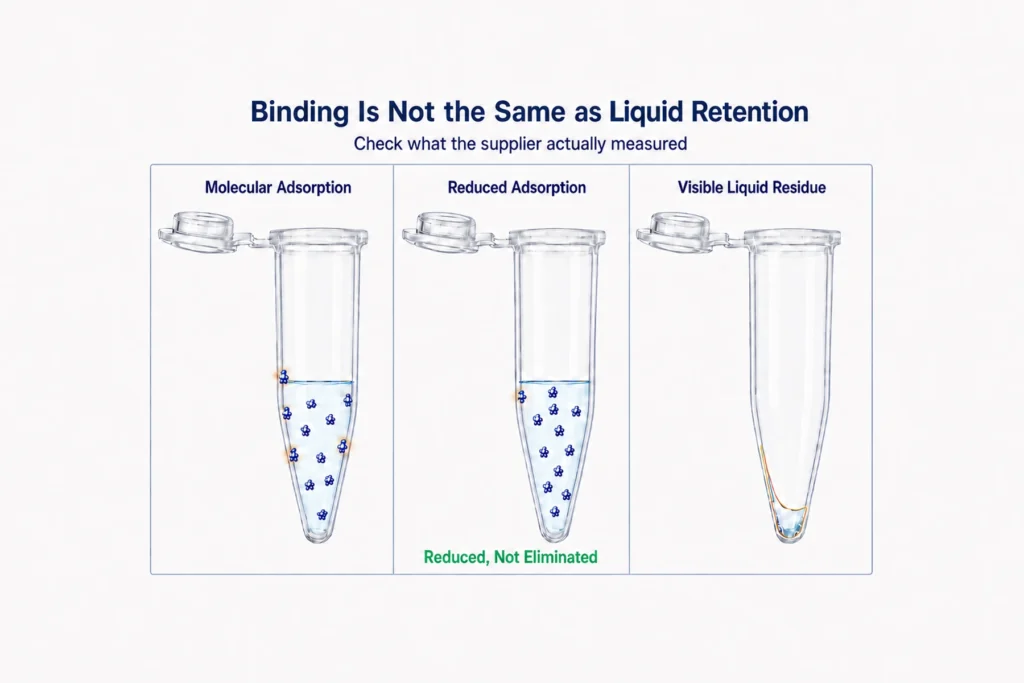
Other terms commonly listed beside low-binding refer to separate product characteristics:
| Claim | What It Establishes—and What It Does Not |
|---|---|
| Low-binding | Indicates reduced adsorption for specified analytes and test conditions; it does not mean zero binding or universal performance. |
| Low-retention | Indicates reduced sample or liquid retention as defined by the supplier; the term is not a universal molecular-recovery grade. |
| DNase-/RNase-free | Addresses detectable nuclease contamination under the stated test method; it does not establish sterility or low-binding performance. |
| Sterile | Addresses microbial contamination through a validated sterilization process; it does not automatically establish nuclease-free, nonpyrogenic, or low-binding status. |
| Nonpyrogenic | Addresses bacterial endotoxin within a stated test limit; it does not establish sterility or analyte recovery. |
A product may combine several of these properties, but one cannot be inferred from another. For example, a tube can be low-binding and nonsterile, or sterile without having a documented low-binding claim.
The same caution applies to the base material. Standard and low-binding microcentrifuge tubes are often both described as polypropylene. “PP” identifies the general polymer, not the tube’s complete surface behavior. Products with the same nominal material can differ in formulation, manufacturing, and documented recovery performance.
A useful low-binding specification therefore names the target analyte and defines the conditions under which reduced adsorption was demonstrated. That distinction becomes more important as the available sample amount decreases and surface loss represents a larger share of the total material.
Why Surface Loss Matters More for Small-Volume Samples
Surface loss begins as soon as sample molecules contact the inner wall of a tube. Proteins, peptides, DNA, and RNA can interact with the polymer instead of remaining entirely in solution. Some interactions are weak and reversible; others leave material on the surface after normal pipetting.
The practical effect depends less on whether adsorption occurs at all than on how much of the total sample it removes. A small absolute loss may be irrelevant in a concentrated stock but significant in a dilute preparation containing little analyte. The surface does not shrink in proportion to the amount of material placed in the tube, so the same available contact area can consume a larger fraction of a low-concentration sample.
Working volume matters for the same reason. A few microliters placed in a relatively large tube can have an unfavorable relationship between available analyte and contacted plastic. Using a vessel that is much larger than the working volume may expose the sample to more surface than the handling step requires. Nominal capacity alone therefore does not describe the risk.
Adsorption can begin quickly, although longer contact generally creates more opportunity for loss. Storage, incubation, vortexing, and repeated pipetting bring the sample into continued contact with the wall. Moving the sample to another container introduces a new surface, so several individually minor losses can accumulate across a multistep preparation.
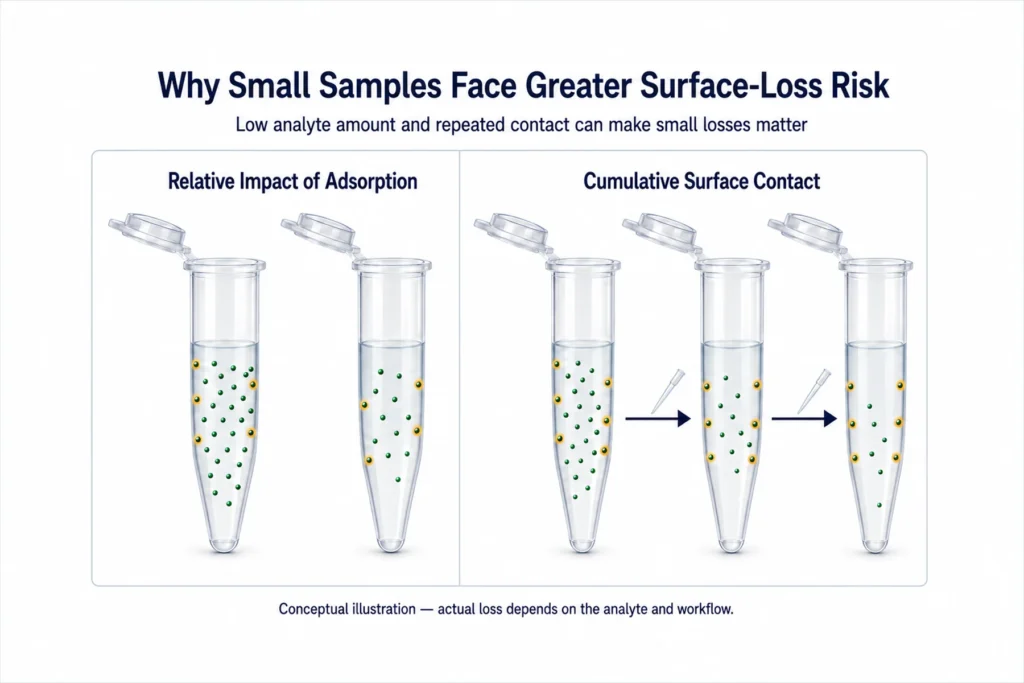
This cumulative effect has been demonstrated experimentally. In a published study of cationic peptides, successive transfers through polypropylene tubes produced progressive reductions in recovered peptide. The study measured progressive depletion from solution as the sample contacted additional container surfaces, making it a recovery problem rather than a visible volume-loss test. The results show why eliminating an unnecessary transfer can sometimes matter as much as changing the final storage tube. View the published study.
Solution conditions can change the extent of adsorption:
- pH influences the charge and structure of the analyte;
- salts can strengthen or weaken surface interactions;
- detergents or carrier proteins may occupy competing binding sites;
- temperature affects molecular movement and sample stability;
- mixing increases contact between the sample and the tube wall;
- drying or partial dehydration can make material more difficult to recover.
These variables must be interpreted together. A tube that provides acceptable recovery for a concentrated standard in one buffer may behave differently with a diluted sample in another. Changing the buffer can sometimes reduce surface loss, but additives introduced only for that purpose may interfere with PCR, mass spectrometry, enzyme assays, or other downstream methods.
Not every decline in measured concentration comes from tube adsorption. Pipette-tip binding, incomplete mixing, evaporation, degradation, and analytical variation can produce similar results. Holding these factors constant is essential when comparing tube surfaces.
The highest risk appears when three conditions coincide: little analyte is available, the sample has substantial contact with plastic, and the downstream result is sensitive to a small change in recovery. Even then, the extent of loss depends on the molecule itself. A surface that performs well for one protein, peptide, or nucleic acid cannot be assumed to behave identically for another.
Protein Low-Binding and DNA/RNA Low-Binding Are Different Claims
A low-binding claim is meaningful only when it identifies the type of sample the surface is intended to protect. Proteins, peptides, DNA, and RNA have different molecular structures and do not interact with polypropylene in the same way. Performance demonstrated for one group cannot be transferred automatically to another.
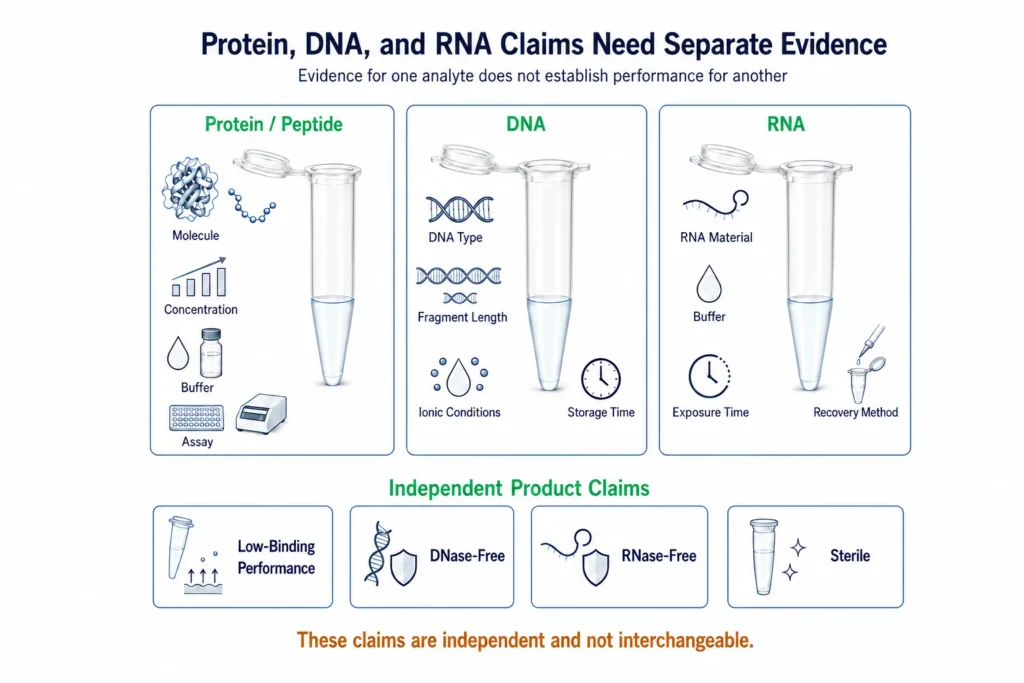
Protein adsorption is especially analyte-specific. Proteins differ in size, charge distribution, exposed hydrophobic regions, structural flexibility, and response to the surrounding buffer. An antibody, enzyme, albumin, membrane-associated protein, and short peptide can therefore show different recovery from the same tube.
Protein low-binding tubes are often evaluated with model proteins, antibodies, or peptides. Those tests provide useful evidence for the molecules and conditions studied, but even products within the same “protein low-bind” category may not perform equally for an unusual or structurally sensitive target.
A published study involving surfactant protein D illustrates this limitation. Tubes marketed as low-retention or low-binding reduced adsorption of a control IgG preparation under the test conditions, yet they unexpectedly increased adsorption of surfactant protein D compared with untreated polypropylene. The study does not show that low-binding tubes are generally ineffective. It shows that the response can depend on the individual protein and that a broad category claim cannot replace analyte-specific validation. View the original study.
Nucleic acids require a separate assessment. DNA and RNA carry negatively charged phosphate backbones, but recovery can still vary with fragment length, molecular structure, concentration, salt composition, storage time, and partial dehydration. Genomic DNA, short oligonucleotides, low-copy standards, sequencing libraries, and RNA preparations should not be treated as a single test material.
When evaluating DNA low-bind tubes, check whether the supporting data used double-stranded DNA, single-stranded DNA, a short labeled fragment, genomic DNA, or another defined material. Results obtained with one fragment in one buffer establish performance for that experiment, not every DNA application.
The same applies to RNA low-bind tubes. The data should identify the RNA material, concentration, buffer, exposure time, and recovery method. Reduced surface adsorption also does not protect RNA from nuclease contamination or chemical degradation. Low-binding performance and RNase-free status remain separate requirements.
| Claim | Evidence Needed and Main Limitation |
|---|---|
| Protein low-binding | Identify the protein or peptide, concentration, buffer and detection method. One model protein cannot represent every protein. |
| DNA low-binding | Identify the DNA type, fragment length, concentration, ionic conditions and storage period. One DNA result does not establish RNA performance. |
| RNA low-binding | Identify the RNA material, buffer, exposure time and recovery method. The claim does not establish RNase-free status. |
| General low-binding | Confirm which analyte categories were tested. A broad label without corresponding data has limited comparative value. |
Some suppliers separate protein and nucleic acid products, while others use one low-binding grade for several sample categories. Neither format is automatically better. The relevant question is whether the evidence covers the analyte the laboratory needs to recover.
This distinction narrows the product choice before price or packaging is considered. A specialized surface adds value only when its analyte claim matches a real recovery risk in the intended application.
When Are Low-Binding Microcentrifuge Tubes Worth Using?
The decision depends on risk rather than sample volume alone. Low-binding tubes become relevant when surface adsorption could remove enough analyte to change a measurement, reduce biological activity, or increase variation between replicates.
Three questions help identify that risk:
- Is the total amount or concentration of the target analyte low?
- Will the sample have substantial or repeated contact with plastic?
- Would a small loss affect the downstream result?
When all three answers are yes, testing a low-binding tube is usually justified.
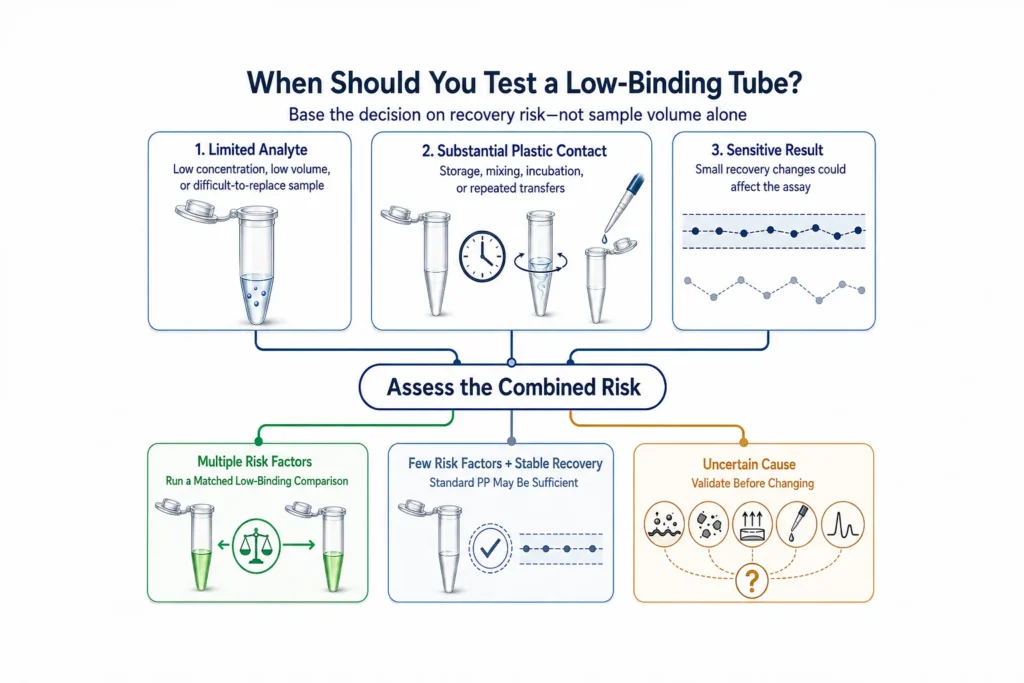
Low-Binding Tubes Are More Likely to Help
Consider low-binding tubes for:
- dilute proteins, peptides, antibodies, or enzymes;
- low-copy DNA or RNA preparations;
- qPCR standards and serial dilutions;
- low-concentration sequencing libraries;
- small-volume samples with limited total material;
- extended incubation or storage in the tube;
- samples transferred through several containers;
- quantitative methods sensitive to small recovery changes.
Irreplaceable or expensive samples also justify a more conservative choice. Their value does not increase adsorption, but it reduces the acceptable risk of losing material or repeating the preparation.
Standard Polypropylene Tubes Are Often Sufficient
Standard PP tubes remain appropriate when:
- the sample is relatively concentrated;
- contact with the tube is brief;
- the step involves routine buffer or reagent handling;
- small losses would not affect the experimental decision;
- the method already produces stable recovery and repeatability;
- or the tube is used for a non-critical mixing or spin-down step.
Existing performance matters more than the product category. If a laboratory has already demonstrated reliable recovery with its standard tube, changing to a specialized surface may add cost without improving the result.
Validate Before Deciding
A comparison is more useful than an assumption when:
- the analyte has no established handling history;
- the buffer or formulation has changed;
- a new tube supplier or surface grade is being considered;
- the result is close to the method’s detection or quantification limit;
- or unexplained variation could come from adsorption, pipetting, degradation, or evaporation.
There is no universal concentration or volume at which a low-binding tube becomes mandatory. A concentrated antibody stock transferred once may be adequately handled in a standard tube, while a diluted working solution stored for several hours may benefit from a low-binding surface. The same distinction applies between a concentrated DNA stock and the lowest points of a qPCR dilution series.
A laboratory also does not need to replace every standard tube in a multistep process. Low-binding tubes can be reserved for the stages with the greatest recovery risk, such as final dilution, low-concentration storage, standard preparation, or handling immediately before a quantitative assay.
The most defensible choice is therefore neither “always use low-binding” nor “standard PP is always enough.” It is to identify the step where surface loss could change the outcome and evaluate the tube under that condition. If a specialized tube is warranted, the next task is determining whether the supplier’s claim actually supports the intended use.
Why Low-Binding Claims Cannot Be Compared by Label Alone
There is no single cross-manufacturer threshold that places every low-binding microcentrifuge tube on the same performance scale. Similar labels may be based on different analytes, reference tubes, exposure conditions, and measurement methods.
The surface technology may also differ. Reduced adsorption can come from the polymer formulation, additives incorporated into the resin, a bonded treatment, a coating, or another manufacturing approach. A coating-free product is not automatically better than a treated surface, and a proprietary formulation is not automatically more effective. The relevant evidence is how the finished tube performs with the intended sample.
A useful review of a supplier claim asks six questions:
- What analyte was tested?
- At what concentration and volume?
- Which buffer, temperature, and contact time were used?
- What tube or initial measurement served as the control?
- How was adsorption or recovery measured?
- Does the result apply to the exact product being quoted?
The reference condition can change the apparent size of an improvement. A candidate may be compared with a standard PP tube from the same supplier, a conventional tube from another manufacturer, another low-binding product, or the sample before surface contact. “Higher recovery” has little comparative value unless that reference is identified.
The reported endpoint also needs interpretation. These measurements answer different questions:
- Material detected on the tube wall provides evidence of adsorption.
- Analyte remaining in solution estimates sample recovery.
- Concentration measurements require stable or measured sample volume.
- PCR, fluorescence, enzyme activity, or mass-spectrometry signals evaluate a downstream effect that may include variables beyond adsorption.
A tube can perform well by one endpoint without supporting every other type of claim.
Percentages are meaningful only with their test conditions. For example, “up to 95% recovery” may accurately describe the best or specified result from a defined experiment. It does not establish a minimum recovery of 95% for every protein, DNA fragment, buffer, or storage period. The analyte, comparator, and protocol determine how closely the number applies to another laboratory.
Supplier-generated data remain useful. They show how the manufacturer defines the claim and help identify candidates for further evaluation. The limitation is not that the data come from a supplier; it is that a published protocol cannot reproduce every sample formulation and handling sequence.
A strong comparison therefore focuses on relevance rather than the largest advertised percentage. The most promising tube is the one supported by evidence closest to the intended analyte, concentration, solution, and contact conditions. A controlled recovery test can then determine whether that advantage remains meaningful in the laboratory’s own process.
How to Validate Sample Recovery in Your Actual Workflow
Supplier data can identify promising tubes, but the final comparison needs to reflect the laboratory’s own sample and handling conditions. The test question should be narrow enough to answer with evidence, for example:
“Does the candidate tube improve recovery and repeatability for our diluted enzyme after preparation and four hours of storage?”
Before testing, define what result would justify changing products. The acceptance criterion may be based on recovery, allowable bias, variation between replicates, biological activity, or downstream assay performance. There is no universal passing percentage, but the criterion should be set before the results are reviewed.
Build a Controlled Comparison
Include the tube currently used and the candidate low-binding tube. A well-characterized reference tube can be added when useful. Prepare all conditions from the same homogeneous sample stock so that preparation differences are not mistaken for surface effects.
Use several independent tubes for each condition. One control tube and one candidate tube cannot separate a genuine product difference from pipetting or analytical variation. Randomizing or interleaving the processing and measurement order also reduces the influence of time drift and instrument order.
The comparison should reproduce the part of the process where recovery matters:
- Use the actual analyte whenever sufficient material is available. If a surrogate is required for initial screening, confirm the final choice with the real sample.
- Include the lowest routine concentration or another realistically challenging level.
- Use the actual working volume, buffer, temperature, and contact time.
- Reproduce relevant mixing, centrifugation, storage, and transfer steps.
- Keep the pipette tips, pipetting procedure, operator technique, and recovery method consistent.
- Include an initial measurement before the defined contact period.
- Include a blank or matrix control to identify analytical background or buffer interference.
- Measure the result with a method relevant to the real experimental decision.
Testing only an extreme condition can exaggerate a difference that rarely matters. Testing only an easy condition can hide a problem at the low end of the method. When sample availability allows, include one routine condition and one higher-risk condition.
Calculate Recovery Correctly
Recovery can be expressed as:
Recovery (%) = (Recovered analyte amount after contact / Initial analyte amount) × 100
Use background-corrected values when the analytical method requires blank subtraction.
Total analyte amount is more reliable than concentration alone if sample volume may change. A higher final concentration does not demonstrate better recovery when evaporation has reduced the liquid volume. If volume remains controlled and verified, concentration can serve as the comparison.
Measure the Outcome That Matters
The detection method should match the application. Protein concentration alone may be insufficient when the experiment depends on enzyme activity or antibody function. A qPCR dilution series may be better evaluated through Cq consistency, calculated copy number, and standard-curve performance. Peptide workflows may require comparison through the number and intensity of signals detected by the downstream analytical platform.
This distinction has practical consequences. A published study found that adsorption of recombinant progranulin to polypropylene tubes altered its working concentration and could create artifacts in functional experiments. The example shows why a validation should examine the relevant downstream result rather than assuming that a general concentration measurement captures every effect. View the published study.
Compare both average recovery and variation between tubes. A candidate with slightly higher average recovery but poor repeatability may not improve a quantitative method. A smaller recovery increase combined with lower variation may be more useful.
If every tube condition shows a similar decline, investigate sample degradation, pipette-tip adsorption, incomplete mixing, evaporation, or assay interference. A consistent difference between matched tube conditions makes surface interaction more plausible, although direct analysis of material on the wall would provide stronger confirmation.
Begin with a focused screening test, then repeat the comparison through the complete handling sequence before approving the product. This keeps the initial experiment manageable while ensuring that the final decision reflects the conditions under which the tube will actually be used.
How to Compare Low-Binding Tubes Before Bulk Purchase
After a candidate passes the recovery test, the approved product needs to be translated into a purchasing specification. The purpose is to prevent a standard PP tube or a different surface grade from being supplied simply because it has the same capacity, shape, and cap style.
“1.5 mL polypropylene microcentrifuge tube” is not specific enough when surface performance matters. The quotation, sample label, purchase order, and final packaging should identify the same product code and low-binding grade used during qualification.
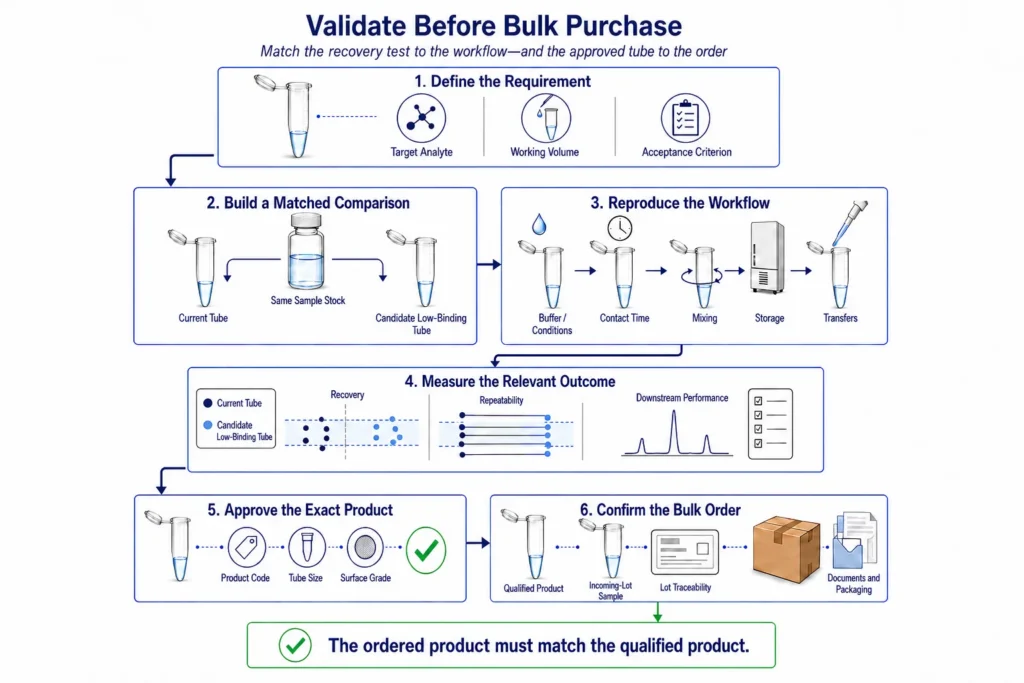
The purchasing review can focus on six controls:
| Purchase Control | What to Confirm |
|---|---|
| Exact product identity | Product code, tube size, surface grade, and any suffix identifying the low-binding version |
| Sample-to-order consistency | Whether the evaluation sample represents the product that will be supplied commercially |
| Available documentation | Technical data, test summaries, purity information, and certificates available for the quoted configuration |
| Lot traceability | Whether received tubes can be linked to a production lot and applicable quality records |
| Product-change communication | Whether changes to resin, surface treatment, manufacturing site, or sterilization process can be communicated |
| Commercial configuration | Packaging, carton quantity, MOQ, lead time, and supply continuity |
The supplier may not disclose a proprietary resin formulation or surface process in detail. A useful response can still define the intended analyte category, describe the technology at an appropriate level, and explain what performance evidence is available. If supporting data are limited, the buyer can rely more heavily on its own recovery comparison rather than treating the absence of a published percentage as proof of poor performance.
Qualification samples should be identifiable and representative. An unlabeled development sample is less useful if it cannot be connected to the final quotation. At minimum, record the supplier, product code or sample reference, surface grade, date received, and any lot information provided.
The laboratory should also retain a short approval record containing:
- the qualified product and supplier;
- the intended analyte and application;
- the sample or production lot evaluated;
- the test conditions and acceptance criteria;
- the recovery and repeatability results;
- and the changes that would require re-evaluation.
A full study is not necessary for every delivery. Re-evaluation becomes relevant when the supplied product changes materially or when the laboratory introduces a substantially different analyte, buffer, concentration range, or storage condition.
Low-binding performance does not replace the normal tube specification. Capacity, closure, centrifugation suitability, cleanliness level, packaging, and equipment compatibility still need to match the application. These general factors can be checked through the laboratory’s existing microcentrifuge tube selection process without repeating them in the low-binding qualification.
For an efficient quotation request, buyers can provide:
- target analyte or sample category;
- required tube capacity and working volume;
- expected contact or storage conditions;
- required sterility or purity grade;
- estimated order quantity;
- and whether samples or supporting recovery information are needed.
At Kelabscience, we offer low-binding microcentrifuge tubes as an optional configuration rather than the default standard PP version. When you contact us, share the information above so we can identify the intended configuration and confirm what samples, specifications, and supporting documents are available before you commit to a bulk order.
Conclusion: Choose Based on Recovery Risk and Evidence
Low-binding microcentrifuge tubes are valuable when surface adsorption could remove enough protein, peptide, DNA, or RNA to affect the result. They are not a necessary upgrade for every routine sample.
A sound choice begins with the analyte and the consequence of loss. Identify the step where plastic contact presents a meaningful risk, then check whether the supplier’s claim covers a relevant molecule and set of test conditions. Similar labels do not guarantee equivalent performance.
When recovery is critical, compare the candidate with the current tube using the actual sample, buffer, working volume, contact time, and downstream measurement. The result should meet a predefined requirement for recovery, repeatability, activity, or analytical performance.
After qualification, record the exact low-binding grade and product code so the bulk order matches the tube that was tested. Standard specifications such as capacity, closure, cleanliness, packaging, and centrifugation suitability still need to fit the application.
The best tube is not the one with the broadest claim or highest advertised percentage. It is the one that delivers sufficiently consistent recovery for the sample and conditions that matter.
To discuss low-binding microcentrifuge tube specifications, sample availability, or bulk configurations, contact us with your target analyte, working volume, required purity grade, and expected order quantity.