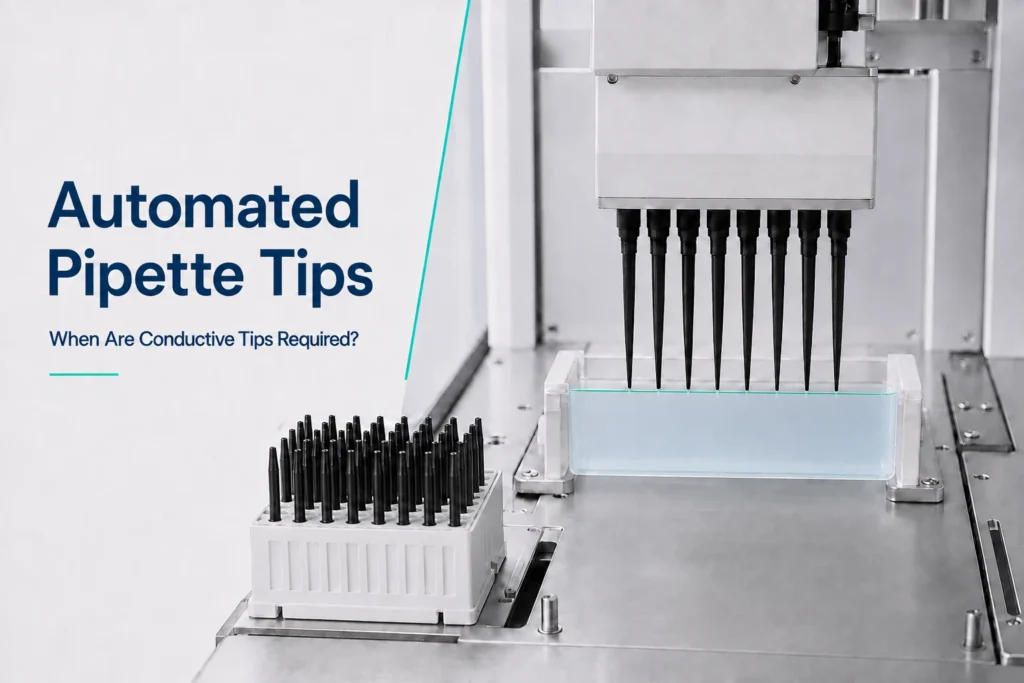
Automated pipette tips are often shortlisted by nominal volume and a general claim of robotic compatibility. That may be enough for an initial comparison, but it does not show how a tip will behave through a complete automated run. When fitting a tip manually, an operator can feel unusual resistance, reseat a loose connection, or adjust the immersion depth by sight. An automated liquid handler repeats the programmed movement without making those small corrections. A minor difference in collar geometry, tip length, rack position, or sealing force can affect an entire row or plate.
Conductivity adds a separate decision. Automated or robotic pipette tips may be conductive or non-conductive, depending on the workstation and method. On platforms that use capacitive liquid level detection, the conductive tip participates in locating the liquid surface before aspiration. Reliable operation still depends on the liquid, sensing settings, mounting interface, and rack—not conductivity alone.
A sound selection process starts by confirming how the instrument detects liquid and whether the method requires a conductive tip. Mechanical fit, working volume, filter and cleanliness requirements, packaging, and on-instrument validation follow from that first decision. This sequence keeps the discussion focused on the actual workflow and begins with an important distinction: “automated” describes where the tip is used, while “conductive” describes one function it may provide.
Automated Pipette Tips Are Not All Conductive
Supplier catalogs may describe the same general product family as automated pipette tips, robotic pipette tips, or automation pipette tips. These terms refer to tips intended for machine-operated liquid handling, where pickup, sealing, positioning, and ejection follow programmed movements. They do not indicate whether the tip is electrically conductive.
Conductive pipette tips are generally made from polypropylene containing a conductive additive. The material allows the tip to couple with a compatible instrument’s capacitive sensing circuit. Although these tips are commonly black, color alone does not confirm conductivity, electrical performance, or platform compatibility. Non-conductive automated tips are often clear or natural in color and can be appropriate for methods that do not detect liquid capacitively.
Other tip features remain independent of conductivity. Conductive and non-conductive options may both be filtered or non-filtered, sterile or non-sterile, and available with different bore designs. Each feature answers a separate workflow requirement. A filter helps limit aerosol transfer into the pipetting channel, for example, while a wide-bore opening changes how viscous or fragile samples move through the tip. Neither feature determines whether the instrument can use the tip for liquid-level sensing.
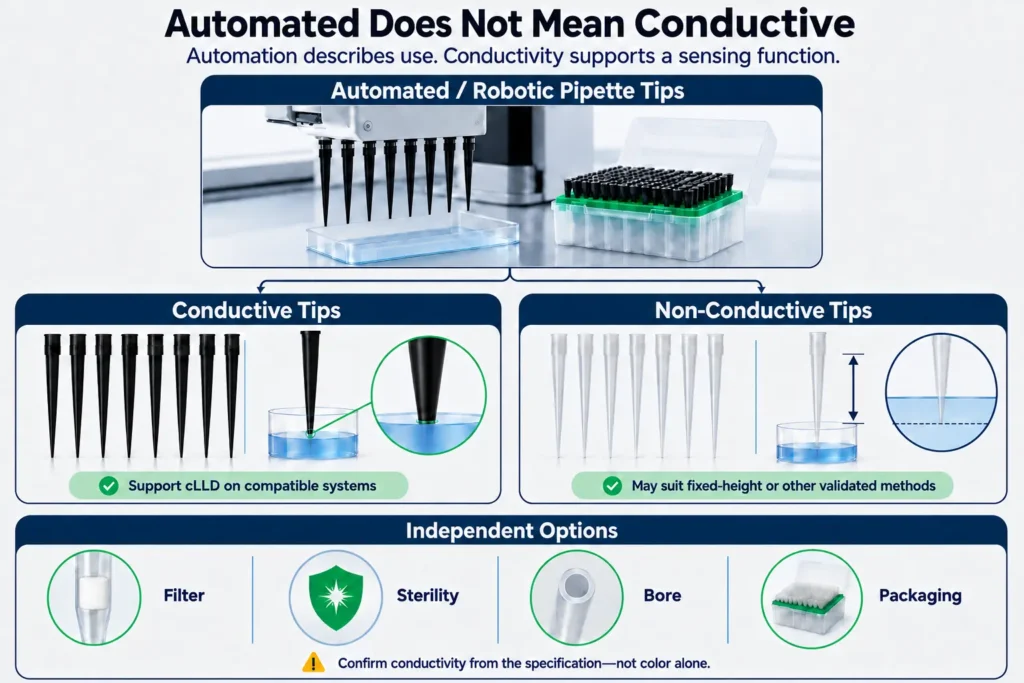
This distinction becomes practical when one laboratory runs different methods on the same automation platform. A fixed-height transfer may not use conductivity, while another method relies on a conductive tip to locate a changing liquid surface. The correct choice follows the sensing method and workflow, not the appearance of the tip. Understanding how the sensing circuit uses that conductive path explains why the difference matters.
How Conductive Pipette Tips Enable Liquid Level Detection
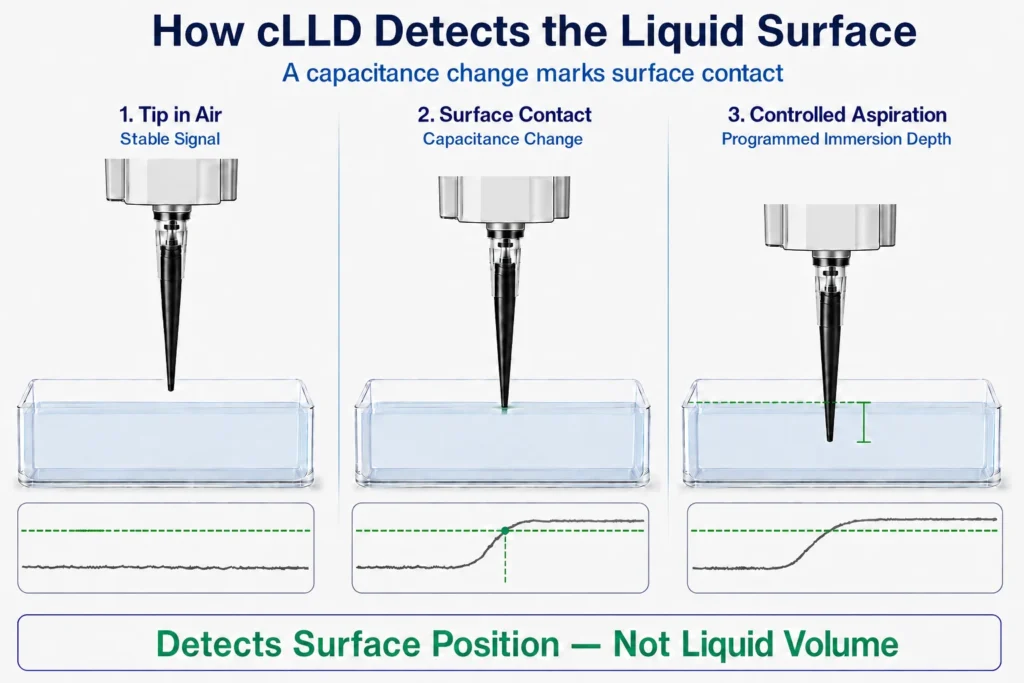
In capacitive liquid level detection, or cLLD, the pipetting channel monitors the electrical capacitance associated with the conductive tip as it moves toward the liquid. The signal remains relatively stable while the tip is in air. When the tip contacts a sufficiently conductive liquid, the measured capacitance changes. Once that change meets the instrument’s detection threshold, the system records the vertical position of the liquid surface.
The detected position then becomes a reference for the programmed aspiration movement. Depending on the method, the tip may move a defined distance below the surface before aspirating and continue tracking the surface as the volume changes. The tip is not measuring how much liquid is present. It is locating the surface at a particular moment. Container geometry, the programmed liquid class, aspiration depth, detection speed, and other method settings still determine what happens after the surface is found.
A reagent reservoir used for repeated transfers shows the practical value of this function. Its liquid level falls throughout the run, so one fixed aspiration height may become unsuitable as more reagent is removed. If the tip remains too close to the surface, it may draw in air. If it enters more deeply than necessary, more of the outer wall becomes wetted. A method using cLLD can re-establish the surface position and aspirate from a controlled depth, helping the system maintain a more consistent approach as the reservoir is depleted.
The result still depends on more than the tip. Liquid conductivity, bubbles, foam, vessel shape, starting volume, detection speed, and sensitivity settings can all affect whether the surface is identified reliably. cLLD also cannot correct an unsuitable liquid class, an incorrect labware definition, or a poor mechanical seal between the tip and the channel.
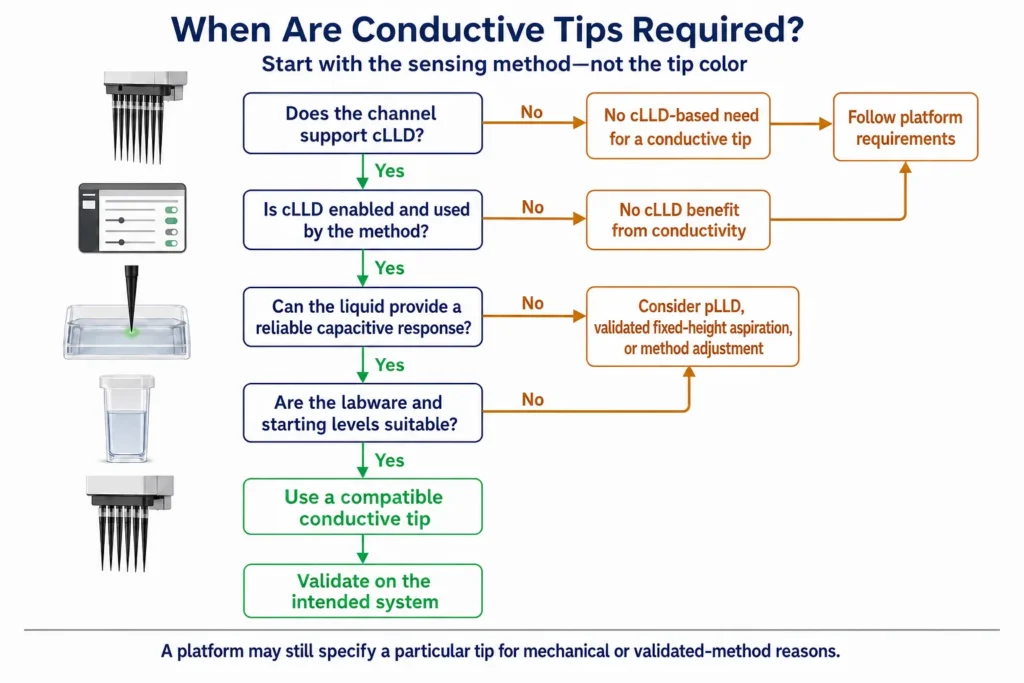
Conductive automated pipette tips enable the sensing path, but the complete method determines whether that signal is useful. Before treating conductivity as a required specification, the laboratory needs to confirm that the workstation supports cLLD, the method has it enabled, and the liquid can produce a detectable response.
When Does an Automated System Actually Require Conductive Tips?
Conductive pipette tips become a functional requirement when the pipetting channel performs capacitive liquid level detection through the tip and the method depends on that detection result. Substituting a non-conductive tip in this situation can prevent the system from identifying the liquid surface. The instrument may report a detection error; its exact response will depend on the error-handling behavior configured in the method.
The requirement begins with the workstation and protocol. Some automated platforms support more than one detection mode, and the same instrument may use cLLD in one method but not in another. Transfers from containers with known geometry and consistent fill volumes can sometimes use a fixed aspiration height. Other systems offer pressure-based liquid level detection, or pLLD, which identifies the surface through pressure changes in the air gap and does not depend on an electrically conductive liquid.
Conductivity is most valuable when the surface position varies between containers or changes during the run. Primary sample tubes may arrive with different fill volumes, partially used reagent vessels may start at unpredictable levels, and repeated aspiration gradually lowers the surface. In these workflows, cLLD allows the method to locate each surface instead of assuming that every transfer begins at the same height.
Liquid properties remain part of the decision. Aqueous buffers, serum, DNA solutions, and liquids containing dissolved salts often provide a usable capacitive response. Ethanol-rich mixtures, DMSO, highly purified water, and some organic solvents can be more difficult to detect. Actual performance varies with the platform, labware, volume, and detection settings. A conductive tip carries the sensing signal, but it does not change the conductivity of the liquid.
Practical Example: Serum Samples and an Ethanol-Based Wash
Consider an automated workflow that processes variable-volume serum tubes and later dispenses an ethanol-based wash solution. The serum samples may be suitable for cLLD because both the starting height and sample volume vary, while the liquid usually provides a detectable response. Surface detection helps the instrument establish an aspiration position for each tube.
The ethanol-based wash presents a different condition. Even if the same workstation and conductive tips are used, its lower conductivity may produce an unstable cLLD response. That step may need separately optimized detection settings, pLLD, or a validated fixed height. Applying one detection strategy to both liquids can create intermittent errors that appear only during certain parts of the run.
Before specifying conductive automated pipette tips, confirm that the channel supports cLLD, the method has cLLD enabled, the liquid produces a reliable response, and the labware and starting volume allow stable surface detection. Instrument documentation may still specify a particular conductive tip design for mechanical or validated-method reasons, even when cLLD is not active. Once the need for conductivity is clear, the selected tip must also prove that it can mount, seal, reach the labware, and eject correctly on the intended system.
Why Conductivity Alone Does Not Guarantee Compatibility
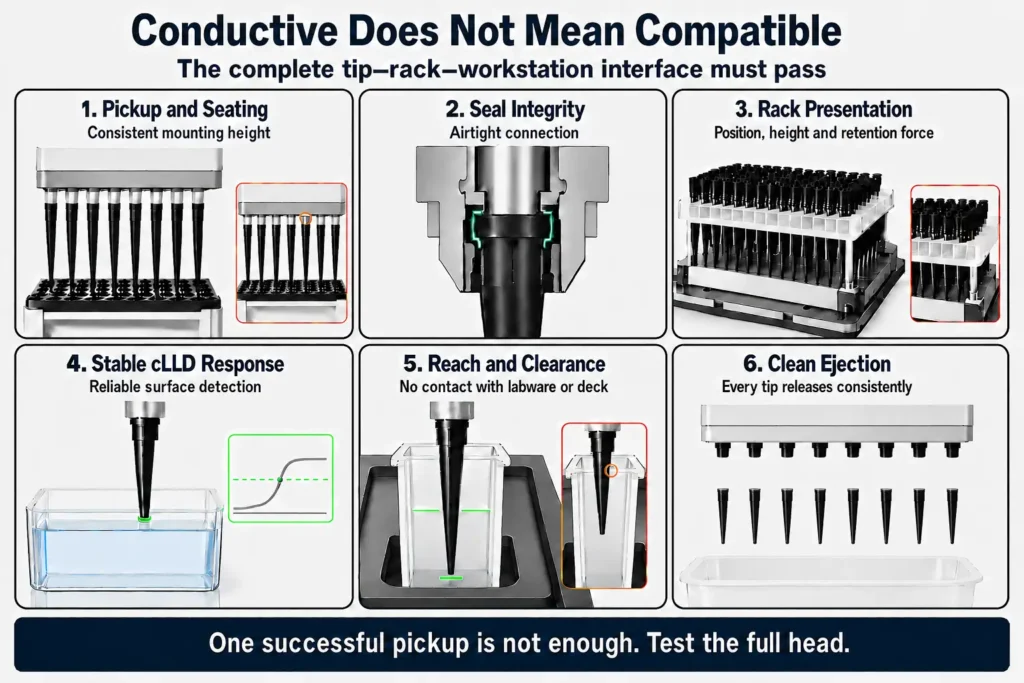
Confirming that a method requires conductive pipette tips narrows the product category, but it does not establish compatibility. Reliable operation depends on a series of mechanical and electrical interactions between the tip, pipetting channel, rack, and instrument method. A conductive tip may support capacitive sensing while still mounting unevenly, sealing poorly, or failing to eject consistently.
Nominal capacity is not a dependable shortcut. Two tips labeled 1000 µL may differ in collar diameter, insertion depth, overall length, taper profile, and sealing surface. Small variations around the mounting interface can change the force required for pickup and the final seating height. A tip may appear secure during a manual check but behave differently when an automated head collects an entire row or rack in one movement.
Mechanical compatibility therefore has several checkpoints. Each channel needs to pick up its tip at a consistent height without excessive force. The mounted connection must remain airtight during aspiration and dispensing. The lower-tip geometry must reach the intended labware without contacting tube rims, well walls, or other deck components. At the end of the cycle, every tip needs to release cleanly without remaining on the channel or disturbing adjacent positions. Success at one stage does not confirm performance at the others.
Rack presentation is equally important. Automated workstations approach tips at programmed coordinates, so rack footprint, spacing, tip height, and retention force all influence pickup. Bulk tips may have the correct mounting geometry but still require a validated rack or loading process that holds every tip upright and at a consistent presentation height. Tilting or uneven seating within the rack can create pickup errors even when the dimensions of an individual tip appear acceptable.
Why a Single Pickup Test Can Be Misleading
A candidate tip may work during a short or single-channel trial and become inconsistent when the full multi-channel head is used. Most positions may seal correctly, while a few tips sit slightly higher or require more mounting force. The resulting symptoms can include intermittent aspiration errors, residual liquid in selected tips, missed liquid detection, or occasional ejection failures.
Because most positions complete the movement successfully, the instrument or method may initially appear to be the source of the problem. Repeating pickup and ejection across the full head, then comparing seating height, rack presentation, and tip dimensions at the affected positions, can reveal a small interface difference that was not visible during the first test.
Electrical compatibility also requires direct confirmation. A tip can be made from conductive polypropylene and still produce an unstable cLLD response if its contact geometry, seating position, or electrical characteristics do not match the sensing system. These requirements need to be checked against the product specification and verified on the intended workstation under representative operating conditions.
Compatibility should ultimately be tied to a specific workstation, pipetting head, rack format, and method. Once mounting, sealing, rack presentation, electrical response, and ejection have been shown to work together, the selection process can move to the workflow-specific requirements covered next: working volume, tip length, bore design, filtration, cleanliness grade, surface properties, and packaging.
Match the Tip Configuration to the Liquid Handling Workflow
After confirming system compatibility, the next question is which tip configuration suits the transfer itself. Conductivity supports the sensing function, but it does not determine the appropriate working volume, tip length, bore, filter, cleanliness grade, surface behavior, or packaging format. These specifications need to follow the liquid, labware, contamination risk, and loading process used in the method.
Capacity should match the routine working range rather than only the largest volume in the protocol. Lower-capacity tips are generally better suited to repeated small-volume transfers, while larger formats support bulk reagent dispensing, multidispense methods, and procedures that require additional capacity for air gaps or excess aspiration volume. Common conductive automated tip capacities include 50, 200, 250, 300, and 1000 µL, with other volumes used by particular platforms. The selected format must remain within the validated operating range of the pipetting channel.
Overall length and bore geometry affect both labware access and sample handling. Longer tips may be needed for deep-well plates, tall tubes, or containers with narrow openings, but they can create clearance problems when the deck layout was developed around a shorter design. Standard-bore tips suit many routine aqueous transfers. Wide-bore options can reduce flow restriction when handling viscous liquids, cell suspensions, fragile biological material, or high-molecular-weight DNA. Appropriate aspiration and dispensing settings are still required; a larger opening cannot compensate for an unsuitable liquid class or excessive pipetting speed.
| Selection factor | Practical question to confirm |
|---|---|
| Working volume | Is the routine transfer near the lower, middle, or upper end of the tip’s intended range? |
| Tip length | Can the tip reach the liquid without contacting the container or interfering with the deck? |
| Bore design | Does the sample require standard flow or gentler handling through a wider opening? |
| Filter | Is aerosol protection needed for the pipetting channel or contamination-sensitive workflow? |
| Cleanliness grade | Does the method require sterile, DNase/RNase-free, non-pyrogenic, or other documented conditions? |
| Packaging | Will the workstation pick up from a rack, an automated loader, or a prepared tip carrier? |
Filter pipette tips are often selected for PCR setup, nucleic acid workflows, diagnostic sample handling, and other procedures where aerosol transfer into the pipetting channel is a concern. The liquid should not normally reach the filter, so usable capacity, air gaps, and aspiration settings still need to be considered. A filter does not make a tip sterile or nuclease-free. Sterility, DNase/RNase-free status, non-pyrogenic claims, and other cleanliness requirements must be confirmed separately for the exact product configuration.
Low-retention performance is another independent choice. It can improve liquid recovery when a method handles detergents, protein solutions, viscous reagents, or small volumes where a film remaining on the inner wall represents a meaningful proportion of the transfer. Retention behavior can vary between reagents, so the surface should be evaluated with the intended liquid rather than selected from a general low-retention claim alone.
Packaging determines how the tips are presented to the instrument. Racked formats allow direct automated pickup when the rack matches the deck and pipetting head. Bulk tips may suit an automated loader, a controlled repacking process, or a high-volume supply arrangement, but the loading method must preserve orientation, cleanliness, and presentation height. Correct tip geometry does not make bulk packaging automatically interchangeable with a validated automation rack.
The difference between two common workflows shows why one configuration rarely covers every method. An automated NGS setup may prioritize low-volume performance, filters, documented cleanliness, low-retention surfaces, and ready-to-load racks. High-volume buffer dispensing may instead use a larger conductive tip, no filter, and a validated bulk-loading arrangement. Both workflows use conductive automated pipette tips, but they impose different requirements on the final configuration.
A specification table can identify a promising option, but it cannot demonstrate repeated pickup, stable liquid detection, transfer performance, or reliable ejection. Those questions need to be answered through a controlled comparison on the intended automated system.
Validate Conductive Tips on the Actual Automated System
Validation needs to reproduce the conditions that will challenge the tips during routine operation. Product drawings and nominal specifications can narrow the options, but they cannot reproduce pickup forces, sensing conditions, deck movements, or repeated ejection. Testing should therefore use the intended workstation, pipetting head, rack or carrier, labware, and method settings. Pressing one tip onto a channel by hand is useful for an initial dimensional check, but it does not represent the behavior of a complete automated head.
A matched comparison provides a practical starting point. If the laboratory already uses a validated tip, test the candidate and reference under the same conditions with the same liquid, labware, transfer volume, and instrument method. Include multiple tips, channels, and rack positions rather than selecting only the easiest positions to observe. This helps separate differences caused by the candidate tip from normal variation in the instrument or method.
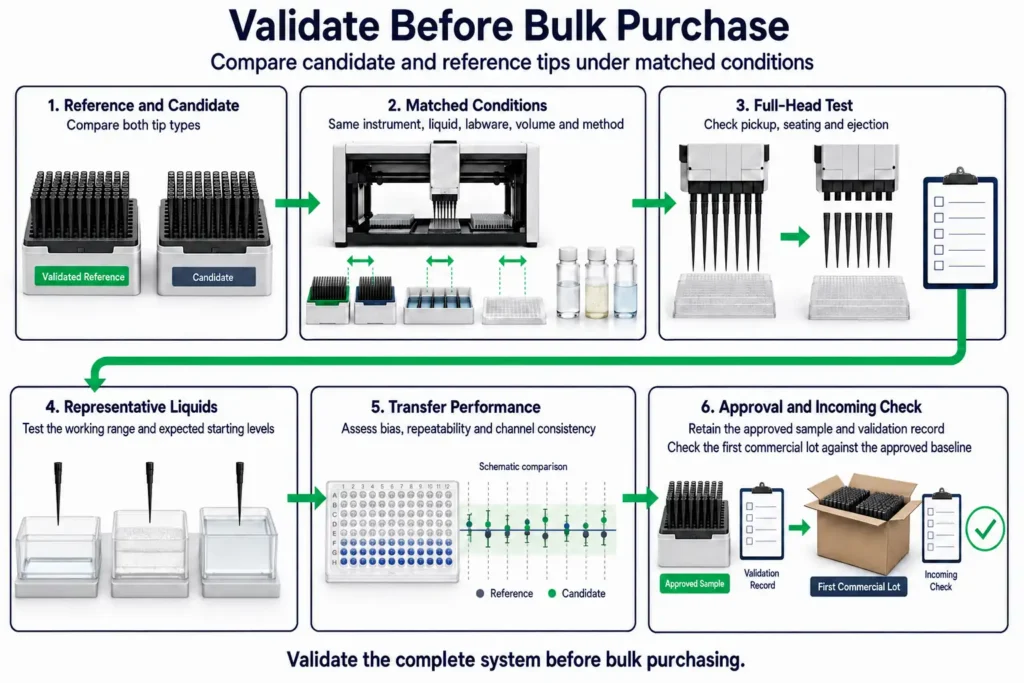
Define the acceptance criteria before reviewing the results. Depending on the workflow, these may cover successful pickup and ejection, seating-height consistency, absence of leakage, liquid-level detection success, transfer bias and repeatability, channel-to-channel consistency, and completion of the representative run without tip-related errors. The limits should follow the laboratory’s method requirements and quality procedures rather than being decided after the test results are known.
Begin with repeated pickup and ejection across every channel used by the method. The tips should mount at a consistent height, remain secure during movement, and release without a second ejection attempt. Watch for tilted tips, unusual pickup sounds, partial attachment, excessive mounting force, or tips retained on individual channels. Repeating the cycle can reveal intermittent behavior that one successful pickup would miss.
Liquid testing needs to cover the intended working range and representative reagents. Where cLLD is used, include the expected minimum and maximum starting levels in the actual containers. Record missed or false surface detections, excessive immersion, droplets on the outer wall, visible residual liquid, and instrument-reported aspiration or dispensing errors.
Water alone is rarely a sufficient challenge. A candidate may work with a clean aqueous buffer and behave differently with a foaming solution, viscous sample, or low-conductivity wash liquid. That difference does not automatically identify the tip as defective. Detection sensitivity, aspiration speed, liquid class, container definition, or the selected sensing method may need adjustment. Testing representative liquids helps distinguish a mechanical compatibility problem from a method-development problem.
Where transfer performance is critical, use an appropriate gravimetric or photometric procedure to evaluate volumetric performance. The assessment can include bias, repeatability, channel-to-channel consistency, leakage, residual volume, and performance near the lower and upper ends of the intended working range.
For a formal study, the test design can be aligned with ISO 23783-2, while data evaluation and reporting can follow the principles in ISO 23783-3. These standards treat the tips as part of the installed automated liquid handling system, reinforcing the need to assess the complete operating configuration.
Record the instrument model, pipetting-head configuration, candidate and reference tip identification, rack or carrier, liquid, labware, method settings, environmental conditions, number of replicates, acceptance criteria, and results. Sufficient documentation allows the comparison to be repeated and helps the laboratory determine whether a later change comes from the tip, product lot, instrument, or method.
Complete the evaluation with a representative automated run rather than a few isolated movements. Once the candidate is approved, retain the validated setup, acceptance criteria, and results as the purchasing reference. Perform a shorter incoming check on the first commercial lot and consider repeating relevant checks when the tip lot, rack, packaging configuration, instrument setup, or method changes. This creates a practical connection between initial compatibility testing, batch consistency, and repeat procurement.
Procurement Checklist for Conductive Automated Pipette Tips
A quotation request for automated pipette tips needs to describe the system and workflow, not just the tip color and nominal capacity. “Black conductive tip, 1000 µL” may refer to several products with different mounting interfaces, overall lengths, rack formats, and cleanliness grades. A more complete request gives the supplier enough information to identify a realistic starting configuration and reduces avoidable compatibility discussions later.
| Information to provide | Why it matters |
|---|---|
| Workstation brand and model | Identifies the platform and general deck configuration |
| Pipetting head or channel type | Clarifies the pickup interface and number of tips collected together |
| Current tip reference or sample | Provides a dimensional and packaging comparison |
| Liquid-detection method | Confirms whether cLLD and conductivity are required |
| Routine transfer range | Matches the tip to the working volume rather than nominal maximum capacity |
| Liquid and application | Guides bore, filter, surface, and cleanliness choices |
| Rack or loading format | Determines how the tips must be presented to the instrument |
| Filter and cleanliness requirements | Separates filtration, sterility, DNase/RNase-free, and other specifications |
| Documentation and lot identification | Supports incoming checks, traceability, and repeat purchasing |
| Quantity, order frequency, and destination | Helps determine packaging, supply, and quotation requirements |
When an original part number or validated cross-reference is unavailable, buyers can provide tip dimensions, clear photographs of the mounting area and rack, or a physical reference sample. Useful dimensions include overall length, connection diameter, insertion depth, lower-tip geometry, and rack presentation height. These details help identify possible candidates, although they cannot replace an on-instrument comparison of pickup, sealing, sensing performance, and ejection.
Compare two typical inquiries:
We need a price for 1000 µL black robotic tips.
This identifies the general product family but leaves most compatibility questions unanswered. A more workable request would be:
We require conductive automated pipette tips for an [instrument model] using an [eight-channel/96-channel] head and capacitive liquid level detection. The routine transfer range is [volume range]. Please confirm available filtered or non-filtered options, cleanliness grade, rack or bulk packaging, documentation, and sample availability for compatibility testing.
The second request does not assume that one conductive tip fits every platform. It also creates a written purchasing specification that can be compared with the validation record and reused for repeat orders. If the instrument model or current reference is still uncertain, photographs and measurements can support the initial review, but the final decision should remain conditional on sample testing.
For a broader framework covering supplier review and bulk-delivery planning, see our laboratory consumables procurement guide.
Kelabscience supplies commonly used conductive pipette tips for automated liquid handling in multiple capacities and configurations. Buyers can share their workstation information, current tip reference, volume range, liquid or application, cleanliness requirements, packaging preference, expected quantity, and destination for specification review. If compatibility has not already been established, the approved sample and validation record should become the reference for the first commercial order and subsequent incoming checks.
Even with a complete purchasing specification, questions often remain about terminology, conductivity, liquid properties, and cross-platform fit. The following FAQs address the most common points without replacing model-specific confirmation and on-instrument validation.
Frequently Asked Questions About Automated and Conductive Pipette Tips
Are Automated Pipette Tips and Robotic Pipette Tips the Same?
The terms are commonly used for the same general product family: disposable tips intended for automated liquid handling instruments. “Robotic” emphasizes the workstation, while “automated” is the broader label. Neither term defines a universal interface, so the exact tip still needs to match the workstation, pipetting head, rack, and method.
Are All Automated Pipette Tips Conductive?
No. Automated pipette tips may be conductive or non-conductive. Conductive tips support electrical sensing functions such as capacitive liquid level detection. Non-conductive tips can be appropriate for fixed-height aspiration, pressure-based detection, or methods that do not sense liquid through the tip. Conductivity remains separate from filtration, sterility, bore, and packaging.
When Are Conductive Pipette Tips Required?
They are generally required when a compatible pipetting channel performs capacitive liquid level detection through the tip and the method relies on the detected surface position. Confirm the equipment instructions, method settings, and liquid properties before changing the specified tip. Some platforms may still require a particular conductive design for mechanical or validated-method reasons.
Can Conductive Pipette Tips Detect Non-Conductive Liquids?
A conductive tip enables the sensing path but does not increase the conductivity of the liquid. Ethanol-rich mixtures, DMSO, highly purified water, and some organic solvents may produce a weak or inconsistent cLLD response. Depending on the system, the method may require adjusted settings, pressure-based detection, or a validated fixed aspiration height.
Will Any Conductive Pipette Tip Fit My Automated Liquid Handler?
No. Tips with the same color and nominal capacity can differ in connection geometry, insertion depth, overall length, rack presentation, sealing surface, and ejection behavior. Conductivity does not confirm mechanical fit or a stable sensing response. Match the tip to the exact workstation and pipetting head, then verify it under the intended operating conditions.
Can Conductive Pipette Tips Be Filtered and Sterile?
Yes. Conductivity, filtration, and sterility are independent specifications. Conductive tips may be available with or without filters and in sterile or non-sterile configurations. DNase/RNase-free, non-pyrogenic, and other cleanliness claims also require separate confirmation. Review the documentation for the exact configuration instead of assuming that a filtered conductive tip meets every cleanliness requirement.
Conclusion: Choose Conductive Tips by System and Workflow
Selecting automated pipette tips begins with the workstation and method. When the pipetting channel uses cLLD, the liquid provides a reliable capacitive response, and the protocol depends on the detected surface position, conductivity becomes a functional requirement. Without those conditions, conductivity itself may add no liquid-detection benefit, although the platform may still specify a particular tip design for mechanical or validated-method reasons.
Once the sensing requirement is clear, the decision moves to system fit and workflow configuration. Connection geometry, sealing, rack presentation, working volume, bore, filtration, cleanliness grade, and ejection behavior all need to work together. A controlled comparison using representative liquids and the intended automated run provides stronger evidence than tip color, nominal capacity, or a general compatibility claim.
For configuration review, buyers can contact Kelabscience with their workstation model, current tip reference, intended volume range, and application. Where compatibility has not already been established, begin with a sample and document the on-instrument result before placing a bulk or repeat order.