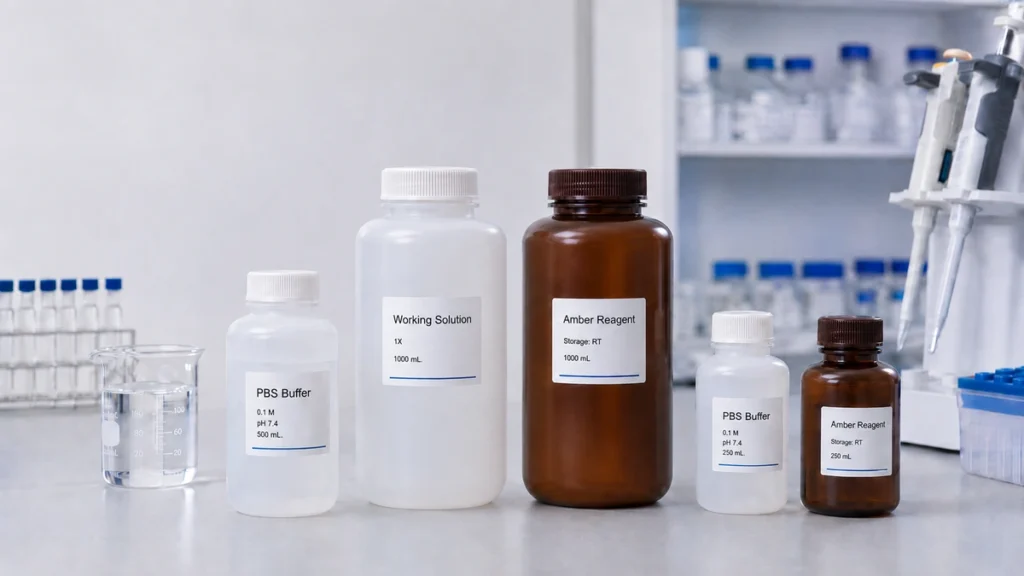
A plastic reagent bottle often looks like a simple storage container until it starts affecting daily laboratory work. A buffer bottle that is too large may be opened repeatedly by several users. A cap that does not close smoothly may become unreliable after weeks of routine handling. A clear bottle may be convenient for checking liquid level, while an amber bottle may be needed when light exposure is part of the storage concern.
These details are easy to overlook because reagent bottles are usually selected by volume, material, or price first. In practice, a bottle used for PBS buffer at the bench does not face the same requirements as one used for a solvent-containing solution, a light-sensitive reagent, or a working solution that moves between storage and the bench every day.
Plastic reagent bottles are widely used for buffers, aqueous solutions, prepared working solutions, and routine laboratory liquids. In this guide, routine chemical storage refers to compatible laboratory liquids and prepared solutions, not unrestricted storage of aggressive, unknown, or highly reactive chemicals. Their value is not simply that they are lighter than glass. When selected correctly, they can make frequent handling, labeling, refilling, storage, and bench use more practical.
For frequently used buffers, separating stock storage from daily working use can often make handling cleaner and more controlled.
This guide explains how to choose plastic reagent bottles by material, bottle design, cap sealing, color, chemical compatibility, and real workflow needs, with practical considerations for laboratories, distributors, and procurement teams.
When Plastic Reagent Bottles Are a Practical Choice
Plastic reagent bottles are most practical when a laboratory needs containers for routine liquids that are handled often and are compatible with the bottle material. These are usually not the most demanding chemical storage applications, but they are the situations where daily usability matters most.
Common examples include PBS buffer, washing buffer, dilution buffer, rinse solutions, salt solutions, and prepared aqueous working solutions. In these workflows, the bottle is opened, carried, labeled, refilled, and returned to storage many times. A suitable bottle should make these repeated actions easier, not simply hold the liquid.
This is especially relevant in teaching laboratories, shared preparation rooms, molecular biology workspaces, and general lab plastics storage areas. In these environments, bottles may move between shelves, refrigerators, sinks, and workstations throughout the day. When several users share the same solution, manageable bottle size, clear labeling, and reliable closure can matter more than a small difference in unit price.
A common mistake is assuming that a larger bottle is always more efficient. For a frequently used buffer, a large bottle may be useful for stock storage, but it is not always the best format for daily bench use. In many cases, a smaller daily-use bottle can make routine handling easier than repeatedly opening the main stock container.
Plastic reagent bottles also give laboratories flexibility in format. A small clear bottle may be suitable for a frequently used working solution. A square bottle may help save shelf space. A wide-mouth bottle may be more convenient for powders or viscous materials, while a narrow-mouth bottle may provide better control when pouring low-viscosity liquids.
The main limit is chemical compatibility, especially for solvent-containing, concentrated, oxidizing, or long-term storage applications. Plastic reagent bottles should not be treated as universal containers for every reagent.
In short, plastic reagent bottles are a practical choice when the stored liquid is compatible with the material and the bottle format supports how users handle, label, store, and replace the solution.
PP vs HDPE Reagent Bottles: How to Choose the Material
After confirming that a plastic reagent bottle is suitable for the workflow, the next decision is material. PP and HDPE are two common choices for laboratory reagent bottles. They may look similar in a product photo, but they can feel and perform differently in daily use.
The material choice should start with the stored liquid, handling environment, and storage conditions. A bottle used for routine buffer storage does not face the same requirements as one used for a concentrated solution, a solvent-containing reagent, or a liquid stored for a long period.
PP Reagent Bottles
Polypropylene, or PP, is widely used in laboratory plastic consumables because it offers a practical balance of rigidity, durability, and compatibility with many routine laboratory solutions. In reagent bottles, PP is often preferred when users want a bottle body that feels more shape-stable during pouring, labeling, and repeated handling.
This can be useful for compatible buffers, prepared aqueous reagents, and routine laboratory solutions. When users pour from a medium or large bottle, a more rigid body can feel easier to control than a softer plastic bottle.
A typical example is a molecular biology lab that prepares common buffers and uses them throughout the week. In this case, the bottle is not only holding liquid. It is part of a repeated handling process, so shape stability and ease of use both matter.
PP is also often considered when better heat tolerance is needed. However, buyers should avoid assuming that every PP reagent bottle is suitable for autoclaving or high-temperature treatment. If sterilization or heat exposure is required, the full product specification should be checked, not the PP material name alone.
HDPE Reagent Bottles
High-density polyethylene, or HDPE, is another common material for plastic reagent bottles. Compared with PP, HDPE usually feels more flexible and impact-resistant. This makes it useful in laboratories where bottles are frequently moved, carried, handled by different users, or stored in busy areas.
HDPE reagent bottles are often used for compatible aqueous solutions, rinse solutions, salt solutions, dilution buffers, and general laboratory storage. Their lighter handling feel can be helpful in teaching labs, shared workspaces, and preparation rooms where bottles are used by multiple people during the week.
For example, a preparation room may supply washing buffers or dilution solutions to several benches. If the liquid is compatible with HDPE, the bottle can be practical because it is lightweight, durable, and less fragile than glass.
The flexibility of HDPE can also require attention. If a bottle is very full, accidental squeezing may affect pouring control. For larger bottles or frequent pouring, wall thickness and bottle shape should be reviewed together.
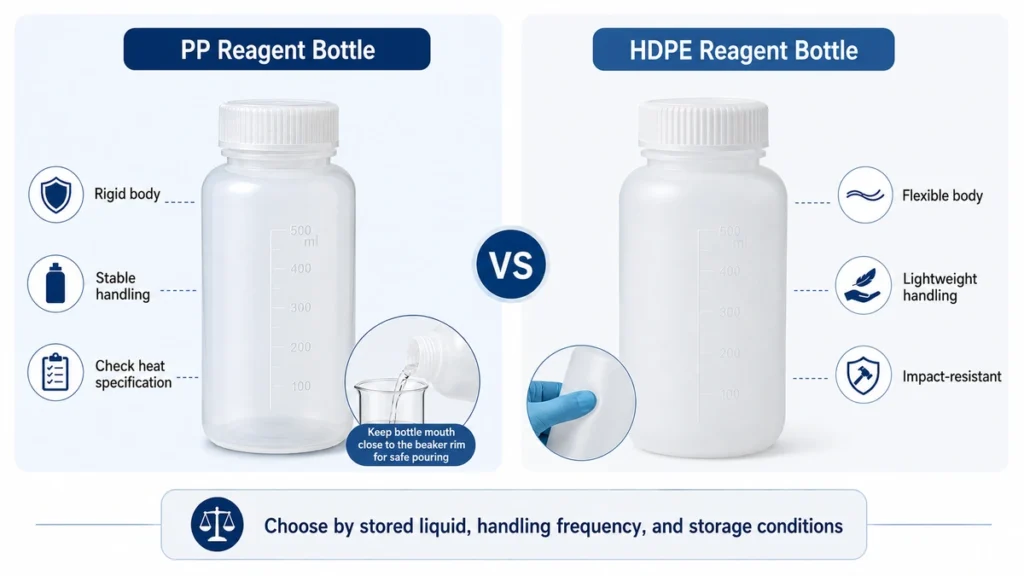
Practical Comparison Between PP and HDPE
| Selection factor | PP reagent bottles | HDPE reagent bottles |
|---|---|---|
| Handling feel | More rigid and shape-stable | More flexible and impact-resistant |
| Common use | Buffers, prepared reagents, routine aqueous solutions | Buffers, rinse solutions, dilution solutions, general storage |
| Pouring control | Often feels more stable in medium or large bottles | Depends more on wall thickness and bottle shape |
| Temperature consideration | May be considered when better heat tolerance is needed, if the full specification supports it | More common for routine ambient or cold storage |
| Main caution | Do not assume every PP bottle is autoclavable as a complete assembly | Do not assume HDPE is suitable for all solvents or long-term storage |
Common Misunderstandings About PP and HDPE Bottles
One common misunderstanding is that PP is always the “better” laboratory plastic. In reality, PP may be better for some workflows because of its rigidity and temperature-related advantages, but HDPE may be more practical when impact resistance, lighter handling, and general solution storage are the main concerns.
Another mistake is treating the bottle body material as the only specification that matters. In real use, wall thickness, bottle shape, cap design, molding consistency, and supplier quality control can all affect performance. A bottle made from a suitable material can still perform poorly if the format does not match the workflow.
Neither material is automatically better. PP may be more suitable when rigidity and controlled handling are important, while HDPE may be more practical when lightweight handling and impact resistance matter more.
For routine buffers and aqueous working solutions, both PP and HDPE may be suitable when compatibility is confirmed. For more demanding storage applications, the material choice should be reviewed together with the stored liquid, concentration, storage time, temperature conditions, and supplier specification.
A professional recommendation should connect material to application. Instead of asking only whether the customer wants PP or HDPE, it is better to ask what liquid will be stored and how the bottle will be handled in daily work.
Choosing Bottles for Buffers and Working Solutions
Buffers and working solutions are some of the most common liquids stored in plastic reagent bottles. They may not be as chemically demanding as strong solvents or reactive chemicals, but they are handled frequently. For this reason, the bottle should be selected not only for material compatibility, but also for how the solution is prepared, accessed, labeled, and replaced during routine work.
The first question is how the solution will move through the laboratory. A buffer prepared for occasional use can be stored differently from one opened many times a day by several users. If a bottle is constantly moved from a shelf to the bench, opened, poured from, and returned to storage, the bottle needs to support repeated handling without making the workflow messy or inconsistent.
A common example is PBS, washing buffer, dilution buffer, or other routine aqueous solutions used in molecular biology, cell culture preparation, or general lab work. These solutions may be prepared in larger batches, but the full batch does not always need to sit at the bench. In many cases, it is more practical to keep a larger stock bottle in storage and transfer part of the solution into a smaller working bottle for daily use.
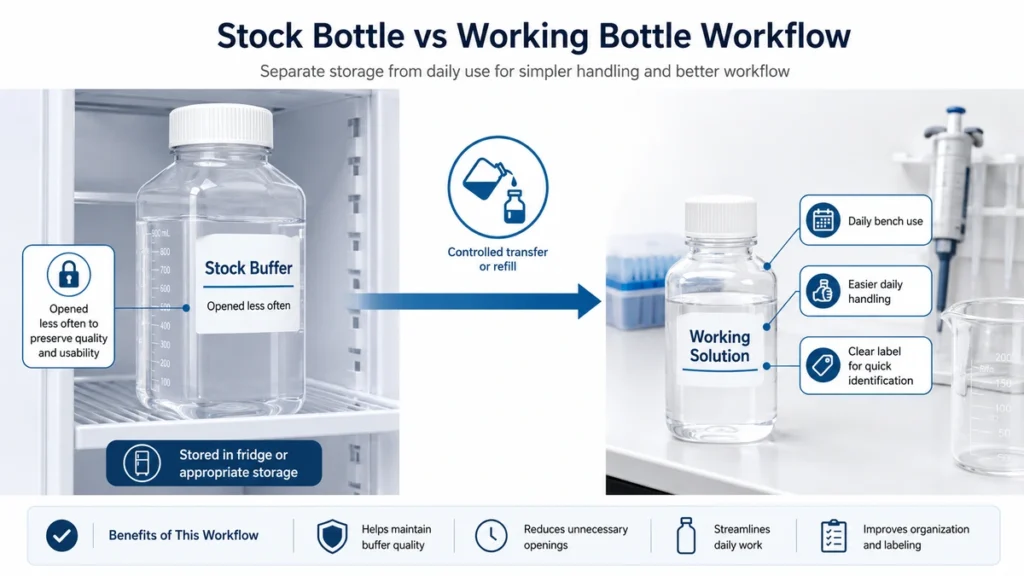
This separation is a small detail, but it often improves daily control. The main stock solution is opened less often, while the working bottle is lighter, easier to label, easier to pour from, and simpler to replace when empty. In shared laboratories, it also reduces confusion because users work with a clearly labeled daily-use bottle instead of repeatedly handling the full stock container.
A common mistake is choosing the largest available bottle because it seems more efficient. Larger bottles can be useful for stock storage or high-consumption liquids, but they are not always the best choice for bench use. If a solution is consumed slowly, a large bottle may remain in use for too long, take up more cabinet or refrigerator space, and become less convenient when full.
Labeling is especially important for buffers and working solutions prepared in-house. The bottle should provide enough space for the solution name, concentration, pH if relevant, preparation date, review date, and batch or user information. In a busy laboratory, an unclear label can create more workflow problems than the bottle material itself.
Visibility can also help routine use. Clear or translucent plastic reagent bottles allow users to check the approximate liquid level, notice obvious cloudiness or precipitate, and see when a refill is needed. These quick visual checks do not replace proper quality control, but they help users catch simple issues before the solution is used.
Mouth design should match how the solution is prepared and dispensed. For ready-to-use liquid buffers, a narrow-mouth bottle usually gives better pouring control. For solutions prepared by adding powder directly into the bottle, or for more viscous materials, a wide-mouth bottle may make filling and mixing easier.
Since buffer bottles are often opened repeatedly, the cap should remain easy to close and reopen during daily use. Detailed closure performance should still be checked when the bottle will be used frequently or ordered in bulk.
A simple way to choose is to separate the storage role from the daily-use role:
| Bottle use | Practical bottle choice | Selection focus |
|---|---|---|
| Stock buffer storage | Medium or large compatible bottle | Material compatibility, sealing, labeling, storage space |
| Daily working solution | Smaller bottle for bench use | Easy handling, clear label, cap usability, visibility |
| Frequently refilled solution | Bottle size matched to turnover rate | Refill convenience, mouth design, closure durability |
| Powder-based preparation | Wide-mouth bottle may be useful | Filling access, mixing, cleaning |
| Ready-to-use liquid buffer | Narrow-mouth bottle may be better | Pouring control and reduced splashing |
For procurement, useful specifications include material, volume range, bottle shape, mouth design, cap type, color option, labeling area, packaging format, and intended storage temperature. A stock buffer, a daily working solution, and a short-term prepared reagent may all be aqueous liquids, but they do not have the same handling requirements.
Bottle Shape and Mouth Design for Daily Handling
After material and storage purpose, bottle design is the next practical decision. Two plastic reagent bottles may have the same volume and material, but they can feel very different in daily use. Mouth opening, bottle shape, shoulder design, and storage footprint all affect how easily the bottle can be filled, poured, labeled, stored, and cleaned.
For low-viscosity liquids such as buffers, rinse solutions, and prepared aqueous solutions, narrow-mouth plastic reagent bottles are often easier to control during pouring. The smaller opening helps reduce splashing and makes transfer into beakers, cylinders, wash containers, or smaller bottles more manageable, especially when the bottle is full.
Wide-mouth plastic reagent bottles are more useful when access matters more than pouring control. They are easier to fill, clean, and use with powders, crystals, granules, or viscous materials. For example, if a lab prepares a solution by adding powder directly into the bottle before mixing, a wide-mouth design can reduce awkward funnel handling. If the bottle is mainly used for pouring a ready-made liquid buffer, a narrow-mouth design may still be more practical.
A common misunderstanding is that a wide-mouth bottle is always easier to use. It is easier for filling and cleaning, but it also exposes a larger opening during handling. For routine liquid transfer, especially with low-viscosity solutions, a narrow-mouth bottle may give better control and reduce unnecessary mess at the bench.
Bottle shape should also match the storage environment. Round bottles are common because they are easy to grip and natural to pour from, especially in small and medium sizes. Square or rectangular bottles can help save space in cabinets, refrigerators, cartons, and storage shelves. They can also make labels easier to face forward in shared storage areas.
However, square bottles are not automatically better. In some workflows, they may feel less natural to pour from than round bottles, and corners can make complete draining or cleaning less convenient. For high-frequency pouring, users may prefer round bottles. For organized storage, bulk packing, or refrigerator space management, square bottles may offer an advantage.
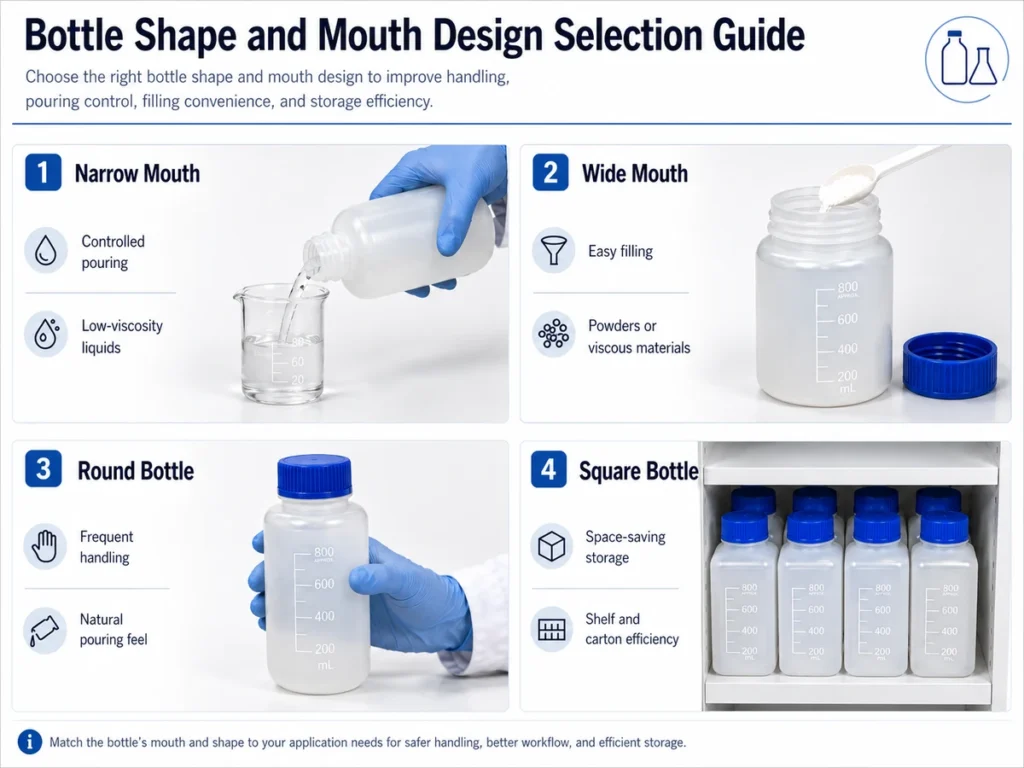
Graduated markings can be useful for quick visual checks, such as estimating remaining liquid or planning refills. They should not be treated as precision measurement tools. For accurate solution preparation, laboratories should still use proper measuring devices.
| If the main need is… | Bottle design to consider | Practical reason |
|---|---|---|
| Controlled pouring of liquid buffers | Narrow-mouth bottle | Better flow control and less splashing |
| Filling powders or viscous materials | Wide-mouth bottle | Easier access for funnels, spatulas, and cleaning |
| Frequent hand use at the bench | Round bottle | More natural grip and pouring feel |
| Shelf, refrigerator, or carton efficiency | Square bottle | Better use of storage space |
| Quick volume checking | Graduated bottle | Useful for reference, not precise measurement |
In short, bottle shape and mouth design should match how the bottle is actually used. A bottle for ready-to-use liquid buffer does not need the same format as one used for powder filling, viscous materials, frequent refilling, or space-saving storage. These details may look small in a catalog, but they directly affect whether the bottle feels easy and reliable in daily laboratory use.
For a broader overview of reagent bottle types and basic selection factors, see our guide on how to choose laboratory reagent bottles.
Clear vs Amber Plastic Reagent Bottles
Bottle color affects both visibility and storage protection. For plastic reagent bottles, the choice is usually between clear or translucent bottles for easy inspection and amber bottles for reducing light exposure. The better option depends on what the laboratory needs to monitor and what the stored liquid needs to avoid.
Clear or translucent plastic reagent bottles are practical for routine buffers, aqueous solutions, rinse solutions, and prepared working solutions. They allow users to check the approximate liquid level, notice whether a refill is needed, and identify obvious changes such as cloudiness, sediment, or color change. These visual checks do not replace proper quality control, but they are useful in daily work.
For example, in a shared preparation area, several buffer bottles may be used by different people throughout the day. A clear bottle makes it easier to see which solution is nearly empty before starting a procedure. This small detail can reduce interruptions and make routine inventory control easier.
Amber plastic reagent bottles are more suitable when the stored liquid may be affected by light exposure. Some prepared solutions, indicators, or light-sensitive reagents should not be kept in fully transparent containers for long periods, especially if they are stored near windows, under strong room lighting, or on open benches. In these cases, amber bottles can help reduce light exposure as part of the storage strategy.
A common misunderstanding is that amber bottles provide complete light protection. They do not. A light-sensitive solution stored in an amber bottle can still be affected if it is left on a bright bench for long periods. For sensitive reagents, bottle color should be combined with suitable storage practices, such as keeping the bottle in a closed cabinet, limiting bench exposure, using secondary packaging, or following the reagent SDS and laboratory SOP.
There is also a trade-off between protection and visibility. Clear bottles make liquid level and appearance easier to check. Amber bottles reduce visibility, especially for colorless solutions or bottles stored in dim areas. If users need both reduced light exposure and routine volume checks, they may need clearer labeling, scheduled inventory checks, or a storage method that balances both needs.
| If the main need is… | Bottle color to consider | Practical reason |
|---|---|---|
| Daily liquid level checks | Clear or translucent bottle | Easier to see remaining volume and obvious changes |
| Routine buffer or working solution storage | Clear or translucent bottle | Supports visual inspection and inventory control |
| Reduced light exposure | Amber bottle | Helps limit light exposure during storage |
| Strict light-sensitive storage | Amber bottle plus controlled storage | Bottle color alone is not enough |
| No need for visibility | Opaque or colored bottle | Confirm labeling and inventory requirements |
For procurement, color options should be confirmed clearly because terms such as clear, natural, translucent, opaque, and amber may vary between product lines. Buyers should confirm whether the main requirement is visibility, reduced light exposure, or both.
In routine laboratory storage, clear plastic reagent bottles support visual inspection, while amber plastic reagent bottles help reduce light exposure. The right choice should match the solution’s sensitivity, storage location, and inspection needs.
Screw Cap, Sealing, and Handling Details
For plastic reagent bottles, the cap should be evaluated together with the bottle body. A suitable material and volume are not enough if the closure does not align smoothly, seal consistently, or remain easy to use after repeated handling.
Most plastic reagent bottles use screw caps because they are simple, reusable, and practical for routine laboratory storage. In daily use, the cap needs to close securely, match the bottle thread properly, and remain easy to open with gloves. These details may look minor in a catalog, but they become important when the same bottle is opened many times a day.
A common misunderstanding is that all screw caps perform in the same way. In practice, thread design, cap material, liner structure, molding consistency, and grip texture can all affect usability. A reagent bottle with screw cap should be checked as a complete system, not as a bottle body plus a generic closure.
Thread fit is one of the first details to check. The cap should engage smoothly without forcing or cross-threading. When tightened, it should feel stable rather than uneven or loose. If the cap is difficult to align, users may close it inconsistently during busy workflows.
Sealing requirements depend on the stored liquid. A bottle used for a routine aqueous buffer may only need a reliable standard screw cap. A bottle used for a volatile, odor-sensitive, or storage-sensitive solution may require closer attention to the cap design, liner, gasket, or inner sealing structure. Buyers should confirm the closure configuration instead of assuming that all screw caps provide the same sealing level.
Repeated use is another practical issue. In real laboratory work, users may handle caps with wet gloves, work near sinks or preparation benches, or close bottles quickly during a procedure. Over time, residue around the neck, thread wear, or cap deformation can affect how consistently the bottle closes.
For example, a wash buffer bottle used near a shared bench may work well at first. After weeks of frequent opening and closing, the cap may start to feel loose or harder to align. The solution itself may still be routine, but the container is no longer behaving predictably.
Glove handling should also be considered. Laboratory users often open bottles while wearing nitrile gloves, sometimes with wet or powdered glove surfaces. A cap with suitable grip texture is easier to control and reduces the chance of dropping the bottle or leaving it only partially closed.
Storage conditions may influence closure performance as well. Bottles moved between room temperature and refrigerated storage can experience condensation around the neck and cap area. This does not automatically make the bottle unsuitable, but users should still check whether the cap remains easy to open and reseal after repeated cold-room or refrigerator use.
| If the main concern is… | What to check | Practical reason |
|---|---|---|
| Smooth daily use | Thread alignment | Helps users close the bottle consistently |
| Glove operation | Cap grip texture | Makes opening and closing easier with gloves |
| Routine sealing | Closure stability | Reduces loose or uneven closing |
| Sensitive storage | Liner or gasket option | May improve sealing for more demanding applications |
| Repeated handling | Cap wear and deformation | Shows whether the closure remains reliable over time |
| Cold storage | Cap performance after temperature changes | Important for refrigerated or variable-temperature workflows |
For bulk buyers, cap consistency should be tested before confirming large orders. Samples should be checked not only for bottle appearance, but also for thread alignment, tightening feel, glove handling, and repeated opening performance. A small cap issue can become a much larger customer complaint when it appears across many cartons.
A screw cap is not just an accessory. It directly affects whether a plastic reagent bottle feels reliable in daily laboratory use. For routine buffers and working solutions, a well-matched closure helps users store, move, open, and reseal bottles more consistently.
Chemical Compatibility and Storage Limits
Plastic reagent bottles are practical for many routine laboratory liquids, but their suitability still depends on chemical compatibility. A bottle may look strong and handle well, but if the stored chemical slowly interacts with the plastic, the container is not suitable for that application.
For routine aqueous solutions, plastic bottles are often convenient when the material is compatible. More caution is needed when the liquid contains organic solvents, strong oxidizing agents, concentrated acids or bases, or other chemicals that may affect plastic over time. In these cases, short-term appearance can be misleading. A bottle may look unchanged after brief contact, while longer storage could lead to softening, swelling, permeability changes, odor transfer, or reduced sealing performance.
A common misunderstanding is that compatibility can be judged by whether the bottle looks normal after initial use. In practice, compatibility problems may develop gradually. A bottle used for a neutral buffer may perform well for weeks, but the same bottle format may not be suitable for a solvent-rich cleaning solution or a concentrated reagent. The handling process may look similar, but the material risk is different. Related storage issues are also discussed in our guide to reagent bottle storage problems.
Storage duration is one of the most important factors. A working solution used within a few days does not place the same demand on a bottle as a chemical stored for several months. Temperature also matters. Refrigerated storage, room-temperature storage, and repeated movement between cold storage and the bench can affect both the liquid and the container. Concentration should also be checked, because a diluted solution and a concentrated version of the same chemical may not have the same compatibility requirement.
Light sensitivity should be treated separately from material compatibility. An amber plastic reagent bottle may help reduce light exposure, but it does not make the material chemically compatible with the stored liquid. If the reagent is both light-sensitive and solvent-sensitive, bottle color, material, cap design, and storage conditions should be reviewed together.
The following table can be used as a screening reference, not as a substitute for supplier compatibility data or the reagent SDS.
| Liquid type | Typical selection note | What to confirm |
|---|---|---|
| Common aqueous buffers | PP or HDPE bottles may be suitable when compatibility is confirmed | pH, storage time, temperature, cap sealing |
| Salt solutions and rinse solutions | Often routine applications for plastic reagent bottles | Concentration, residue formation, storage duration |
| Alcohol-containing solutions | May require more careful review depending on concentration and storage time | Alcohol type, concentration, cap compatibility |
| Strong acids or bases | Do not assume compatibility from material name alone | Chemical resistance data, concentration, temperature |
| Organic solvents | Require careful compatibility review; glass may be more suitable in some cases | Solvent type, permeability, swelling risk, storage time |
| Light-sensitive solutions | Consider amber bottle plus controlled storage | Light exposure, material compatibility, storage conditions |
| Unknown or mixed formulations | Treat as higher-risk until confirmed | SDS, supplier data, internal validation |
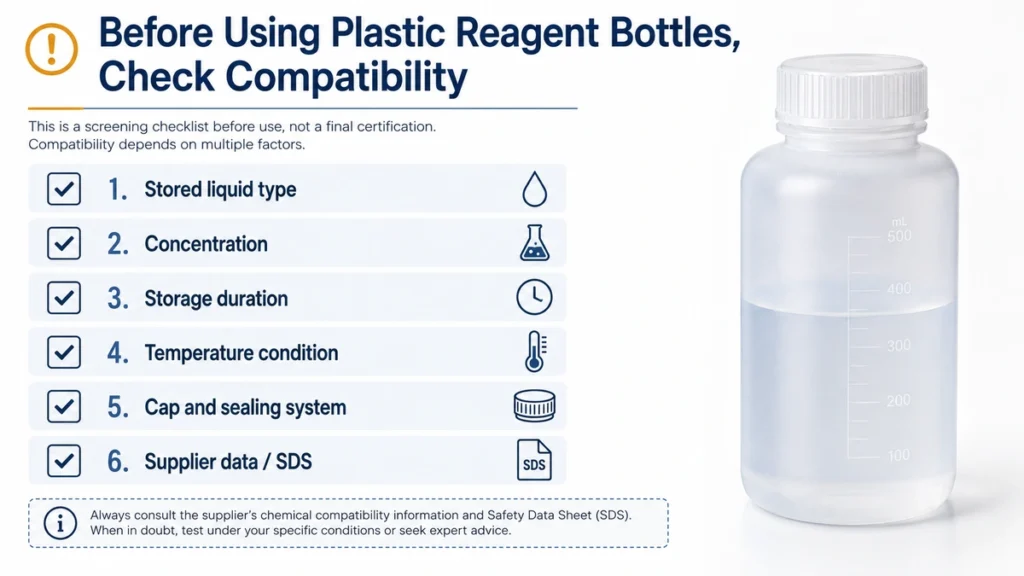
For higher-risk applications, laboratories should review the reagent SDS, supplier compatibility information, expected storage duration, temperature conditions, and actual concentration before routine use. For critical or unfamiliar formulations, small-scale testing or internal validation may also be needed.
For distributors, this step is especially important. Customers may ask for “plastic reagent bottles” without explaining the actual application. One buyer may use them for buffer storage, another for repacking routine chemicals, and another for solvent-containing solutions. Asking about the stored liquid, concentration, storage time, and handling conditions before quoting makes the recommendation more professional and reduces the risk of product mismatch.
Plastic reagent bottles are reliable when used within their intended limits. For aggressive chemicals, solvent-containing liquids, or long-term storage, the decision should be based on compatibility evidence rather than assumption.
Bulk Purchasing Checklist for Plastic Reagent Bottles
For laboratories, distributors, and OEM buyers, bulk purchasing should focus on more than unit price. A plastic reagent bottle may look acceptable as a single sample, but large orders require consistent material, dimensions, cap fit, packaging, and supply continuity. Small differences become more noticeable when the same bottle is used across many benches, customers, or product batches.
The first step is to confirm the intended application. A customer asking for 500 mL plastic reagent bottles may be storing buffer, repacking routine chemicals, preparing working solutions, or supplying bottles to different laboratories. These use cases may require different materials, cap designs, mouth openings, colors, cleanliness grades, and packaging formats. Asking a few application questions before quoting often prevents mismatch later.
A practical way to start is to identify the main use case:
| If the customer needs… | Start by checking… | Why it matters |
|---|---|---|
| Daily buffer storage | Material, volume, cap fit, labeling area | Supports repeated handling and clear identification |
| Working solution bottles | Smaller volume, visibility, glove-friendly cap | Makes bench use easier and more controlled |
| Powder or viscous material storage | Wide-mouth design, cleaning access, cap sealing | Improves filling, removal, and reuse convenience |
| Light-sensitive solution storage | Amber option and storage conditions | Reduces light exposure but still requires proper storage |
| Solvent-containing solution storage | Compatibility data, cap structure, storage time | Reduces risk of swelling, permeability, or sealing issues |
| Biological or molecular biology workflows | Cleanliness grade and packaging condition | Helps match sterile, non-sterile, or application-specific requirements |
| Distributor resale | Packaging, carton quantity, MOQ, repeat supply | Improves inventory planning and customer fulfillment |
| OEM or private label supply | Bottle consistency, labeling surface, packing method | Supports branding, repacking, and repeat orders |
After the application is clear, buyers can review the core specifications together: material, volume range, bottle shape, mouth design, cap fit, color option, labeling area, cleanliness grade, compatibility requirement, packaging format, and supply terms. For biological, cell culture, or molecular biology-related workflows, buyers should also confirm whether sterile, non-sterile, or application-specific cleanliness requirements are needed.
A final bulk purchasing checklist can include:
| Item to confirm | What to check |
|---|---|
| Material | PP, HDPE, or other plastic |
| Application | Buffer, working solution, powder, solvent-containing liquid, or routine storage |
| Volume range | Small, medium, or large bottle formats |
| Bottle shape | Round, square, or space-saving design |
| Mouth design | Narrow mouth or wide mouth |
| Cap fit | Thread alignment, sealing feel, glove handling |
| Color option | Clear, translucent, amber, or opaque |
| Labeling area | Space for solution name, batch, date, or customer label |
| Cleanliness grade | Sterile, non-sterile, or application-specific cleanliness requirement |
| Compatibility | Stored liquid, concentration, storage time, and temperature |
| Packaging | Bottles per carton, cap packing, inner packaging |
| Supply terms | MOQ, lead time, sample availability, repeat supply |
| Customization | OEM, private label, or special packaging needs |
For distributors, sample testing is usually worth doing before confirming a large order. Check bottle wall consistency, mouth finish, cap fit, label surface, carton packing, cleanliness or packaging condition if relevant, and whether the actual bottle matches the customer’s storage environment.
A cheaper bottle is not always the better purchase if it creates problems with cap consistency, labeling, packaging, cleanliness requirements, or customer compatibility. For laboratory consumables, stable quality and predictable supply often matter as much as the first quoted price.
When application, specifications, packaging, cleanliness requirements, and supply terms are confirmed in advance, plastic reagent bottles become easier to quote, easier to supply, and easier for customers to use confidently in routine laboratory storage.
Conclusion
Plastic reagent bottles are practical for routine laboratory storage, but they should not be selected as generic containers. A suitable bottle should match the stored liquid, material compatibility, handling frequency, bottle design, closure reliability, color requirement, and storage environment.
For routine buffers and prepared working solutions, the strongest selection logic is to start from the actual workflow. How is the solution prepared? How often is the bottle opened? Will it be stored as a stock solution, used daily at the bench, placed in a refrigerator, or supplied to multiple users? These questions often lead to better choices than selecting by volume or price alone.
For laboratories, distributors, and OEM buyers, choosing the right plastic reagent bottle helps reduce repeated workflow problems related to handling, labeling, pouring, storage, and product consistency.
Kelabscience supplies plastic reagent bottles for buffer storage, working solutions, routine chemical storage, and general laboratory handling. If you are comparing PP or HDPE bottles, clear or amber options, wide-mouth or narrow-mouth formats, or bulk packaging requirements, our team can help recommend suitable configurations based on your application and procurement needs.
📩 For pricing information or configuration consultation, please contact us.
FAQ
What are plastic reagent bottles used for?
Plastic reagent bottles are used for storing and handling routine laboratory liquids such as buffers, aqueous solutions, rinse solutions, prepared working solutions, and other compatible reagents. They are often selected when laboratories need bottles that are lightweight, breakage-resistant, easy to label, and convenient for repeated daily use.
Are plastic reagent bottles suitable for buffer storage?
Yes. Plastic reagent bottles are often suitable for buffer storage when the buffer is compatible with the bottle material. PP and HDPE bottles are commonly used for many routine aqueous buffers and working solutions.
For daily-use buffers, a smaller working bottle may be more practical than repeatedly opening a large stock bottle.
What is the difference between PP and HDPE reagent bottles?
PP reagent bottles are generally more rigid and shape-stable, while HDPE reagent bottles are usually more flexible and impact-resistant.
PP may be preferred when stable handling or pouring control is important. HDPE may be preferred for lightweight handling, impact resistance, and general compatible aqueous solution storage. The right choice still depends on the stored liquid, concentration, storage time, temperature conditions, and handling frequency.
Is a larger plastic reagent bottle always better?
No. A larger bottle may be useful for stock solutions or high-consumption liquids, but it is not always the best choice for daily bench use.
For frequently used buffers or working solutions, it is often more practical to keep a larger stock bottle in storage and use a smaller labeled working bottle at the bench.
Can plastic reagent bottles store organic solvents?
Some plastic reagent bottles may be suitable for certain solvent-containing solutions, but they should not be assumed to be compatible with all organic solvents.
Before using plastic reagent bottles for organic solvents, concentrated chemicals, or long-term storage, laboratories should check the reagent SDS, supplier compatibility data, and internal safety requirements.
Should I choose clear or amber plastic reagent bottles?
Choose clear or translucent plastic reagent bottles when users need to check liquid level, color, clarity, or visible precipitate.
Choose amber plastic reagent bottles when reduced light exposure is needed. However, amber bottles do not provide complete light protection, so light-sensitive solutions should still be stored according to the reagent’s recommended conditions.
How should laboratories check chemical compatibility?
Laboratories should check the reagent SDS, supplier compatibility information, storage duration, temperature conditions, and actual concentration of the stored liquid.
For higher-risk applications such as solvent-containing solutions, strong acids or bases, oxidizing agents, or long-term storage, compatibility should be confirmed before routine use.
What should distributors check before buying plastic reagent bottles in bulk?
Distributors should confirm material, volume range, bottle shape, mouth design, screw cap fit, color options, labeling area, packaging format, MOQ, lead time, sample availability, and supply consistency.
They should also ask about the customer’s intended application before recommending a bottle. A bottle used for routine buffer storage may require a different configuration from one used for solvent-containing solutions, powder handling, repacking, or OEM supply.