
Product Info
Kelabscience Centrifuge Bottles are polypropylene laboratory containers available in five nominal capacities from 250 mL to 2000 mL. The range includes eight configurations with different bottle diameters, opening sizes and overall heights, allowing laboratories to select bottles according to sample-handling requirements and equipment dimensions.
All available configurations feature flat bottoms and threaded necks for screw-cap closure. The bottles are supplied non-sterile. Heat sterilization is supported, subject to confirmation of the applicable processing conditions for the selected configuration.
For centrifugation applications, users must verify the permitted relative centrifugal force (RCF), rotor compatibility, filling requirements and appropriate support arrangements before use. Nominal capacity and bottle dimensions alone do not establish centrifugation suitability.
Available Bottle Configurations and Dimensions
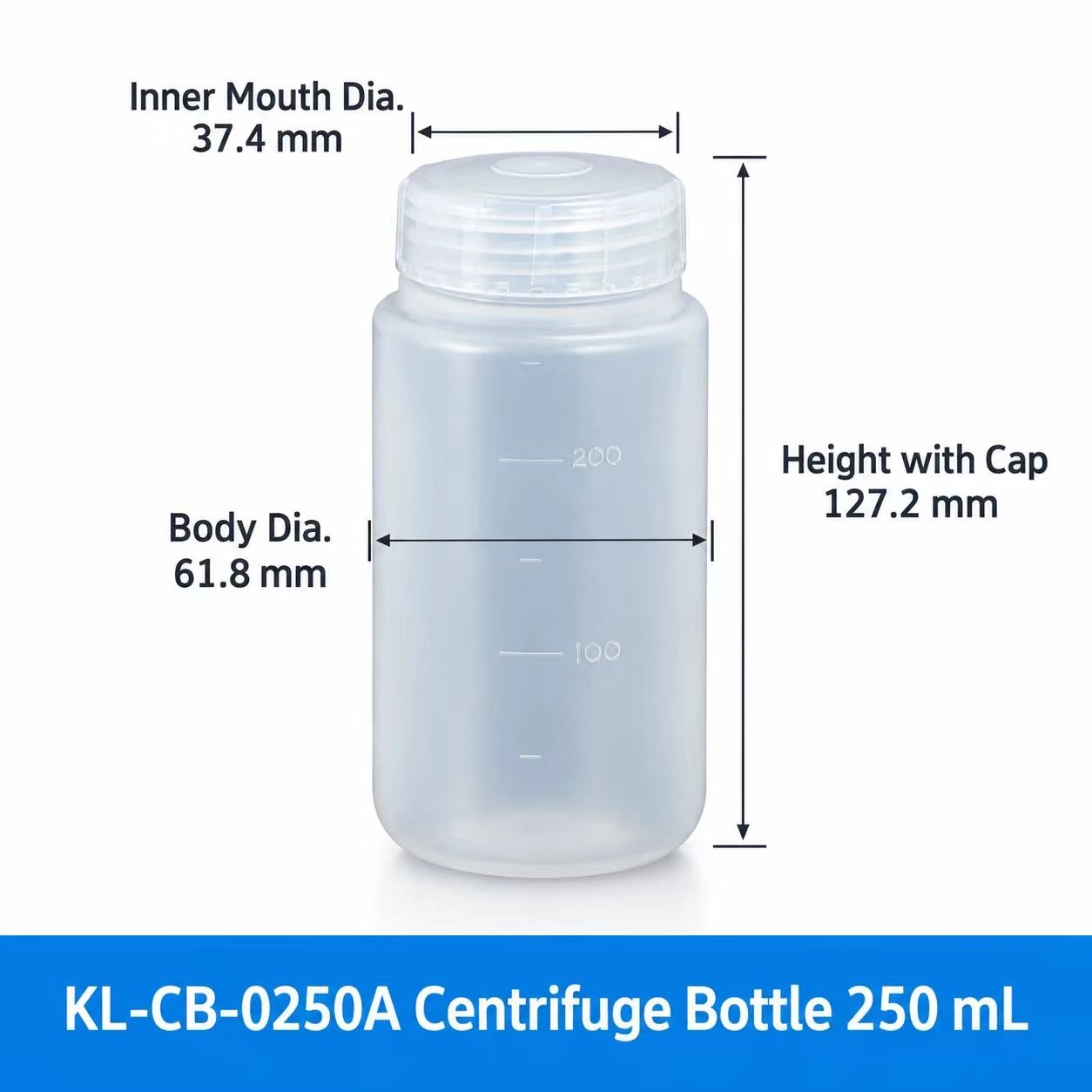
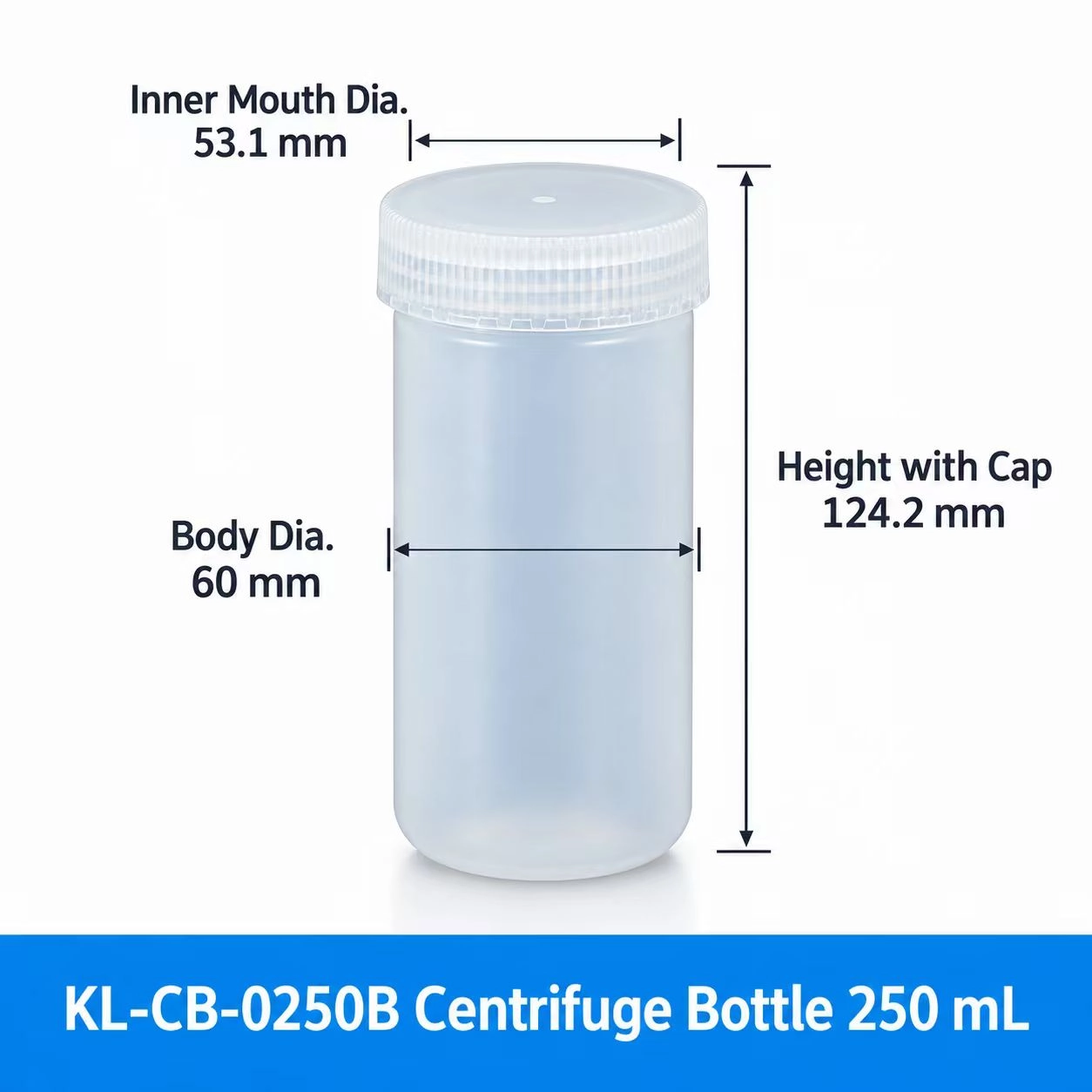
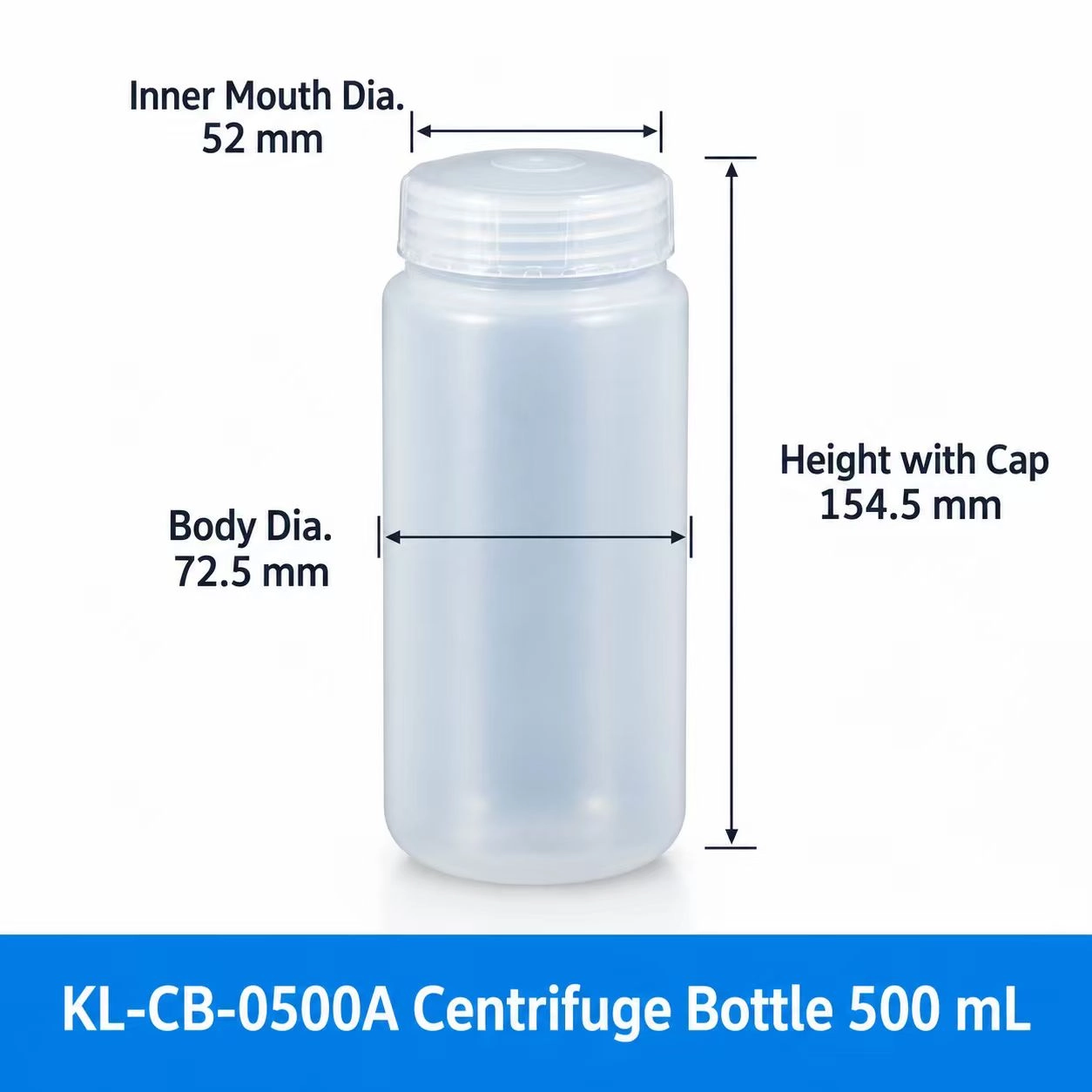
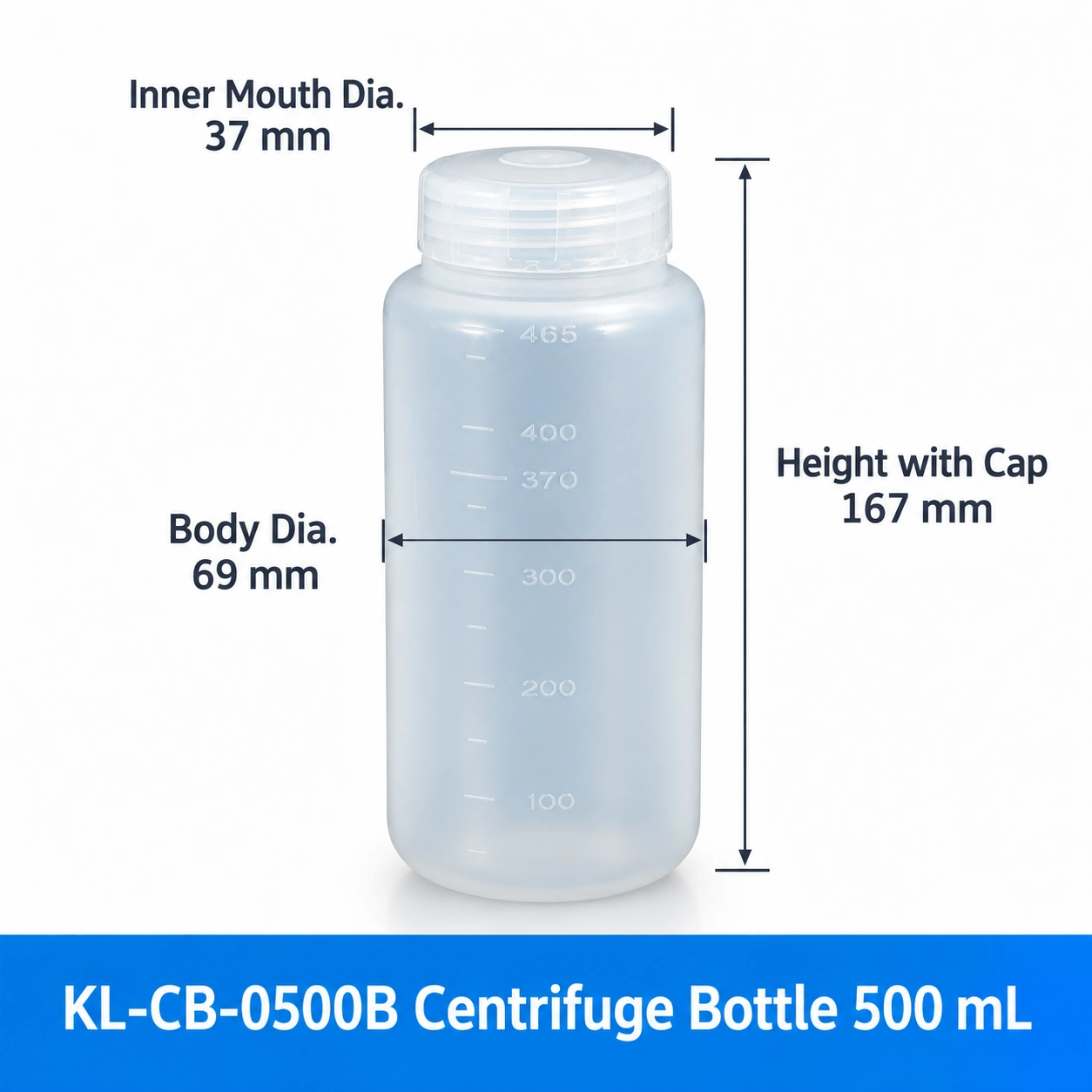
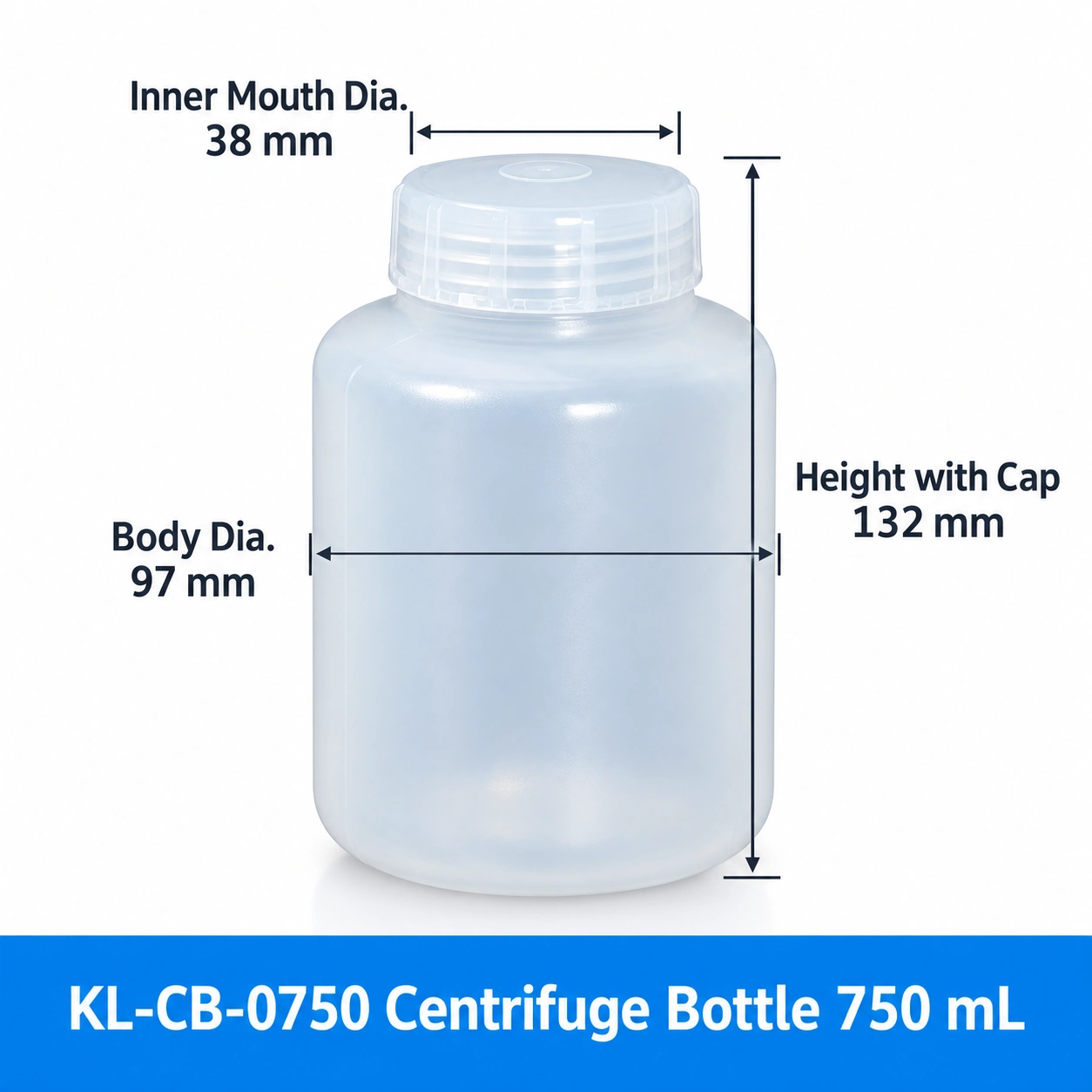
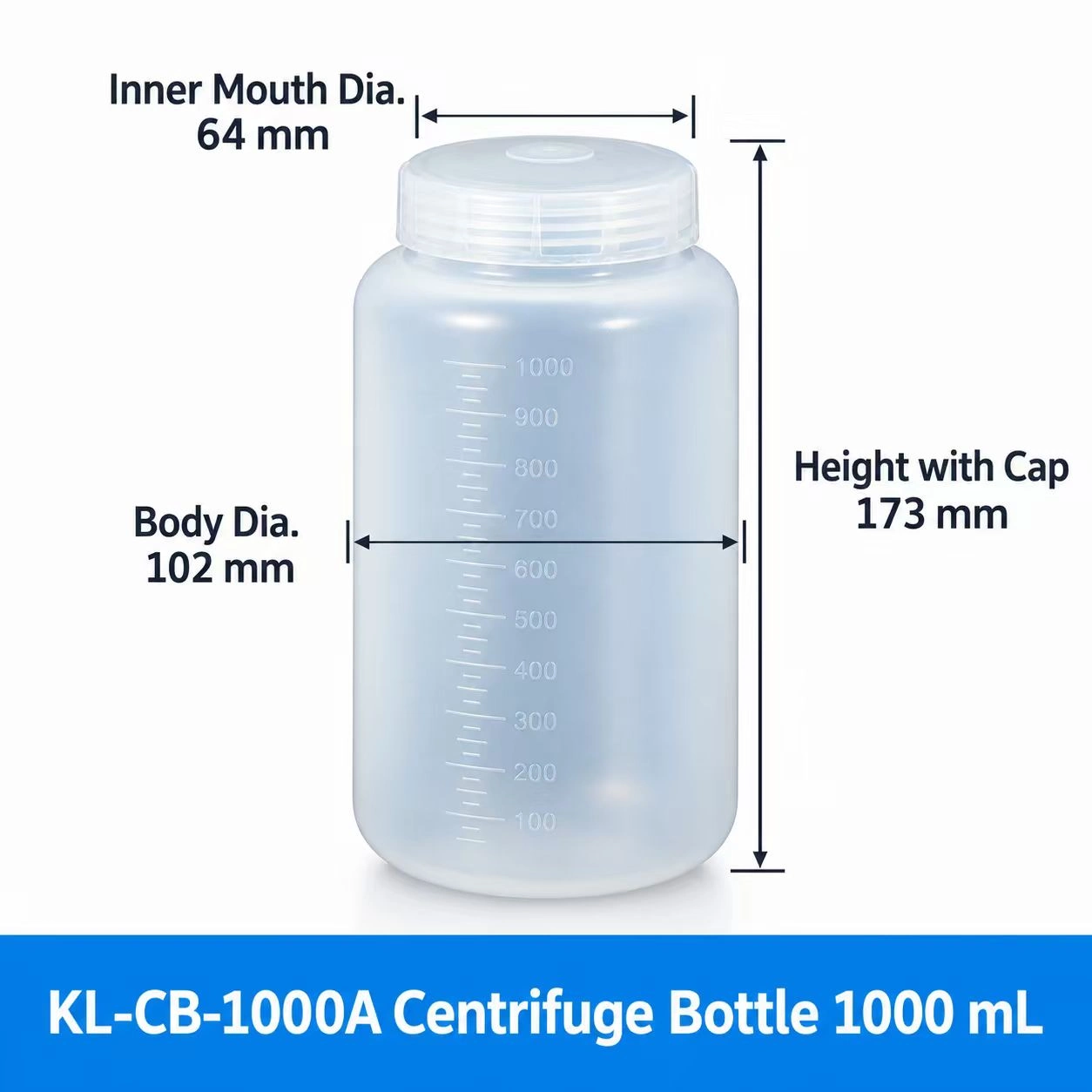
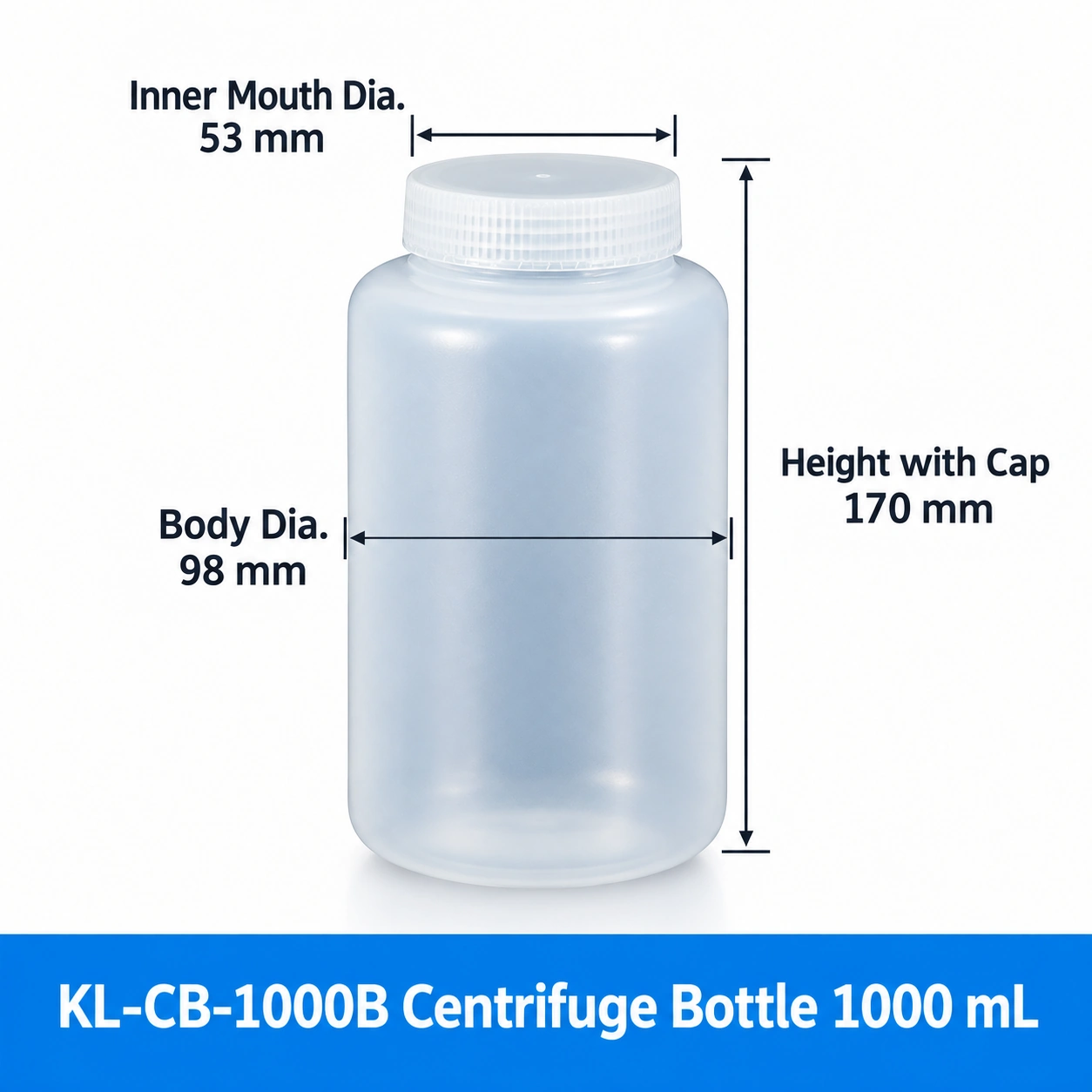
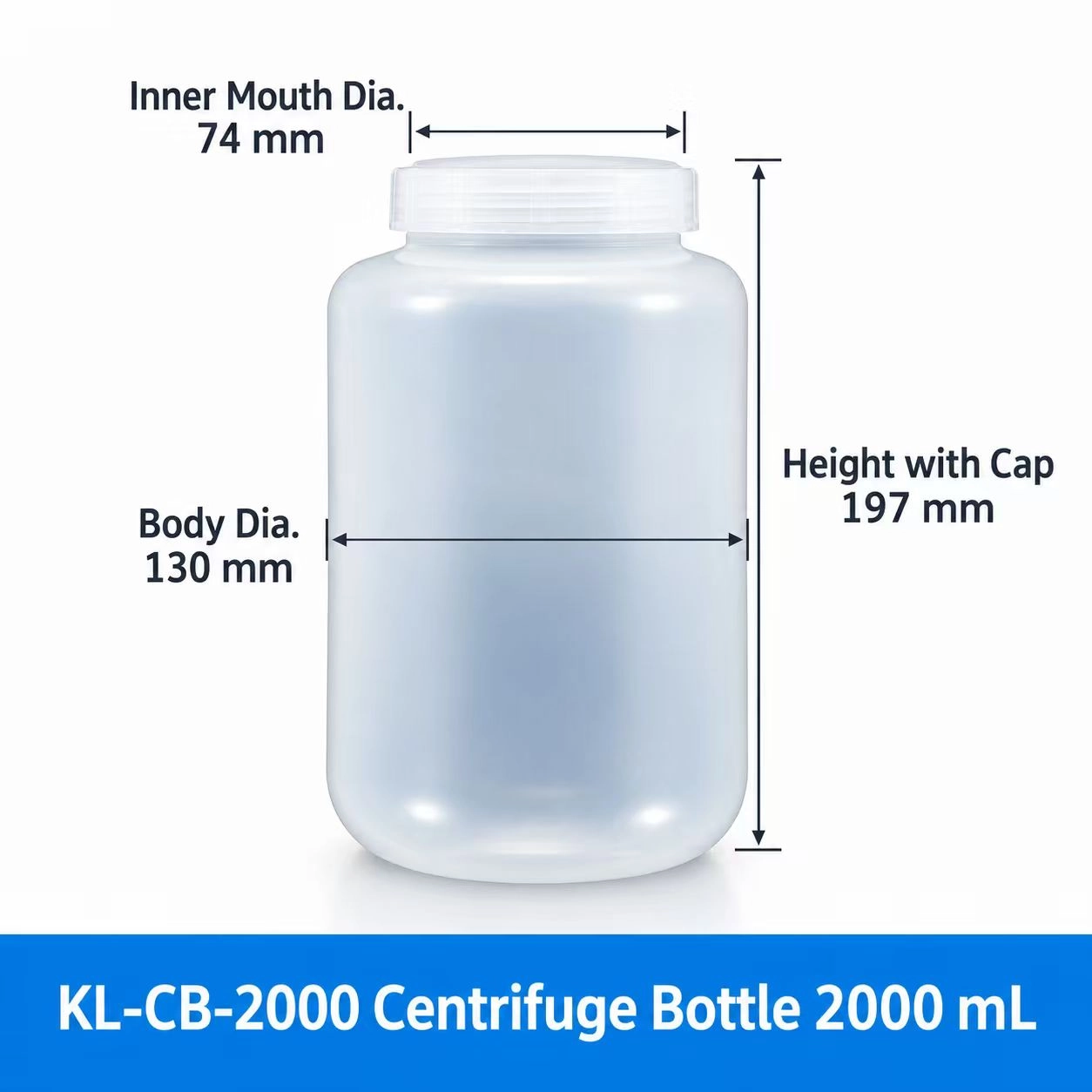
The product range includes 250 mL, 500 mL and 1000 mL bottles in two dimensional configurations each, alongside single listed configurations for 750 mL and 2000 mL.
At 250 mL, the two configurations have inner mouth diameters of 37.4 mm and 53.1 mm. The 500 mL versions have inner mouth diameters of 52 mm and 37 mm, while the two 1000 mL versions differ in opening diameter, body diameter and overall height.
These differences are important for more than identifying bottle variants. Opening diameter can affect filling, pouring and access during sample preparation, while the body diameter and height with cap are essential dimensions when assessing storage space and potential equipment fit.
Customers should compare the exact configuration rather than assuming that all bottles with the same nominal volume are interchangeable.
For smaller-volume sample handling, explore our centrifuge tubes in 5–120 mL capacities.
Polypropylene Material and Chemical Compatibility
Polypropylene (PP) is widely used in laboratory plasticware because of its relatively low weight and resistance to many aqueous solutions, including a range of diluted acids and bases.
However, chemical resistance depends on the specific reagent, concentration, temperature, exposure duration and mechanical conditions. A polypropylene bottle suitable for storing a solution at room temperature is not automatically suitable for centrifuging that solution.
For applications involving organic solvents, concentrated chemicals or elevated temperatures, laboratories should assess material compatibility under the intended conditions. Particular attention is required when chemical exposure and centrifugal loading occur together.
Flat-Bottom Design and Laboratory Handling
The flat-bottom design allows the bottles to stand upright on suitable level surfaces during filling, preparation and routine handling.
This can be useful when working with larger sample quantities, preparing multiple containers or transferring liquids before processing. The threaded neck provides a screw-cap closure arrangement for handling and transport within the limits of the specific bottle assembly.
However, flat-bottom construction does not mean that a bottle can be placed directly into any centrifuge bucket. Appropriate support may be required to distribute forces correctly during centrifugation.
The bottle’s dimensions and geometry should be checked against the centrifuge manufacturer’s rotor, bucket and adapter requirements.
Centrifugation Performance and Equipment Compatibility
A centrifuge bottle must be selected as part of a complete centrifugation system rather than as an isolated container.
Maximum permitted RCF, rotor type, adapter design, sample density, filling volume and closure configuration can all influence safe operation.
RCF is generally more informative than RPM when comparing centrifugation conditions because the force experienced by a sample depends on rotational speed and rotor radius.
Bottles with similar capacities or external dimensions may have different permitted operating limits. Physical fit inside a rotor does not demonstrate that the bottle is approved for the intended force.
Before centrifugation, laboratories should obtain the relevant operating limits for the exact bottle configuration and ensure that the selected rotor and supporting accessories are appropriate.
Non-Sterile Supply and Heat Sterilization
Kelabscience Centrifuge Bottles are supplied non-sterile for laboratories that perform their own cleaning and sterilization procedures. For sterile supply requirements, please contact Kelabscience to discuss suitable options and availability.
The PP bottle range supports heat sterilization. The applicable sterilization method, temperature, exposure time, cap position and permissible number of cycles should be confirmed for the selected configuration.
PP material properties alone are not sufficient to determine whether a complete bottle-and-cap assembly is suitable for a particular autoclave cycle.
After heat exposure, bottles should be checked for visible deformation, cracking, thread damage or other changes that could affect subsequent use.
Key Features
-
Five nominal capacities: 250, 500, 750, 1000 and 2000 mL.
-
Eight dimensional configurations: Multiple variants within selected capacities to accommodate different handling requirements.
-
Polypropylene construction: PP material for compatible laboratory liquid-handling applications.
-
Flat-bottom design: Allows upright positioning on suitable laboratory work surfaces.
-
Threaded necks: Screw-cap closure design across the available range.
-
Documented dimensions: Inner mouth diameter, body diameter and height with cap provided for configuration comparison.
-
Non-sterile supply: Intended for laboratories using appropriate preparation and sterilization procedures.
-
Heat sterilization: Supported, with processing conditions to be confirmed for the selected configuration.
Applications
-
Large-volume sample preparation: Handling compatible liquid samples requiring containers larger than standard centrifuge tubes.
-
Centrifugation-related processing: Larger-volume separation workflows where bottle ratings, rotor compatibility and support requirements have been verified.
-
Buffer and reagent preparation: Preparing and handling compatible laboratory solutions.
-
Sample collection and temporary handling: Organizing liquid samples during laboratory processing, subject to chemical and closure suitability.
-
Research laboratory workflows: Handling larger liquid volumes in life science, biotechnology and general laboratory settings.
Bulk Supply and Procurement Support
Kelabscience offers five nominal capacities and eight bottle configurations for laboratory purchasing and distribution requirements.
Customers can identify the required variant using the Kelabscience product code and the corresponding bottle dimensions. For applications requiring a particular bottle opening, maximum external diameter or overall height, these measurements should be specified during quotation enquiries.
For centrifugation applications, customers are encouraged to provide the centrifuge model, rotor or bucket reference, required RCF, intended sample volume and relevant chemical conditions so that available compatibility information can be reviewed.
Packaging quantities, detailed operating limits and applicable sterilization instructions require confirmation before critical applications or procurement decisions.

